
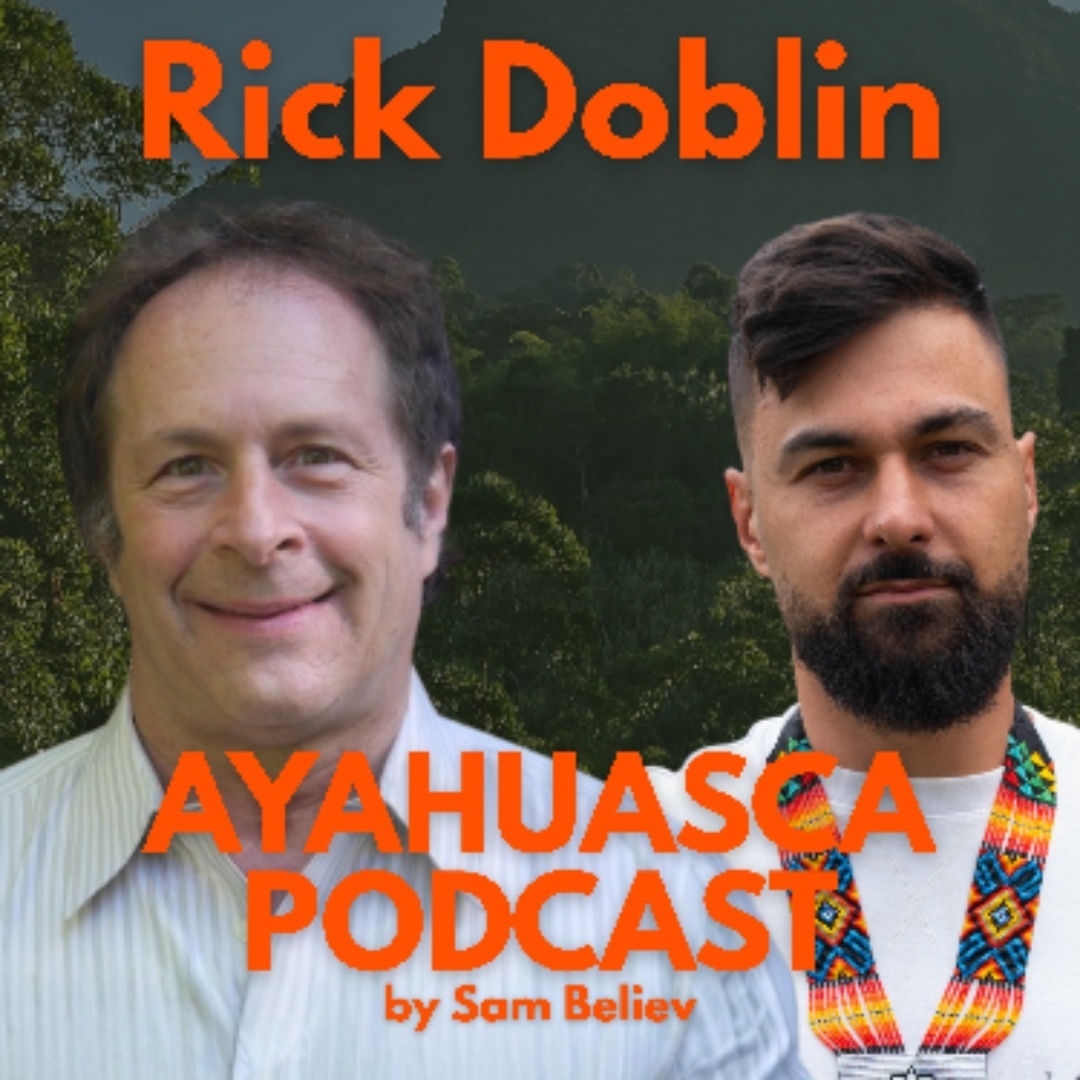
In this episode of the Ayahuasca Podcast, host Sam Believ sits down with Rick Doblin, Ph.D., the visionary founder of MAPS (Multidisciplinary Association for Psychedelic Studies). Rick has spent over 40 years leading the “Psychedelic Renaissance,” moving MDMA through rigorous FDA clinical trials to treat PTSD and advocating for a post-prohibition world.
Rick shares his profound journey—from a draft resistor in the 70s to a global leader in drug policy—explaining why he believes humanity is currently in a “race between consciousness and catastrophe.”
Key Discussion Points
- 04:15 – The Origins of Passion: Rick describes his upbringing in the shadow of the Holocaust and the Cuban Missile Crisis, which led to a lifelong quest to bridge the gap between human intellectual power and spiritual maturity.
- 09:30 – The Bar Mitzvah That Wasn’t: Why Rick’s first LSD trip at 17 felt like the true “rite of passage” his traditional Bar Mitzvah failed to provide, sparking his interest in ancient transformative rituals.
- 13:45 – The “Hitler Within”: A vulnerable recount of a DMT and Ketamine sequence in 1984 where Rick realized that the capacity for evil exists within everyone, leading to his mission for “mass mental health.”
- 18:20 – The Birth of MAPS (1986): Navigating the DEA crackdowns of the 80s and deciding that medicalization through the FDA was the only viable path forward for psychedelics.
- 24:50 – A Global “Ayahuasca Day”? Sam and Rick discuss the potential of cultural integration—moving psychedelics from the counterculture to the mainstream as a tool for societal sanity.
- 29:10 – The Inflection Point: Rick reflects on the irony of President Trump’s executive order to accelerate psychedelic approvals and what it means for bipartisan support.
- 34:00 – Inner Work as a Global Necessity: Discussing Carl Jung’s warning that “the only real danger now is man himself” and how psychedelics can help us manage our own destructive capacities.
- 39:15 – Post-Apocalyptic Utopia: Exploring the vision of a world where technology handles labor, leaving humanity to focus on poetry, art, music, and consciousness.
The MAPS Strategy: From Criminal to Clinical
Rick explains that the strategy for the last 40 years has been to “go where the suffering is.” By focusing on treatment-resistant PTSD, MAPS has been able to show that these substances are not just “party drugs” but powerful tools for clinical healing.
The Race Between Consciousness and Catastrophe
Rick posits that as our technological capabilities (AI, nuclear energy, etc.) grow, our emotional and spiritual development must keep pace. Without a shift in consciousness, our advancements become tools for destruction.
Learn more about Rick Doblin and MAPS:
- Website: maps.org
- Rick’s TED Talk: The future of psychedelic-assisted psychotherapy
Experience Authentic Healing: Are you seeking your own “inner transformation”? Visit ayahuascaincolombia.com to learn about our retreats in the heart of Colombia.
Transcript
Rick Doblin: Humanity is in a race between consciousness and catastrophe, and psychedelics are here to help consciousness prevail. So I do think that we are potentially capable with the powers that we have, with the technology that we have, of destroying the earth and destroying each other. Our intellectual advancement as humans, as a species, has incredible, but our emotional and spiritual development has lagged way behind.
And when I first tried LSD when I was 17, I felt, “Yeah, this is what my bar mitzvah should have been.” This isn’t just an outer ritual, but it’s an inner transformation. And that really helped me to see how psychedelics have been used for thousands of years for these kind of rites of passage. And then you have this idea, if I’m part of everything and everything part of me, then Hitler is part of me, too.
It’s not out there. It’s hu- And we all have that capacity to be that evil. And I think the context matters more than the substance. And so that’s where I’m saying either a spiritual context or a therapeutic context, but even in a recreational context, let’s say, which I like to use the word celebratory instead of recreational.
You’re listening to AyahuascaPodcast.com.
Hi, guys, and welcome to Ayahuasca Podcast. As always, with you, the host, Sam Belyev. Today I’m having a very special guest Rick Doblin, who needs no introduction, but I will give you an introduction nevertheless. Rick is a pioneering researcher and founder of MAPS, a nonprofit organization that has led the psychedelic renaissance since 1986.
With a doctorate in public policy from Harvard’s Kennedy School of Government, Rick has dedicated his life to creating legal and cultural pathways for the beneficial use of psychedelics and marijuana. His work has been instrumental in moving MDMA through FDA clinical trials, aiming to treat millions suffering from treatment-resistant PTSD.
Beyond medicine, Rick is a leading voice in a drug policy reform and the vision of a post-prohibition world where these tools are used for healing and personal growth. This episode is sponsored by LaWayra Ayahuasca Retreat. At LaWayra, we combine affordability, accessibility, and authenticity. LaWayra, connect, heal, grow.
Guys, I’m looking forward to hosting you. Rick, welcome to the show. Thank you, Sam. It’s a pleasure to be with you, and I’m glad that we’ve both recovered from being a little bit sick earlier. Yeah, the San Francisco virus. As I was– as we talked a little bit before that, we almost had a in-person interview in San Francisco, and then I got sick, and your assistant told me you got sick also right after that.
It’s a historical moment right now for you and for MAPS. MAPS just turned 40, so you’ve been doing this for 40 years. But before we talk about all the exciting things that are happening now, let’s let’s go back to the past and tell us what made you so passionate and so excited 40 years ago that you’ve been doing this work without stopping?
Let’s go back just a little bit further so that really it was 1972 when I was 18 years old. I was a draft resistor to Vietnam and doing non-violent resistance, so I was planning– I thought I’d be arrested and put in jail, but that never happened. But I had basically been raised with stories of the Holocaust and human cruelty.
Then I was a young boy during the Cuban Missile Crisis, where we were told that “Duck under your desk, duck and cover,” that maybe we could survive nuclear war, and that just terrified me as well. And then my own country in confrontation with Vietnam. But I was also raised with this incredible family where my parents were saying to me they will support me whatever I wanted to do.
And so I just kept realizing that it was really our intellectual advancement as humans, as a species, is incredible, but our emotional and spiritual development has lagged way behind So that’s led me to start trying psychedelics when I was 17 and 18 years old. And when I did that I immediately felt, connected to something larger than myself, but I also felt scared.
It’s difficult to let go. I wasn’t really good at it. I felt it was important, and this was after the backlash of 1970 and the Controlled Substances Act. So I decided that I would keep trying LSD and keep trying mescaline. But it was so difficult. I went to the guidance counselor at college, and I said “Help me with my tripping.”
And the guidance counselor gave me this book Realms of the Human Unconscious: Observations from LSD Research by Stan Grof, and that’s what changed my life. And reading that book, it was about science, it was about mysticism, but from a scientific lens about our interconnectedness. But it was fundamentally about healing, and that’s what really attracted me and also the fact that psychedelics had been suppressed.
They were part of the counterculture that was pro environmental movement, pro-civil rights, pro-women’s rights, anti-war. But through this guidance counselor, I eventually contacted Stan, and he wrote me back and encouraged me to meet with him, which I did for a workshop in 1972. But I realized that I was not emotionally and spiritually ready to really become a therapist.
I had to do my own work. So I dropped out of college for 10 years and went back to the same college in ’82 and did a semester. My first semester, part of it was at Esalen again with Stan Grof and and Christina, and that they were teaching breathwork. This was a workshop called The Mystical Quest, and that’s where I learned about MDMA.
And when I learned about MDMA, it was both ecstasy as starting to be as a party gru-drug, but it had been used as a therapy drug since 1976, and it kept quiet. It was legal, but people didn’t wanna make it public for fear that, it would become criminalized. But only when it started to become a party drug did it really start attracting the attention of the police.
So it became clear to me and others that there was going to be this crackdown, but that there was this period of time where it was still legal, that we could introduce it to people who would then become witnesses in the case. So I started a nonprofit in ’84 connected with Buckminster Fuller and this was before the backlash.
And we had Albert Hofmann, Sasha Shulgin all, all the main people involved in psychedelics were on the board of advisors. And me and two women, Debbie Harlow and Elise Agar, were the staff and the, and the board of directors. And later it was this incredible situation where we were able to introduce it to monks, to rabbis, to psychiatrists at Harvard Medical School.
And so in the summer of ’84 is when the DEA moved to crack down on MDMA, and I went to Washington and filed some paperwork for a hearing, which we got, and that started these DEA administrative law judge hearings. And we were winning in the court of public opinion and winning in the court also, and that freaked out the DEA.
So in 1985, they decided to criminalize MDMA on this emergency scheduling basis because of the fear of neurotoxicity, which, now we know is completely unfounded. But it was just really frustrating to see that because the, the hearing wasn’t even over, and then it turned out that we won the hearing.
The judge said it should be Schedule III, meaning that it should be available as a medicine but illegal for recreational use, and the administrator of the DEA rejected that recommendation. So it was clear that there needed to be a new pathway, that the legal pathway wouldn’t work, and that the only pathway would be through the FDA, even though psychedelic research had been completely suppressed around the world and was suppressed at that time.
But that was the plan. MDMA was the, the main vehicle, and MAPS that I started in ’86, As sort of the only path forward that I could see, which would be through medicine, through scientific research, through going to where the suffering was and trying to show that MDMA-assisted therapy could help. So that, that’s the origins of MAPS.
Yeah. No, this is, Thank you so much for sharing and I appreciate the work that you’ve been doing and that you managed to not give up in 40 years. But just to talk a little bit about your past as well. You mentioned obviously growing up with the fear that created by Holocaust, and you’re Jewish.
And also I just wanna kinda tie it all together because you talk about how you had a bar mitzvah and it failed to make you feel like an adult, and you feel like psychedelics have potential there. Yeah. And also talk about, being Jewish and growing up with that fear. And a lot of Jewish people ended up moving to spirituality and psychedelics because there’s– it’s a pretty big trauma to process.
And you also say that you had an experience one where you realized we’re all connected, and it also means that you are somehow connected to Hitler and, like- Yes. Yeah … let’s talk about that kinda all together. Okay. That’s a bunch of things in one. But I will say that the early intimations I got when when I was just 17 and 18 years old taking LSD and mescaline was that there was something that connects us that I’m not just this isolated individual, but I’m part of much- something much larger, as we all are.
And I felt that if we can feel that way, it will be harder to dehumanize others, and it will be harder to trash the environment because we’re part of it and we’re part of everybody else as well. So it was this kind of political sense that I felt that psychedelics could be really make a positive contribution.
Not just in the healing, which is also incredible, but also in this sort of deeper spiritual way of helping us realize we’re all on one planet and we have to learn how to live together. And if we can do that, the science that we’re developing is so incredible, so miraculous, that we could have everybody live in health and have enough food and enough shelter and things like that, if we had equitable distribution of resources.
And so– but, I had a dream from a Holocaust survivor telling me to focus my life on psychedelics. This is when I was into my early 20s. And so that’s one, one– that’s probably the main reason why I never gave up this whole time. But I but I had the sense that my bar mitzvah, which was a rite of passage, which was supposed to turn me into a man, at least that’s what I thought.
I’m the oldest of four kids. But it didn’t change me internally. And I just was left feeling really hollow. And when I first tried LSD when I was 17, I thought, “Yeah, this is what my bar mitzvah should have been.” How do I fit into something larger? And where am I and who am I? And I need courage.
This isn’t just an outer ritual, but it’s an inner transformation. And that really helped me to see how psychedelics have been used for thousands of years for these kind of rites of passage, even though they’ve been suppressed recently. And it was years later, that was 19, ’72 when I really focused my life on psychedelics, but it was 1984 at Esalen, where a group of us were experimenting. Both, both I’d already started this nonprofit, Earth Metabolic Design Lab, before Maps, and this was with Terence McKenna and Andy Weil and a bunch of luminaries in the psychedelic world. And we were at Esalen for a workshop to help plan how to protect MDMA.
And so one evening, we all about 10 of us sat in a circle to do DMT, and I had never smoked DMT before. And the way we would do this is one person would smoke. It’d take 10, 15 minutes, and then you are out of it, and then you come back and you share a little story about what happened, and then you pass the pipe to the next person.
So it’s a whole long evening and everybody’s doing this, and we’re learning from each other. And so during my first DMT experience it was, The way I describe it now is that I immediately felt like there was a horizontal line when I closed my eyes. There’s this horizontal line, then a vertical line.
Then it turned a color, which was red. Then it became cubes three-dimensional, and then it became like an M.C. Escher painting where, staircases go up and down at the same time and I was blasted into this other universe, this other way of understanding, and it was just fantastic.
And I’m connecting to evolution, and I’m connecting to thousand– millions, billions of years, and I’m part of this vast thing, and I’m thinking how wonderful it is that it’s all moved to the present moment where we’re able to be humans and do all this stuff. I just felt this was a glorious progression and felt I’m part of everything and everything’s part of me.
But then I realized that I was only appropriating the good parts of humanity, and I have this idea, if I’m part of everything and everything part of me, then Hitler is part of me too. It’s not out not out there. It’s human. And we all have that capacity to be that evil. So that was very shattering for me to think that.
And it really… when you do DMT or you do any psychedelic you really need to give yourself time afterwards to process what happened ’cause it can be surprising and profound. And so it really took me this whole next day of just really wrestling with this fact that I’ve got Hitler inside of me.
And so the next night we were experimenting with ketamine, and that’s where I would say that I really developed a lot of the strategic approach that MAPS is taking. So under the influence of ketamine, now this same theme of Hitler being a part of me was still really resonating and somehow I’m transported and I’m above and behind Hitler as he’s giving a big speech.
So like the Nuremberg rallies, and there’s like tens of thousands, hundreds, enormous numbers of Germans there, and he’s giving this speech. And I just thought, “Okay, how do I get inside his head to try to make it so somebody like that wouldn’t wanna kill all these people? What is it– What can be done?
Is there any kind of psychological approach, something that, that could help?” And so while I’m thinking this, I’m getting more and more scared and I realized that this fear was building in me, and the image I had was the fear is bubbling up air bubbles underwater or so. And I realized that if the fear overtook me, that I wouldn’t be able to do my mission, that I wouldn’t be able to really try to address this.
And because it was ketamine, one of the things with ketamine is it doesn’t interfere with your breathing. So I could remember, “Just breathe. Just breathe.” And that kind of grounded and anchored me and reduced the fear to the point where I’m back now in the scene and I’m looking at Hitler and and I’m still thinking about, how to What can be done for somebody like this?
But then I had this insight that was, I saw the Heil Hitler salute, like Heil Hitler, and then I saw everybody do it back to him. And then he did it again, and it went back and forth, and I realized that he was a master of helping people feel part of one thing, that they were all part of the German nation and that they’re…
But I also felt like he’s pushing the energy out to them, and then all these people are pushing it back to him. So it’s the one to the many and the many concentrating their power in the one. And then as it gets repeated over and over, like this higher vibration frequency of them being together and it was like this ecstatic moment.
And that’s where I realized that there was no way I could get into his head, that he was getting so much out of it that, it’s like Trump had COVID. Did it make him more compassionate? No. So you have to wanna change. That’s the fundamental thing about psychedelics. You can’t just dose people.
They’re not gonna automatically get better. You really have to wanna change, and it’s hard work. It’s not– People think about it as shortcuts, but it’s really direct and it’s difficult. And so I realized that I could never get inside his head ’cause he d- wouldn’t want it. But all these people that are giving away their power are getting less out of it, and they’re being manipulated by fear, by anxiety, by the big lie, by hating others who caused their problems supposedly.
And from that, I realized that we needed mass mental health, a spiritualized humanity, and that would come through a combination of medical research, medical science, medicalizing drugs, getting them through the FDA. That would come first because there was so much enormous misinformation, fear, propaganda.
LSD causes chromosome damage, makes you crazy. MDMA causes holes in your brain all, all this. I didn’t know that at the time, but that later became the story about MDMA. So I realized that, That the medicalization comes first, but we also need drug policy reform. And we need it so that we can have the grounding so that potential future despots, dictators they’re only powerful because people give them their power.
And so if we could spread the healing potential of psychedelics and spiritual connection on a mass way that would insulate us ’cause there always will be people that wanna be Hitler, people that wanna be dictators people that wanna be tyrants. And so from that experience, that led to MAPS being both about drug policy reform and also about medicalization.
So I’d say that it was really 1985 and these DMT– first off DMT and then ketamine sequence of experiences that set the future, and both of this was before I started MAPS in ’86. Yeah. Thank you for sharing that story. And yeah I agree a lot with, as you say, spiritualized humanity and, I– anyone who has engaged with psychedelics, and obviously my psychedelic of choice is ayahuasca, but I like all of them, is and, gets that message that we are all connected and fighting a war or killing someone is like cutting your own finger.
And that’s why I also believe that psychedelics is one of the fastest ways to get people to understand that. And as you say, yeah, people need to be ready. But if it is legal and if it is safe and if it is part of a culture, as I’m thinking to myself and, I have this idea about creating an international Ayahuasca Day, like a day where everyone drinks ayahuasca.
It’s like- … why can’t we have Christmas and everyone drinks alcohol and it’s fine? But why can’t we just have this part of our culture where once a year on the same day, everyone just takes their psychedelic of choice, obviously in a safe manner and… Because what could it do to us as a society?
How can it change our thinking? So I think anyone who works with psychedelic gets inspired. And thanks to people like you, you’ve done your work, and you’ve progressed it so much. I guess our generation can keep pushing, and maybe eventually we’ll have a say in society if we don’t destroy the Earth before that moment comes.
So I almost kinda see it as an arms race where who gets there first. I think- I don’t know if you have any thoughts on that. Totally. So I’ll say that my TED Talk, which was from 2019, so it was the first TED Talk on the main stage about psychedelics. But I ended the talk by saying humanity is in a race between consciousness and catastrophe, and psychedelics are here to help consciousness prevail.
So I do think that we are potentially capable with the powers that we have, with the technology that we have, of destroying the Earth and destroying each other. At the same time, we have the potential to create more of a utopia with food production, with shelter, where people can can live really productive lives and can explore poetry and literature and love and spirituality and arts and culture, and that’s a possibility as well.
And that really will depend upon our emotional and spiritual development. And so that’s where I think really psychedelics can come into play. Not that they’re the only way, but that they’re been one of the most reliable ways for thousands of years for people to do this sort of combination of sort of spirituality, spiritual connections, and healing.
And we also know so much about the mind-body connection. The placebo effect, we all know about it, where you think something and you can actually impact your body in that way and feel certain things, but it’s not from the chemical, it’s from your mind. So how can we learn how to do those things consciously, and how can we learn to appreciate people that are different from us and appreciate the differences?
Because underneath it, we know we’re fundamentally similar. And so I think that we are at a ironic situation because on April 18th, we celebrated the 40th anniversary of MAPS. Actually April 8th was our anniversary date, but this was when we had this big party out in San Francisco. But that was the same day that President Trump put out the executive order on accelerating approval for psychedelics.
So it just felt 40 years of work and now here we’ve reached this state where even the president of the United States, who’s extremely conservative and the kind of people that I think really need psychedelic therapy. I should add that one of my very favorite studies that’s a real study that’s actually happening right now it’s called an investigator-initiated trial, meaning that the investigators have started it.
It’s not part of the drug development path, but the study is in Washington State, and it’s psychoanalytically informed MDMA-assisted therapy for pathological narcissism And it’s a real study. And so I asked the researchers, “How are you getting people to volunteer?” To say, “Okay, I’m gonna be a study for pathological narcissist.”
And what they said was that these are people that have had problems in their life because of it, and they’ve been referred to therapists, and the therapists will refer them to the study. And so that- that’s how they’re willing to do it. But I think this opportunity that President Trump is presenting to try to accelerate psychedelics, really shocking, and it points to the fundamental success, I would say, of the strategy of trying to get bipartisan support.
Because psychedelics were connected with the anti-war movement, with the hippies, with the counterculture. And so I would say that when I was 17 and 18, because I was a draft resistor, I identified myself as a counterculture drug-using criminal And the arc of my life has been to try to go from counterculture to culture, to mainstream psychedelics, from criminal to legal, and I found that psychedelics have played a role throughout my entire lifespan.
Some people have said, “When you get the message, hang up the phone.” But I think that it’s not the same message. As you age, there’s different issues, and so there’s just a lot of different messages. So from my point of view we are at an incredibly promising but dangerous inflection point in humanity and human history, and I think that global warming nuclear weapons so much is helping us to think on a global scale.
So many of the problems are global, that we really need to think of ourselves as a common humanity, and then how do we really work together to make it a better world? And I think that there’s a real potential that we’ll screw it up. I think life will continue. Hopefully some humans will survive, but more hopefully, we can learn to control our own emotions. One, one of the best most powerful sayings I’ve read is from Carl Jung, and he was Jungian analys- he created Jungian analysis. He was a student of Freud’s and broke with Freud and talked about, a lot about spirituality and the collective unconscious.
But he had a quote that said that the only real danger now is man himself. We’re– there’s snakes, there’s lions, there’s tigers, there’s crocodiles, but really the only real danger is man himself. And he said, “And we far– we know far too little about ourselves,” and said, “Therefore, we need more psychology.
We ne- need more understanding of man because we are the source of all coming evil.” It was very frightening, we are the sol- source– natural disasters are not evil. They’re just disasters, natural disasters. So we are the source, and in some ways we will be the source for natural disasters too because of climate change.
So it just points to the necessity to do this inner work for humanity to really pass in a successful way through these crises that we’re in now. Yeah, no I believe in in a better outcome. Obviously I’m being an optimist and, that we can, instead of, Trump was such a, it was such an unexpected person to introduce that kind of thing, and, but still it happened.
So I think somehow those kinds of events will happen and we will end up through psychedelics and through everything, thanks to the internet and all the connection, all the information, we will… It’s kinda in a Hollywood movie, you come so close to the abyss and then you recover, and I think it’ll be hell of a story to tell.
But you started talking about that, positive outcome and the utopia, and I think about it a lot. Let’s say AI ends up being a good thing and not a bad thing, and we end up not having to do boring jobs anymore. And you say, as you say, people will do arts and they’ll have so much time and then, and that.
But I was thinking like it might get boring, eventually to do all the arts and y- once you read all the books, and I thought that once again, psychedelics could be that thing that could be done in community. And let’s say I’ve had more than 100 Ayahuasca ceremonies and I’ve never been, I’ve never found myself bored or being like, “Oh, this is, I’ve reached the end.”
So maybe that’s, in that stage of our development as humans, we can- Live in community and take psychedelics and just explore spirituality or like nature of the universe. That kind of- or romance. Romance and love and art and music and… it turns out that, at least from what I understand, and I might be wrong about this, but that, in the early origins of humanity, prehistory people had a lot of time to just sit around.
They would spend some amount of time, getting food in some ways killing animals or harvesting fruits and vegetables or somehow or other. But they would spend a lot of time just sitting around the campfire telling stories. And and now we work super hard. We work way, way hard more, but we have way more stuff, and we can take airplanes and fly all over the world and do different things like that.
So the, the hope is that if we can have the technologies that we develop help us support our basic needs and even more than our basic needs, then we can spend more time with what makes us uniquely human. And so I th- I think that… But you’re reminding me of a really interesting book that people might wanna consider reading.
It’s a long book. It’s called Magister Ludi: The Glass Bead Game, and it’s by Hermann Hesse, who won the Nobel Prize, and he wos- wrote this during World War II. And the book is about a post-apocalyptic society after there’s been, war and devastation. And it’s how do they channel these sort of competitive energies?
And they developed this, what they call the glass bead game. And the glass bead game is a way to try to describe the universe in a combination of music, mathematics Poetry, storytelling, and this, like the, the Olympics. Whoever can describe the universe in the most beautiful way, wins these glass- the glass bead game.
Over time it doesn’t channel the passions of the people and the leader, this Magister Ludi of the glass bead game decides to leave it. But it’s a really interesting book about what we could be doing, what the potential is if we can resolve all of these, Or not even resolve all the disagreements, but not resolve them just violently, but in other ways, of what we can create.
So I think that having that vision, people have had this vision for, thousands of years that we can somehow or other create a better world that’s not so much based on who’s got the bigger army or who’s trying to take over who. And so on the one hand, it seems that we could descend into chaos and destruction, or we could ascend, you’re saying, into cooperation, collaboration, and a consciousness shift.
So I th- I do think psychedelics, not the only way, but one of the major ways that we’ll have. And so the irony is how does it come out of the Trump administration that has Destroying so much This episode is sponsored by LaWayra Ayahuasca Retreat. Most of LaWayra if you’ve been listening to this podcast for a while.
Some of you might have already been to LaWayra before. For those who don’t know us yet, we started LaWayra four years ago. At LaWayra, we combine authenticity, accessibility, and affordability. LaWayra is currently highest-rated Ayahuasca retreat in South America, with more than 700 five-star reviews and an average rating of five stars.
If you come to LaWayra, you’ll experience powerful, authentic ceremonies led by our indigenous shaman, Fernando, in a very beautiful venue just one hour south of Medellín, Colombia. We’re surrounded by nature and have comforts like hot water, Wi-Fi. At LaWayra, our team has guided more than 2,500 people through this life-changing transformation of Ayahuasca experience.
At the same time, we keep it very affordable. So whether you’re coming for healing, clarity, or a deeper connection to yourself, LaWayra is the best choice. If it is your first time drinking Ayahuasca, you will love our three-and-a-half-hour preparation course and integration support. All of that is included in price, as well as pickup from Medellín, accommodation, and Ayahuasca.
Visit lawayra.com to book your retreat or learn more. LaWayra, connect, heal, grow. L-A-W-A-Y-R-A.com. Yeah. Definitely a great idea to still compete, but compete for different things, like who could be the best at living the happiest and not having the biggest house and being miserable. But y- you mentioned Drug Administration.
Let’s talk about, your ups and downs with MAPS in like last 40 years, and obviously you come so close to to getting it a few years ago. I went to MAPS at 2025, and- … that was kinda the moment of the, the bad news where you got rejected, and now situation with the Trump.
So te- tell us about that story and also what is the outlook? H- how positive are you on the outlook? Yeah. Let me start by saying from 1986, when I started MAPS, Psychedelic research was completely shut down all over the world. It took us till 1992 to get the first protocol for MDMA.
And the FDA said that they would do this only as a phase one dose response safety study. So even though we knew a lot about the doses that had been used in therapy, there had been over half a million doses used in therapy. Personal growth contexts, and millions of doses used in recreational context by that point.
They said none of that data counts, it only counts on what you do under FDA approval. And 1992, we got permission to do the first safety study, and that went through much of the ’90s. Then we started doing work with PTSD in Spain. That began in 1999 and 2000. That was women survivors of sexual abuse, and there was some media coverage which was really positive, but that alerted the Madrid Anti-Drug Authority and they shut the project down for political reasons.
And it wasn’t until 2004 that we were able to start in the US, and then from 2004 to 2016, we did a series of phase two studies. All of this is through philanthropy, and we’re starting research in Israel. We’re starting research in Switzerland. Also beginning research after that– shortly after that in Canada.
And so we had this end of phase two meeting at 2016, November 29th, and FDA said, “Yes, you can go to phase three.” Now, at this point, really there hadn’t been much of the for-profit psychedelic companies, but w- there weren’t really any. But once we had shown that we could do phase two and the FDA would let us go to phase three, and then once they decided to let us go phase three, we realized that we shouldn’t do that yet.
We should engage in what’s called the special protocol assessment process to negotiate every aspect of the phase three design, which we did for eight months, including a lot of time spent on how to deal with the double-blind And, I won’t go into it right now ’cause it’s a bit of a longer story, but I got my PhD at Harvard 2001.
The solution I had for the double blind was therapy with low dose MDMA versus therapy with full dose MDMA. And the challenge was finding the dose of MDMA that’s high enough to cause some confusion, so microdose doesn’t work, but not so high that it’s so therapeutic you can’t tell the difference. And throughout these 16 years of phase two studies, we ended up realizing that the low doses made people uncomfortable.
People still got better but they didn’t get as much benefit if they had therapy with no MDMA at all. And then we realized that this was 25, 30, 40, and 50 milligrams. The 75 milligram dose group did really well. So we didn’t find this sweet spot of where the dose doesn’t either compromise the therapy or facilitate the therapy in a major way.
So then we went to the FDA and said, “We’ll give you blinding, but you’re gonna make our job easier to find a difference between the two groups. And so we should be testing against therapy at its best, at its strongest.” And the FDA agreed with that, and they said, “We want you to do therapy with inactive placebo versus therapy with full dose MDMA.”
What happened then is now starting to be the rise of the for-profit psychedelic companies, but then those people we negotiated with at FDA left the FDA, and new, more conservative people came in. And so by 2018 is when we started the phase three studies. We raised all the money we needed by 2020.
We had this $30 million capstone. But at that point, it looked like we were gonna succeed, and we hired the Boston Consulting Group to advise us. And they said, you’re gonna have to spend $60 or $70 million to prepare for commercialization.” That’s what a big pharma company would do. And we’re like, “Why do we need to do that?
But also, we can’t raise that much money that quickly from donors.” By that point, we’d raised, well over $125 million from donors. That MAPPs– And in 2014, we started the MAPPs Public Benefit company that was gonna be our public benefit pharmaceutical arm, 100% owned by the nonprofit. But then once we started taking in investors, there was more interest in separating the companies.
Then it wasn’t just MAPS controlling it. It wasn’t only about public benefit anymore. Now it was about return to shareholders. I didn’t understand commercialization. I only understood drug development. So this is where I would say I made my big mistake. We should have continued as a slow startup through donations.
We didn’t really need to accelerate commercialization at that point, and enormous amounts of money were lost, and MAPS lost control over it. And so then we have this pharma company that now we’re hiring traditional pharmaceutical company marketers and pharmaceutical people, and they didn’t understand mental health.
They didn’t understand psychedelics. They didn’t understand therapy. But they understood that they should be a drug company and just sell drugs and diminish the therapy. And they also made the fundamental mistake, which was to think that culture no longer mattered, and it was only about the science. If it was really only about the science, psychedelics would never have been criminalized in the first place.
It was only about the culture. So they res- they imposed a quiet period, stopped MAPS from media from communicating, from even responding to critics, blocked me from… They persuaded enough members of the MAPS board that the traditional pharma approach was right. And so we lost control of the narrative, lost control of the culture, ended up lots of opportunities to respond, but we didn’t take them And so what ended up happening is the FDA was rejected MDMA because people said, “Oh, it’s not double blind, functional unblinding,” all these other concerns.
They didn’t understand the therapy. FDA only regulates drugs, doesn’t really regulate therapy, and we were saying therapy is the key thing more than the drug. You can take the drug and be worse off. It’s the context within which you take it. So what happened then was this heartbreak of in, in August of 2024 with the FDA saying no.
And then I realized that the people that were running the company were thinking in too much traditional ways. With a fellow, Rod Beller, and I we brought in two new investors, Antonio Gracias and Sir Christopher Hohn. Christopher Hohn last year was the most successful hedge fund person in the world.
Made $18 billion, his hedge fund. But he’s also a major philanthropist, and he’s also very interested in spiritual healing and therapy. And so this new group is in the midst of negotiating with the FDA. I think that this latest presidential order executive order will be helpful in these negotiations with FDA.
And basically what I anticipate within the next couple of months, there’s probably gonna be some sort of an agreement between the company called Resilient and FDA about what’s next towards FDA approval, what kind of research is gonna be necessary, and what kind of preliminary access will be approved.
And so I think when the FDA said no in August of 2024 it wasn’t really no, it was really not yet And they need more. So my hope is that it’ll be clear that we’ve demonstrated efficacy. Maybe the FDA has some concerns about safety, but you could gather them in a way where you don’t need a control group, just monitoring safety from large numbers of people.
The first people that started… The first PTSD patients that get MDMA in therapy. Meanwhile, though, there’s MDMA all over the world. So Australia has got compassionate use of MDMA and is doing incredible work. And the, in Australia, the Australian Veterans’ Affairs and Medibank, one of their biggest insurance companies, are reimbursing already for treating people with PTSD with MDMA-assisted therapy, 30,000 Australian dollars.
And because the drugs are coming from Canada at relatively low generic prices, most of that money’s going to the therapists. There’s incredible work going on in Israel with MDMA. And including one of the most important studies in the entire world. It’s the only study in the world actually, of which I’m aware of any psychedelic-assisted therapy for any condition where it’s a direct comparison of individual versus group.
So as you know from the Ayahuasca ceremonies all of them are– Not all of them, but most of them are group sessions And so with group sessions, we may be able to get similar results to individual. I think the individual therapy goes deeper, but I think that the group can support each other and the group integration can really ma- potentially make up for that.
So this is called a non-inferiority study, 180– 168 people. We’ve raised about two and a quarter million dollars from philanthropy. It’s being done by MAPS Israel, and it’s just starting, and it’ll take a couple years to get the results. There’s been lots of research inside the Veterans Administration with MDMA with really promising results, and the federal government has put $10 million into MDMA-assisted therapy for PTSD in active duty soldiers.
And so we’ve helped train those therapists. Those studies are starting. There’s been research early phase two research throughout Europe. Switzerland is working with MDMA, LSD, and psilocybin in compassionate access. So I think this psychedelic renaissance is not just in the US, it’s really global.
And, just to say about Ayahuasca it’s incredible the range of people that, that Ayahuasca began in the jungles of the Amazon, and now it’s all over the world. It’s just really surprising. And what I’ve learned too is that it’s not all just group sessions. Sometimes when you’re training new shamans, you can have a vision quest, you can have some private sessions, things like that.
But most of it is in group. And I think the context matters more than the substance. And so that’s where I’m saying either a spiritual context or a therapeutic context. But even in a recreational context, let’s say, which I like to use the word celebratory instead of recreational. If people are willing to really acknowledge that you don’t always know what’s gonna come up, and sometimes it’s gonna be really difficult material.
And so if you just take psychedelics for fun and difficult stuff comes up and you’re not prepared to deal with it, and you try to shut it down, you could end up being way worse off But if difficult material comes up and you try to work with it, you could actually do a lot of healing on your own or with peer support.
So I think the challenge for us is that the executive order has given three different companies what they call priority vouchers, which means expedited review. One of them is Compass Pathways with psilocybin for treatment-resistant depression. Another is Usona, which is psilocybin for major depressive disorder.
One of the big issues about Compass Pathways is they’ve tried to patent the polymorph molecule size of psilocybin, ’cause psilocybin you can’t patent, it’s in the public domain. Psilocybin for depression was started way before the for-profit companies were started. The research was begun way earlier.
And so they tried to patent this particle size for use to try to block everybody else. Usona is a more of a nonprofit organization, and they’ve created Freedom to Operate, which is designed as an organization to fight bogus patents. So Usona is not concerned about Compass’s patents. They may end up suing each other.
We don’t know. I think that if they do Usona’s likely to win. And then the other one was methylone, which is a milder version of MDMA for PTSD, with a company called Transcend that just sold itself to a Japanese pharma company, Otsuka, for $1.23 billion. It’s shocking. And prior to that, Gilgamesh, which was developing kind of a shorter acting psilocybin-type molecule they sold that to AbbVie, the other big pharma company, for $1.2 billion Unbelievable.
And they’re both just in phase two studies, not even in phase three studies. So big pharma’s starting to get interested. I think the throughout the Veterans Administration, the Department of Defense, internationally. So I think the real issue is now more how do we integrate psychedelics rather than whether they will be integrated.
And I also wanna just talk about the incredible proliferation of psychedelic churches in America, which is astonishing. But it began with the Native American church use of peyote that went up to the Supreme Court and said they had religious freedom to use peyote, and then it was the Uniao do Vegetal, one of the Ayahuasca churches that went before the Supreme Court and won religious freedom more than 10 years ago.
And then it was the Uniao– then Santo Daime went up to the Ninth Circuit, and they won as well. Now we have hundreds and hundreds of psychedelic churches where people are, it’s not personal. I- in a way it’s not recreational use it’s not therapeutic use, but in some ways it’s both and celebratory, but it’s also these psychedelic churches that are not being shut down by the police.
Just last year the government agencies estimated that 11 million people in America took psilocybin and four and a half million took MDMA. So There’s so much benefit going on. Occasionally things will go wrong, but overall I think the culture is really moving forward. And there’s thousands now of psych- of ketamine clinics.
And I would say ketamine is one of the biggest in my mind, one of the biggest examples of what not to do, that Spravato was approved by Johnson & Johnson, without any therapy at all. And then, so what happens there is you just need to keep buying more ketamine ’cause it fades. And so it’s about what’s best for the stockholders, but not what’s best for the patients.
But overall, I think we’re gonna be getting approval for psilocybin, MDMA, 5-MeO-DMT, LSD. All these things are gonna be coming over the next couple years. And the goal is to have therapists cross-trained in the different therapeutic modalities, and then customize treatments with each patient. Yeah. It’s going in the right direction.
I think it’s a matter of time, and yeah, mistakes will be made and hopefully rectified. You mentioned ayahuasca and I wanna talk about that. I know you’ve had experiences with ayahuasca and can you tell us about the story where, or if it’s true or not, that ayahuasca inspired you to take singing lessons?
It’s totally true. Yeah. Okay. The first opportunity I had to try ayahuasca was with the União do Vegetal. This was in Sa- Santa Fe. Jeffrey Bronfman was the head of the church in the United States. Ironically, he’s from the Jewish Bronfman family from Canada that made their billions initially smuggling alcohol during prohibition, and then bought Seagram’s alcohol company and stuff like that.
But he found maybe his bar mitzvah was like my bar mitzvah, that it didn’t really do enough for him, but the ayahuasca started doing that. And I was invited to participate in an ayahuasca ceremony as the community was forming and while they’re planning their legal case with the Supreme Court.
And my first experience was really very wonderful, but what most impressed me was how During the ceremony, people would sing their prayers. And it wasn’t just from the leaders, but other people would express in the community. And I just thought how beautiful that was that people could let out their emotions through song.
But I felt like I had this terrible singing voice, and I– at this point, I had a bunch of little kids, three little kids, and I thought, I think what I really wanna do, my integration process will be taking singing lessons so that I’m not so embarrassed, so I can sing lullabies and stuff to my kids.”
So I did that, and I did do the singing lessons. I don’t think I’m a much better singer, but I lost a lot of self-consciousness about it. But it was just beautiful to see how the ceremonies operated. I did go back a second time, and this time I was told that I needed to decide whether I’d become a member of the church.
And I understand why they were doing that, because they were thinking that they’re gonna go before the Supreme Court. They wanna say they only have members. And they told the story of their the history of Ayahuasca and the history of their church. And this became one of the more difficult psychedelic experiences I ever had, and also difficult Ayahuasca experience because the story that we were being told was something that, I had a hard time believing.
The story was that King Solomon left Jerusalem, went to Brazil, instructed people how to put the plants together, and then went back to Jerusalem. And I’m like, “Oh, okay, I understand. This is a metaphor. King Solomon wise, King Solomon and somebody smart, some indigenous brilliant person or maybe not even that brilliant, but just put these two plants together for whatever reason, and now all of a sudden you got ayahuasca.”
And they said no, that’s not what happened. It was King Solomon.” I’m like, “You gotta be joking. Y- you don’t expect me to believe that.” But they did. And so that’s where I felt like, “God, I love this ayahuasca, I love this community, but I just can’t buy into this.” And so I think that’s just the story of any religion.
They’ve got- Yeah … things that are hard to believe. Yeah. Once it comes to religion, then the, that’s where the problems start. I think you’d appreciate… So I run a, an ayahuasca retreat as well here in Colombia, and I think you’d appreciate my approach where we actively prevent any information or beliefs being passed from facilitators to the group.
It’s like the information comes from ayahuasca directly, and that kinda keeps it clean because with things like ayahuasca and even other psychedelics, it- it’s very easy to start telling stories and then it becomes a religion or even worse, a cult. So yeah, I’m very proud of that, Sam.
That, that is terrific to hear. Thank you. I really appreciate the way that you’re doing that. And I’ll say that I’ve since gone and done ayahuasca in the Santo Daime context multiple times, but my favorite experience of ayahuasca was in Brazil of all places. It was a ayahuasca retreat. It was done in a therapeutic context, so a bunch of us took ayahuasca together multiple times, but we would have a very short little ceremony and then we’d lie down and we each have our own trip.
So we’d have common music Each had our own trip, and we could raise our hand if we needed help to go to the bathroom or something. So it was higher doses of ayahuasca. We didn’t have to track the community, and we could just have this internal flow that we’re working with. And so that, that actually was my favorite context.
And it sounds like it might be the one that’s closest to the ceremonies that you conduct. Yeah. I have an idea which was given to me by our yoga teacher, but to get all of the sorta guests that I have on my podcast, legendary people like yourself or Gabor Maté, Wade Davis, Dennis McKenna, and bring you all here- and just give you ayahuasca. N- no conference, no people, nothing. Just to sorta create like a think tank together with ayahuasca. So may- maybe it would be- … an, an idea for the future because I have a feeling that once we start using psychedelics, not just for healing but also to use them specifically, okay we have this…
How are we gonna make a world better place and have like an, an external intention that I think we can achieve a lot from it. And it’s interesting you said you have three small kids and singing is, I sing in a ceremony, and when I warm up my voice in my house, and I also have three small kids, one, three, and five I go through the singing exercises at home, and we do it together.
So they’re, they… it’s like an activity. Don’t you- Great for you … connected to the AWE program, by the way? Sorry? In… the AWE program that’s conducted out of Colombia? No, I never heard about it. Really? It’s the best psychedelic therapy training program that there is in the world because it’s connected to experiential opportunities in different parts of the world in different cultures.
Leela Vega is the one… he, his family studied with Claudio Naranjo- … who was a psychedelic psychiatrist from Chile Jewish. Claudio was fantastic. So the AWE program you can find it on… it is like a three-year program for people wanting to be psychedelic therapists or just learn about psychedelics.
And the other thing just to share is that Marcelo Talora, who is the lead… one of our lead trainers grew up in Medellín. And she really wants to bring MDMA therapy to Colombia. And so we’re having a training of therapists in October in Mexico City for people from around South America, Latin America, Central America.
It’ll be the first training that we’ve ever conducted entire- in Spanish. And so there’s information on it on the MAPS website. But Marcella, one of her goals is really to bring the healing potential of psychedelics in a legal way to- I would really love to connect with those people. I think maybe I’ll ask your assistant afterwards, interview them, and if you ever need a platform here, we have a really big and nice venue.
Rick, do you have another call right after that, or can I ask you one more question? Go right ahead. Go right ahead. Okay. Yeah. My question is obviously now with Trump’s order, there’s much more psilocybin, and I know you’re– you have this personal interest in MDMA winning. How does it make you feel?
And also maybe tell us why MDMA and why did you choose MDMA specifically? That’s a good question. So by winning, I’m really about everything, about… it’s like psychedelics, I would compare them to the colors of the rainbow. Each psychedelic has a little bit different flavor, a little bit different color, but they’re all about bringing stuff up from the surface.
And we want therapists to be using experience with all of them and, as I said, customized treatments for each individual. And MDMA, I felt when we– you know it’s somewhat different now, but when I started this there was just an enormous amount of fear and misinformation about psychedelics.
Also one of the things that we feel is that the therapists who are gonna be working with this they’ll be more effective if they’ve tried the drug themselves. So I don’t think there’s ever been in the entire history of Ayahuasca an Ayahuasca shaman that never did Ayahuasca. You just wouldn’t even think about it.
There’s never been a roadman in Native American church who’s never done peyote. Or even in Freud when he started psychoanalysis, everybody who wanted to be a psychoanalyst had to go through their own psychoanalysis. When you learn any kind of psychotherapies, you go through them yourself. But what’s really controversial, for no good reason, is that when we talk about psychedelic therapies, we talk about how the therapist would be better if they’ve experienced the drug themselves.
And so I felt that MDMA was the most gentle of all the psychedelics, and psychiatrists and therapists who we’re trying to really reach out to are less frightened of taking MDMA than they are of psilocybin or LSD or the classic psychedelics, which dissolve your sense of self. You lose control more.
You have to be trusting the process. A lot of people are just very into that control. I was. That was a big problem that I had when I was first doing psychedelics, to lose control. The other part was that MDMA is incredibly profound. It’s both, the gentler of the psychedelics, but it is really profound.
And it reduces fear. It reduction of activity in the amygdala. And so I like to say that we don’t just do science, we do political science. And by that I mean that everything we do is with the idea of culture. What is the culture? How do we change the culture, as well as how do we generate the information?
So it was key that we have bipartisan support, and that’s what we see now in this executive order coming out of Trump. And so I felt that in 1984 is when I first worked with the first PTSD patient with MDMA and saw how tremendously effective it was. But also I realized that at the time, that there was hundreds of thousands of Vietnam V- War veterans that had PTSD.
And there were SSRIs, there were other drugs, but it didn’t really help them that much. So I felt that if we could use in a way m- the most gentle but also extremely profound psychedelic, the one that would most appeal to psychedelic future psychedelic psychiatrists and therapists, and that we could work with sympathetic patients.
And with PTSD the veterans get the most sympathy, but also most of the people that have PTSD are women with sexual abuse, rape, assault, domestic violence, all of that. And those are not as sympathetic to veterans, but they should be also sympathetic. So I felt that, Doing this kind of overall political science strategic analysis that the most likely and most successful approach to, to bring something through a, a terrified and traumatized and misinformed culture was MDMA-assisted therapy for PTSD.
Now, while I, yeah, secretly or not even that secretly wanted to be first, I want MDMA to make it through first, I also believe that it’s about the ecosystem. So what we did was we put in the public domain all of our communications with FDA, both our responses to them, to their questions, our information that we submitted, and all of this helped the whole field it just when I was little or even not that little, but w- I lived at Lake Michigan in Chicago, outside of Lake Michigan, and friends and I would have this game of the most incredible catch.
So we’d get in the water, and we’d throw a football, and we’d just try to make it so the person who had to do this incredible leap in order to catch it. And w- and so it was a combination of the person trying to throw it at just the right spot and the person, getting the most incredible catch.
So in a way, it’s competition, but it’s designed for each person to do better with fair competition. So what did happen is that because we were more focused on drug development, we at MAPS, and the psilocybin researchers were more academic researchers, and they were more focused on knowledge and understanding, but they weren’t really thinking drug development.
And actually, that’s what led to George Goldsmith, who started Compass Pathways, to move into a for-profit, because he felt that the nonprofit people doing psilocybin didn’t really know what they were doing in terms of drug development. We had a friendly competition, but a- as it turned out, because we were focused on drug development from the very beginning MAPS was the first one to get breakthrough therapy designation with MDMA, and then we were the first one to go into phase three, and then the first one to have a new drug application.
But Because we had lost control of it by then, and the traditional pharma people at the company didn’t understand the importance of culture, didn’t really understand that we have to constantly be educating the FDA about our therapeutic approach, about why the FDA, the previous people at the FDA, why they chose inactive placebo.
So I think right now, the priority vouchers have been given to psilocybin and methylone, but Resilient is the name of the company that’s doing MDMA. They don’t really need a priority voucher ’cause they’re already in the process of negotiating with FDA. So I would say that it’s not 100% clear who’s gonna be first.
We- we’ll s- we’ll know in a couple months, I think, what the FDA has to say about MDMA. But even if it’s not first, it’ll get there eventually. I feel very confident. And then the good news is that Prisan and Antonio Gracias have said that MDMA should be generic in all of Africa, in India, in Lebanon, and in medium and low-income countries, which they’ve not yet specified which ones they mean by that.
So that’s a big part of the public benefit. So what MAPS is doing is going around the world trying to go to high trauma, low resource areas, and bring and train local people in how to work with MDMA, and tell them that once you’re trained, once you have… also, for example, in Rwanda I, I don’t know what the story is in Colombia, but I know in Rwanda where there’s enormous genocide and enormous trauma, but there’s hardly any psychiatrists or therapists.
So the issue is who are the local healers? So that’s gonna be a big issue for us, trying to find the local healer. But so Resilient is gonna go forward and get it approved in the MD– in the US with the FDA, and they’re finally starting to think about Europe to some extent. And MAPS is training therapists.
Resilient doesn’t wanna train therapists. They just wanna sell the drug. So MAPS is training therapists, is bringing MDMA around the world, and one of the most important things that I’ll say we’re doing is starting a project for MDMA for couples therapy And the, the beautiful thing about that is that first off, MDMA is great for couples therapy.
The lowered fear the sense of self-compassion the sense of self-acceptance so that you can really wanna hear what your partner has to say. You’re not as defensive. So that communication under MDMA with couples is greatly enhanced and many people report this. But the FDA has only approved drugs to treat illness.
They’ve never approved something where there’s no designated patient. So we’re working on couples therapy just to getting close to getting it ready. It’ll be academic studies. And then if we feel we’ve got a good outcome measures to try to demonstrate success in these couples, then we’re gonna try to engage the FDA with our regulatory lawyers and try to see if we can have the FDA agree to approve for wellness, not just for illness.
And the advantage of going through the FDA is then you get insurance coverage. So that’s gonna be a lot of what MAPS is doing going forward as well. Yeah, no, this is great news. And as you said in the book with the glass beads, competing for good things is good. We’re humans, we are dopamine driven.
I think it’s totally fine to use the positive sides of our ego and compete for good things. And I know- That it’s competing in a way where we try to make the opponent as strong as possible, too. Yeah. So it’s two athletes training against each other. The better each of them become, the better the other becomes.
So yeah, that, that’s how it was. Fair competition. And I’ve… So I’ve never tried MDMA because I’ve just got introduced to psychedelics through the plant medicine path, but I’m opening up to it. I recently interviewed Jonathan Robinson, who also wrote a book about couples therapy and MDMA, and I’m trying to find a way to do it legally and make sure there’s not any bad admixtures.
But I, I’ve been having some issues with my relationship, and unfortunately, my wife doesn’t want to drink Ayahuasca. It would’ve helped as well, but maybe, may- maybe MDMA is the solution, so I’m gonna be experimenting on myself as, as long as I figure out how and where and find the good- Yeah.
The- … to do it … yeah, for you to consider, and I did this with my grandmother, is that if your wife doesn’t wanna do MDMA for whatever reason, you could do it and just spend the day with her. And, we talk about the contact high, the shift in you, the openness that it will produce in you She will be able to see.
And y- and she can, You can actually probably have a significantly productive conversation even if one person is doing it. Both don’t need to. Yeah. That’s a great idea. Thank you so much. Rick, thank you so much for coming on. It would be great to do it in person, but I’m still glad we did it online.
Yeah. Wonderful. And, Yeah. What are your parting comments to the audience? What do you want them to do? Where do you– where do you want them to go? I think this idea of trying to bring MDMA to in humanitarian contexts. So for example, there’s an enormous amount of violence and suffering in Colombia.
So I think I’d like people to think about supporting nonprofits in different areas of the world that are working to bring healing with psychedelics, and to particularly… we’re not sure if Colombia or other countries what the Brazilian will consider low and middle income countries, but we’re gonna try to get clar- clarity on that over the next couple of months.
But I would encourage people to really study up. The most important training tool, teaching tool is your own experiences. So I’d say do them in a careful, supportive way. And then to consider, if you want, that donate to MAPS. But also we’re gonna have one of the world’s largest psychedelic conferences ever in in May in 2027.
So Psychedelic Science 2027 is coming up, and I think we’re on an upswing in terms of optimism, in terms of hope and in terms of therapists realizing that this might be something that they should be learning about now ’cause then they can put it into practice sooner. Yeah, I’m planning to be there.
In 2025 we had a booth. I’m not gonna do booth again. It’s too much work, too difficult. But I’ll definitely come by and there’s a lot of people that I love that live in Denver as well. So Rick, thank you so much for coming. Guys, you’ve been listening to Ayahuasca Podcast. As always, with you the host, Sam Belyav, and I’ll see you in the next episode.
I hope you enjoyed this episode. If you’d like to support us and psychedelic renaissance at large, please follow us and leave us a wherever it is you’re listening. Share this episode with someone who will benefit from this information. Nothing in this podcast is intended as medical advice, and it is for educational and entertainment purposes only.
This episode is sponsored by LaWayra Ayahuasca Retreat. At LaWayra, we combine affordability, accessibility, and authenticity. LaWayra, connect, heal, grow. Guys, I’m looking forward to hosting you