
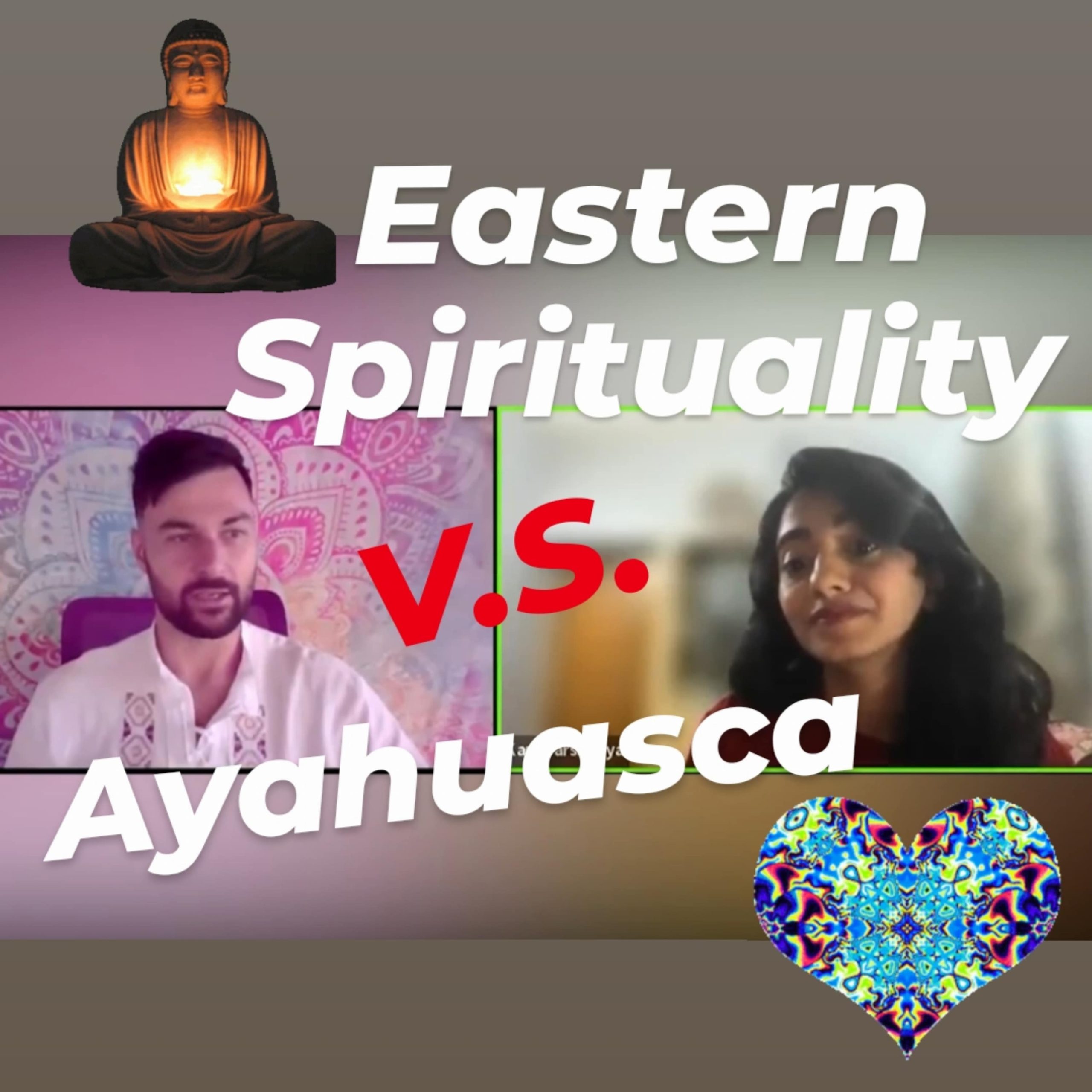
In a thoughtful and wide-ranging conversation, host Sam Believ sits down with Kani — based in northern India and immersed in Eastern spiritual traditions — to explore the parallels and contrasts between classical Eastern practices and the Amazonian plant-medicine path of ayahuasca. What emerges is a meeting of worlds: two deeply human systems of transformation, communicating across culture, context and consciousness.
Two Traditions, One Aim
From the outset, Sam and Kani note that though the contexts are very different — jungle ceremony versus temple meditation, vine brew versus breath or posture — the underlying aim remains strikingly similar: to awaken the human being, to remove layers of ego, conditioning and suffering, and to realign with deeper truth. Kani reflects that in the East the path may focus on subtle energy, meditation, and stillness; in the Amazon the path often involves the plant, sound, ceremony and the dissolution of the boundary between self and spirit. Yet both seek to “work on the same system,” she says — the body-mind-spirit complex.
Complementarity & Synergy
One of the most engaging parts of the talk lies in how Sam describes his retreat’s practice of including meditation and yoga ahead of the ceremony, and Kani recognises that as a natural bridge between traditions. “These are complimentary,” she observes: meditation opens space, body and mind relax; when the plant medicine arrives, the field is already primed. Conversely, the medicine may bring what years of silent practice could only hint at. Sam notes how participants often receive visions, emotional purging and relational insights — while Kani frames that as a kind of “accelerated stillness” or “embodied awareness” that in her tradition might take decades of sitting.
Differences in Method, Not Destiny
Of course, differences abound — and they are neither accidental nor trivial. Kani emphasises that Eastern paths often emphasise discipline, renunciation, detachment and gradual purification, whereas ayahuasca retreats lean into surrender, visceral encounter, and often dramatic catharsis. The tools differ: breath, posture, mantra and ritual frames in the East; vine, sound icaros, dark-room ceremony, community in the Amazon. Sam points out that the plant tradition often bypasses the conceptual (thinking) mind and works more directly with felt-body, memory, energy and trauma. Kani reminds us that Eastern traditions speak to the subtle body — chakras, kundalini, prana — whereas plant-medicine traditions speak through mythic language, archetypal imagery and direct phenomenology.
Integration and Long-Term Practice
Another vital theme emerges: that both traditions stress integration and sustained practice, not just peak experiences. Kani warns that meditation retreats alone don’t guarantee insight; there must be follow-through, ethical living, community, reflection. Sam echoes that a one-week ceremony is not a cure-all. The parallel becomes clear: whether you sit in lotus or brew the vine, the call is the same — live what you see, embody what you sense. For Sam, yoga and meditation ahead of ceremony create stability; for Kani, they form the ground of inner discipline that supports any deeper states. The key message: transformation is not just what happens in the moment, but how you live afterwards.
Cultural & Ethical Reflections
Across the conversation lies an awareness of culture, lineage and context. Kani speaks of the East’s long, intergenerational transmission of teachers, texts and sacrificial systems. Sam speaks of Amazonian tradition, community, respect for the medicine, and the way the brew emerges from indigenous cosmologies. They both agree it matters how one enters these paths: with humility, respect and intention. The conversation implicitly challenges the “spiritual tourism” mindset — whether sitting in a temple or going to jungle ceremony. The question is: are you ready to let something real change you?
A Shared Invitation
By the close of their discussion, Sam and Kani extend something beyond comparison. They invite the listener not simply to pick a path, but to feel the overlap: the body/mind quieting, the heart relaxing, the sense that life is more than daily grind. Whether you lean through meditation, plant medicine, yoga or ceremony — the call is the same: wake up. Kani says: “When we still the mind and open the body, the deeper intelligence speaks.” Sam adds: “When the vine shows you your shadow, you either respond or you remain asleep.”
Final Words
This episode doesn’t suggest one path is superior. Instead, it shows how two paths — Eastern spirituality and the ayahuasca tradition — can converse, complement and illuminate each other. If you are drawn to either or both, the takeaway is clear: approach with curiosity, integrity and responsibility. The journey is not a weekend adventure but a lifelong unfolding. And whichever door you walk through, you will still need to keep walking.
For those caught between yoga mats and jungle ceremonies, the message is simple: they may look different, but they share the same horizon — the realisation of freedom, presence and deeper connection.
Based on the Ayahuasca Podcast episode “Eastern spirituality V.S. Ayahuasca” with Sam Believ and Kani.