
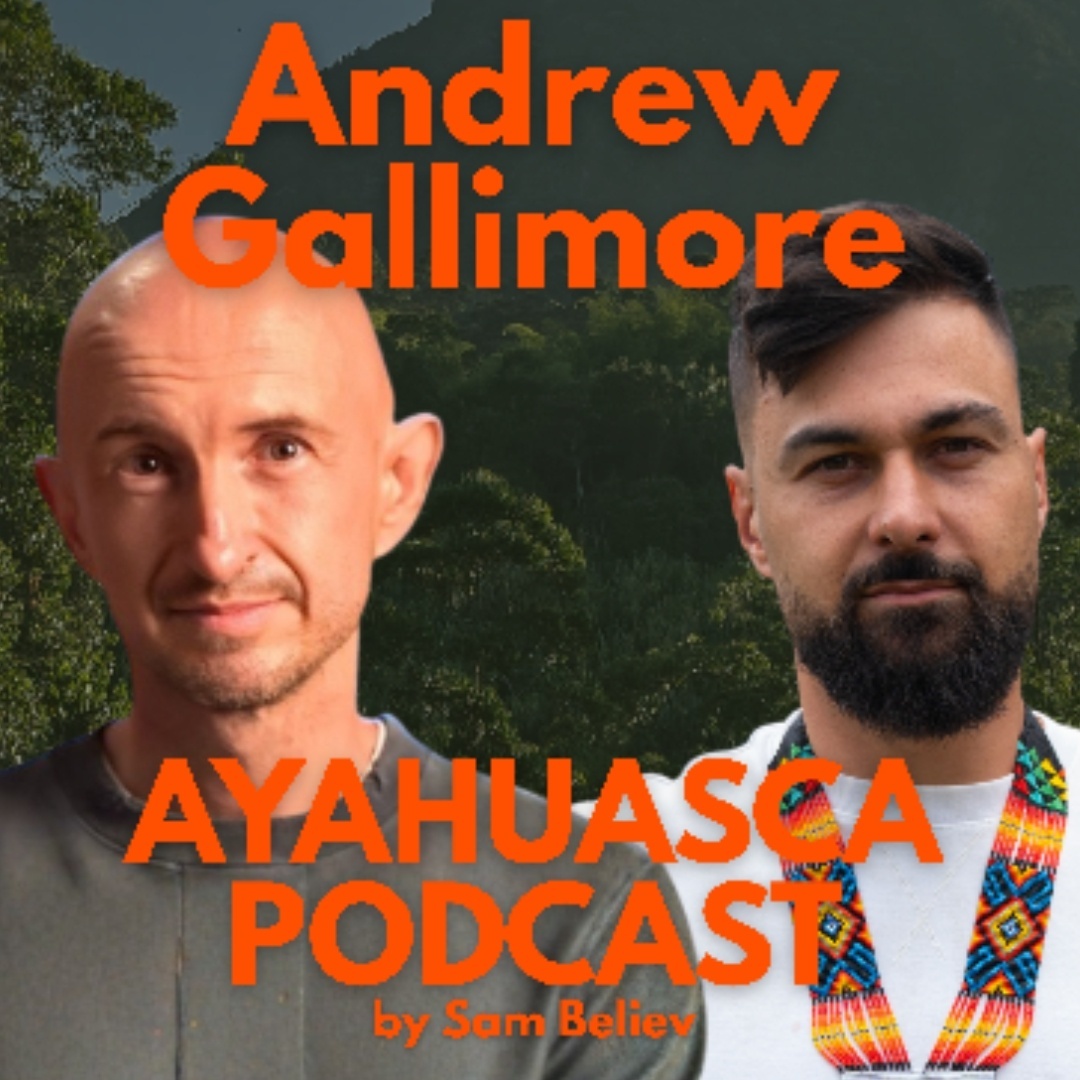
In this episode of the Ayahuasca Podcast, host Sam Believ connects with Andrew Gallimore, a computational neurobiologist, pharmacologist, and chemist based in Tokyo. Andrew is a prominent voice in the cutting-edge study of psychedelic neuroscience and the author of Alien Information Theory, Reality Switch Technologies, and his latest work, Death by Astonishment.
Self-described as a “DMT exceptionalist,” Andrew explores how this efficient, reliable molecule acts as the ultimate reality channel switch—obliterating our normal waking model of the world and instantaneously replacing it with a staggeringly complex, alternate reality populated by advanced, intelligent entities.
Key Discussion Points
- 02:30 – From the Occult to the Cortex: Andrew shares his teenage pivot from ghosts and folklore to chemistry and pharmacology, driven by a lifelong obsession to understand how molecules interface with the human brain.
- 06:15 – Brain Mechanics and the Edge of Chaos: How classic psychedelics nudge the brain’s world model away from perfect order and toward a more fluid, entropic, and dynamic state.
- 10:40 – Turning the Radio Dial: The difference between a slightly disordered trip and the total structural collapse into a new frequency that occurs during a breakthrough DMT experience.
- 14:55 – Is the DMT State Being Mapped? Andrew proposes that rather than creating a “hallucination,” DMT may be gating the flow of alternative sensory inputs, letting the brain construct a model informed by an external source.
- 21:20 – The Genesis of DMTX: Retooling target-controlled intravenous infusion technology from anesthesiology to stabilize the notoriously short DMT trip into a controlled, hours-long exploration.
- 27:40 – Deep Sea Diving in Consciousness: Moving away from the disorienting “rollercoaster” of standard DMT hits toward a stable, navigational space where the ecology of the alternate reality can be charted.
- 33:15 – The Secret History of Ayahuasca: A look at the discovery of the brew from Richard Spruce in 1852 to beat writer William Burroughs, highlighting the brilliant example of indigenous pharmacological synergy between the Banisteriopsis caapi vine and Psychotria viridis leaf.
- 39:50 – Indigenous Science vs. Random Chance: Moving past the Western-centric idea that indigenous peoples merely stumbled across the brew, showcasing their deep historical mastery of combining complex plant medicines.
- 45:10 – Endogenous DMT and the Moment of Death: Analyzing why DMT is found naturally in mammals and discussing the physiological hypothesis that it spikes to protect neurons during hypoxic stress or childbirth.
Follow Andrew Gallimore’s Work:
- Website: buildingalienworlds.com
- Latest Book: Death by Astonishment: Science, Endogenous DMT, and the Reality Switch
- DMTX Facility Info: Explore legal extended-state research opportunities at eleusismind.com
Explore the Original Reality Technology: If you want to experience the original, traditional extended DMT technology through safely facilitated plant medicine, visit: ayahuascaincolombia.com
If you found this scientific dive into the alien information theory fascinating, please leave us a 5-star review!
Transcript
Andrew Gallimore: I’m a, a DMT exceptionalist in the sense that I think DMT is the most fascinating molecule on the planet, and perhaps also the most important because it is so efficient, it is so reliable. It will instantaneously take you somewhere else. Not just any somewhere else, but the most remarkable, inexplicable, unanticipated, staggeringly complex alternate reality that’s filled with beings that are neither animal nor human and appear to be far older in some ways, and far more intelligent, far more advanced than us.
D- I think DMT makes it abundantly clear that there’s far more to reality than what we perceive normally. I think what we experience now represents only a, a very thin slice of reality. The ground of my worldview is this idea that it’s all one huge illusion, that it’s one huge drama, and that there’s nothing really real apart from consciousness itself.
Sam Believ: You’re listening to AyahuascaPodcast.com.
Hi, guys, and welcome to Ayahuasca Podcast. As always, with you, the host, Sam Beliaf, and today I’m interviewing Andrew Gallimore. Andrew is a computational neurobiologist, pharmacologist, and chemist who has become a leading voice in the study of psychedelic consciousness, particularly DMT. He’s the author of Alien Information Theory and Reality Switch Technologies.
This episode is sponsored by LaWayra Ayahuasca Retreat. At LaWayra, we combine affordability, accessibility, and authenticity. LaWayra, connect, heal, grow. Guys, I’m looking forward to hosting you. Andrew, welcome to the show Good to be here. Andrew, so I know your story a little bit, but share, share your story with the audience how you got interested in things like DMT.
Andrew Gallimore: Ooh it’s a long story, but… I became interested in DM- well, in psychedelics when I was a teenager. I graduated from an interest in the occult ghosts and vampires and werewolves and that kind of thing. But when I became, when I got to about sort of 15 years old, I learned about psychedelics what they were and, Ultimately learned about DMT, which sounded remarkable.
This drug that was described as similar to LSD that, but lasts like 15 minutes. Thought this is this is very interesting. A- and the rest, as they say, is history. I decided at that point that I wanted to study chemistry and I wanted to study pharmacology. I wanted to learn how these molecules can interface with the human brain to to elicit truly remarkable alterations in the, in, in the structure and the dynamics of conscious experience.
And none more so than DMT really. It is the ultimate reality channel switch to borrow Terence McKenna’s phraseology. And so yeah, I’ve spent the last 30 years, studying DMT from various perspectives, both, both from a subjective personal perspective, but but also critically from a neuroscientific chemical pharmacological perspective as well.
Trying to understand how and why DMT is able to elicit such astonishing, truly astonishing changes in in the structure of conscious experience, such that the normal waking world is just is obliterated in an instant and replaced with one that that is altogether stranger. That I think remains even after all this time, despite what many scientists will like to have you believe that we’ve got it worked out that it’s just some exotic form of hallucination.
Actually, I think DMT remains, and may well remain for some time a, a true mystery
Sam Believ: Yeah, I know you were never satisfied with what science tells us about it and also what was written in the books. So that’s why you wrote your last book, right? Explaining it a little better. But yeah, what is your understanding of how psychedelics work?
How much have you been able to understand so far?
Andrew Gallimore: Yeah. I’ve written three books on, on, on the topic. To condense it broadly when we’re talking about a psychedelic they come in a number of classes. They don’t all work exactly the same way. But the kind of the end point the output, if you like of a psychedelic drug’s action in the brain is to nudge the brain into a slightly more fluid and dynamic state.
So just the classic psychedelics that bind to those serotonin 5-HT2A receptor, for example, they stimulate certain populations of neurons within, in the cortex, which respon- re- which is responsible for constructing your model of reality. The world that appears to you is this model constructed by the cortex and the psychedelics by stimulating these, this populations of neurons in the cortex.
They nudge the cortex into this on the continuum between perfect order and chaos, the brain normally sits here, towards the edge of chaos. It’s dynamic and yet stable. And this is essential for the brain to construct a world model that is dynamic and stable. The world model that you experience has to be stable enough such that you can make sense of it, that it’s coherent and it’s, i- it’s cogent.
But at the same time, it needs to be dynamic and constantly changing and responsive to sensory inputs. And so it has to strike this delicate balance, the brain, between order and disorder. It needs to be ordered but not too ordered so to speak. And what psychedelics do is they nudge the brain into a slightly more disordered state, what Robin Carhart-Harris would call a, an entropic state, if you like.
They increase the entropy, they increase the complexity of the brain and this comports well with the subjective experiences of psychedelics. The world changes. The world becomes more fluid and dynamic, just as the cortical activity becomes more fluid and dynamic. So you go from order into a slightly more disordered state.
But with psychic- with DMT, it, you seem to push further. I often describe it as it’s like those old radio sets where you have you turn the dial and if you’re in one channel and you turn the dial, it goes slightly out of tune. It becomes noisy. It becomes a little bit messy. This is what psychedelics are doing.
But with DMT is if you continue to push that dial even further. And eventually this entirely new channel kind of crackles through the speakers. And so y- with DMT you go from the order of the normal waking world into this slightly more disordered state, and then the whole thing kind of collapses.
It’s like the, the system collapses into this entirely new order in which the, the normal waking world model is no longer being constructed. And the brain is somehow beginning to construct an entirely different world model. A world model that it, in my opinion, shouldn’t know how to construct
Sam Believ: Yeah. I like your explanation that when we see the normal reality, our brain creates the construct of what we see, and then when you dream, it’s more flexible. But then when you are under the influence of DMT, it creates this entirely new reality, which it, as you say, it shouldn’t know how to create.
So do you have any theories about it, or like what is it? How come we know that, that image?
Andrew Gallimore: To take another analogy, if you were, Or let’s stick with the radio analogy. If you turned the radio from one channel that you were listening to and twisted the dial and it became noisy and there’s lots of static and just and then suddenly a new channel of came crackling through the speakers.
What can you conclude from that? You wouldn’t conclude that the radio was spontaneously generating this new channel. You would assume there must be some that the information that informs that channel, there must be some other there must be some other channel there that’s being received by the radio.
And in, in the same way, I think the fact that the brain is able to construct these worlds that don’t seem to have any ob- obvious referent in the normal waking world, that aren’t, in many cases, have no relationship at all to the normal waking world. The fact that the brain is apparently constructing these models suggests that it’s being informed by or modulated by some alternative source of sensory inputs.
That would be the explanation. I don’t think you’re going to another world, so to speak, when you when you use DMT. But just like the normal waking world, the normal waking world is a model constructed by the brain, but it’s modulated, it’s informed by sensory input, since constantly tested against sensory input.
So there is a mapping normally between the world model that you’re experiencing, which is always in your head. It’s always being constructed by a brain. There’s a mapping between that and the environment, information from the environment. So my– the logical kind of conclusion there is that the DMT state is also being mapped in some way.
That’s the big question. Is it being mapped? Is it entirely internally generated a- as in the dream state, for example? Or is it being, is it mapped some way to some alternate source of sensory inputs, some other whatever? We don’t know. I don’t wanna say another world, because I don’t know if that’s what it is.
But it seems as if the, if somehow DMT is gating the flow of information from something, somewhere somebody else. That would be my explanation. So it’s like you’re, it’s like you’re tuning into a different, And you have to be a little bit careful. I don’t like pushing the radio analogy too much because I think it’s overdone, but it’s like you found a new frequency, if you like, and the brain is indeed receiving information it doesn’t normally have access to.
Sam Believ: Yeah, that’s definitely how it feels like. So interestingly enough, even though this is my sixth episode on DMT in last few months, and I don’t know what happened there, the floodgates opened and I started getting all the DMT guests without me specifically planning for it. I mostly have experience with Ayahuasca, which is obviously DMT based.
I will need to experiment with DMT soon enough. I’m sure it’s coming. I know Danny wants to come visit. Maybe that’s the, maybe that’s the way to do it. But with Ayahuasca, the experiences, as far as I understand, are much more diverse and with your radio frequency channel, like with DMT by itself it’s very visual and it’s entities.
With Ayahuasca it’s very diverse, where you go from, jungle entities to Egyptian god entities, to everything in between, and s- seeing exactly what on DMT by itself. Do you have, have you had experiences with Ayahuasca or just pure DMT?
Andrew Gallimore: Pure DMT. I’m a DMT guy, yeah.
Sam Believ: Okay. I’ll, if you’re ever in this hemisphere, you are completely invited- … to come here to my retreat and because from s- strictly from a scientific point of view, I just need to know what and what you make of it, because obviously you understand a lot. But in a way, you together with Rick Strassman, whose book I’m actually reading right now I’m doing this deep dive into DMT, created this method, which is DMTX, which is the extended DMT states with the IV.
And I’ve interviewed Danielle McQueen as well about it recently. But basically you kinda discover the more precise Ayahuasca, like extended DMT state or, is it similar or different? How much do you know about it? How much do you wanna share about this this modality?
Andrew Gallimore: Yeah.
So myself and Rick Strassman, we proposed what’s come to be known as DMTX in 2015. So as you say, Ayahuasca is an ex- is in essence, there are differences, but it is in essence an extended DMT trip in that the, the metabolism of DMT is is slowed down. But still you’re at…
So r- so with a, a regular DMT trip, let’s say by intravenous injection, it very rapidly rises in the bloodstream and in the brain, and then it just as quickly begins to come down again. It falls off exponentially, and this is why the DMT trip is so short. With Ayahuasca you’re kind of that, that b- brain concentration curve is stretched.
But still it rises, it reaches a peak, it plateaus a little bit, and then it comes down slowly. So you’re still at the mercy of pharmacokinetics, albeit impeded by the monoamine oxidase inhibitor, harmine and harmaline in the case of Ayahuasca from the copy vine.
But, What myself and Rick wanted to do was actually properly stabilize the DMT state, so you’re not no longer at the mercy of pharmacokinetics. We proposed to retool a, a technique from anesthesiology called target controlled intravenous infusion which is a technique whereby a- an anesthesiologist will use a programmed infusion device to maintain, to reach and maintain a stable concentration of a short-acting anesthetic drug in the brain of a patient such that they can induce them into an anesthetized state and hold them there as, as long as necessary, and to be able to manipulate the depth of that state as well.
And, based upon my analysis and also on Rick’s work showing the lack of subjective tolerance of DMT it appeared to me that DMT, you could simply repurpose that technology, target controlled intravenous infusion, but rather than an anesthetic drug you, and you put DMT into the equation.
So we basically developed a kind of a proof of principle model back in 2015 which was merely aimed to show that this could work that DMT possesses the requisite pharmacological properties, pharmacokinetic properties, such that it should be amenable to this, this technique.
And then five or six years later the Imperial College team, then headed by Chris Timmerman, a DMT research group, were able to actually implement this in humans and show that you can reach and maintain a stable DMT concentration in the brain and, in fact, a stable DMT experience.
So you can induce someone into the DMT state, at various dose levels by reaching particular concentrations of brain DMT using this programmed infusion device informed by a pharmacokinetic model and then you can stabilize the experience. And they were able to stabilize it at first in this very fir- kind of small pilot study with a dozen volunteers.
They were able to stabilize it for 30 minutes, but other groups now have shown that, this can be extended much longer, up to several hours in, in some cases. So yeah, that’s, in my opinion, that’s kind of- currently represents kind of the pinnacle of DN- DMT administration techniques and that it takes DMT from a very short kind of rollercoaster-like experience where you’re hurtled into the space, you’re tumbling around, you’re disorientated and then you’re dragged back out.
It transforms that into one where you can actually enter the space in a controlled fashion and remain there. It’s like the difference between free diving and deep sea diving. Once you have a line, an air line from the boat you can spend as much time as you like exploring deeper and deeper areas of the ocean and learning a lot more about its structure and its ecology and, the flora and fauna, so to speak.
And in the same way, I see DMT as a largely uncharted domain. And DMDX, I think, is the ideal technology for exploring it and to unders- or un- trying to understand its structure and its dynamics and its occupants.
Sam Believ: And have you been able to try it yourself already, the DMTx?
Andrew Gallimore: No, I’ve never had the opport- opportunity I’m in Tokyo not so easy. Yeah. But we do have a … So I’m working with a company called Eleusis in the Caribbean who have a, a special license from the, the government of Saint Vincent and the Grenadines.
And we’re setting up a, a DMTx island, if you like, or a DMTx facility- … on an island where people can come and experience DMTx in a medically supervised and controlled and fully legal, importantly. So nobody’s breaking any laws. A fully legal, perfect kind of ideal tropical setting.
So if I was gonna try DMTx, that would be the place. And people can sign up already. It’s opening next month, in March. Go to Eleusis Mind, E-L-E-U-S-I-S mind.com, and people can see what Eleusis is all about and even sign up, a- and go to the island
Sam Believ: Maybe when you’re here in Caribbean, which is very close from us, we’re we’re in Colombia, maybe you can come and check the original DMTX 4.0-
Andrew Gallimore: The
Sam Believ: original
Andrew Gallimore: technology
the
Sam Believ: traditional.
Andrew Gallimore: Yeah. Yeah. Yeah. It definitely feels
Sam Believ: like …
Andrew Gallimore: yeah, Ayahuasca is the original technology. In my latest book, Death by Astonishment, I spent a lot of time in the first half discussing, how we… How did we get from this molecule that’s ubiquitous and scattered throughout the natural world, but basically inaccessible.
It’s not easy to get an effect from DMT. You can’t just go munching on plants or whatever. You have to actually learn how to how to use it. And certainly Ayahuasca was the original technology a true pharmacological technology that allows one to to experience DMT DMT’s effects.
And DMTX really is just the next phase, if you like in our, kind of- Yeah … our learning to use this, this reality-switching technology.
Sam Believ: Let’s talk about DMT. You call yourself the DMT exceptionalist and the, this- … the simplicity of this molecule, but then lack of tolerance and also how prevalent it is in nature.
And maybe talk about the history of it and also your new book, ’cause I only thought you have two books, so it’s great to know- No … now you have three.
Andrew Gallimore: Yeah. So Death by Astonishment is the is focused on DMT. So my first two books, Alien Information Theory, was a bit of fun, metaphysical speculation.
Reality Switch Technologies, the second book, was more about the kind of going into detail on the neuroscience of psychedelics generally. So not just DMT, but classic psychedelics salvia even the tropane alkaloids and ketamine-like drugs. How they work in the brain, how do they actually change the structure and dynamics of your w- of your experienced world.
And then for my third book, Death by Astonishment, I focus on purely on DMT and science’s, the discovery of DMT, the DMT molecule by science, and how science has spent the last century really trying to understand and make sense of this molecule. And, in my opinion, failing for the most part.
Or at least relying on what I think are flawed assumptions about what DMT is and how DMT works and what DMT represents. I think it represents something far stranger than we’re currently capable of even comprehending. That’s why I’m a, yes, a DMT exceptionalist in the sense that I think DMT is the most fascinating molecule on the planet and perhaps also the most important because it is so efficient, it is so reliable.
It will instantaneously take you somewhere else. And not just an- not just any somewhere else, but the most remarkable inexplicable unanticipated staggeringly complex alternate reality that’s filled with beings that are neither animal nor human. And appear to be far older in some ways, far more intelligent, far more advanced than us.
And and yet this is also, not a rare molecule by any stretch of the imagination. One could say it is the most common naturally occurring psychedelic on the planet. It’s everywhere. It’s ubiquitous. Nature is drenched in DMT as, as Dennis McKenna likes to say.
And so that’s the reason I think. There are many other… I’m interested in psychoactive drugs generally not just psychedelics even, but I think DMT really is, that’s the one, that’s the jewel, in my opinion. That’s the one that that’s why I’ve spent my life try- trying to understand this molecule.
Sam Believ: This episode is sponsored by LaWayra Ayahuasca Retreat. Most of LaWayra if you’ve been listening to this podcast For a while. Some of you might have already been to LaWayra before. For those who don’t know us yet, we started LaWayra four years ago. At LaWayra, we combine authenticity, accessibility, and affordability.
LaWayra is currently highest-rated Ayahuasca retreat in South America with more than 700 five-star reviews and an average rating of five stars. If you come to LaWayra, you’ll experience powerful, authentic ceremonies led by our indigenous shaman, Fernando, in a very beautiful venue just one hour south of Medellín, Colombia.
We’re surrounded by nature and have comforts like hot water, Wi-Fi. At LaWayra, our team has guided more than 2,500 people through this life-changing transformation of Ayahuasca experience. At the same time, we keep it very affordable. So whether you’re coming for healing, clarity, or a deeper connection to yourself, LaWayra is the best choice.
If it is your first time drinking Ayahuasca, you will love our three-and-a-half-hour preparation course and integration support. All of that is included in price as well as pickup from Medellín, accommodation, and Ayahuasca. Visit lawyra.com to book your retreat or learn more. LaWayra, connect, heal, grow.
L-A-W-A-Y-R-A.com Regarding psychoactive molecules, have you ever looked into the the harmala alkaloids in the ayahuasca vine and, the interaction with DMT or no?
Andrew Gallimore: Yes. I… depends what you mean by their interaction with DMT, but absolutely. That’s, I- in, in Death by Astonishment I devote a lot of time to discussing that and how that technology was actually discovered.
We have to remember that ayahuasca was discovered by Western science. This is a very Western-centric viewpoint, but it was discovered, undisputably by Western science in 1852 when Richard Spruce, the, the British botanist sat by the banks of the river Vaupés and drank this curious, bitter decoction m- made with him by a member of the, the Tukano tribe and found the vine that was responsible, was said to be responsible as a key component of this, this magical drink, and named it Banisteriopsis caapi.
But it was 100 years, over 100 years after that sort of 120, 130 years later that we actually understood exactly how the ayahuasca vine was eliciting its effects, and the idea of this, this binary decoction of a a MAO inhibi- MAO inhibitory alkaloid-containing plant, in this case Banisteriopsis caapi, and a DMT-containing plant.
That science really struggled with that for a long time and it was inexplicable because they assumed that it was all about the vine and nothing else. And, doctors were injecting people with massive doses of harmala alkaloids and, they were getting dizzy, and they were becoming drunken, and, passing out and stuff, or having seizures and all this kind of stuff.
But none of them were complaining about being accosted by creatures from another world. And many scientists actually started to question whether, whether- Ayahuasca was even, the ayahuasca vine was even import- or whether people have been making up these stories about going to other worlds and seeing these strange creatures.
And it was a long time before, cl- including people like, William Burroughs, the, the beat p- the beat writer, for goodness sake. Him traipsing through the, the Colombian rainforests and being let into this secret of this, this additional leaf that’s added alongside the vine, which turned out to be Psychotria viridis in the end.
And although he wasn’t properly given credit for that discovery, but he did. Amazingly this this heroin addict beat writer was the, the true, in my opinion, discoverer of the of the secret component, at least from the Western perspective, of the secret catalyzing component of the ayahuasca brew.
But then again, it was still another couple of decades until scientists were able to work out that this was a, a, an example of, a beautiful example of pharmacological synergy, where you have two drugs, two molecules that on their own, when ingested orally, aren’t particularly impressive. But when you add them together, you get this rem- this incredible magic happens, which we now refer to as the ayahuasca effect.
But yeah I certainly very interested in in, in harmala alkaloids.
Sam Believ: Yeah, it’s it’s very interesting. I have a pretty far out theory, and I’m not sure about it, but when you travel to Peru specifically and you see the ancient megalithic structures they contradict our normal understanding of the progress, where the previous people were always less advanced than the future people.
And I… You can see that the stones underneath are very huge and very perfectly aligned, and then the layer above it is less advanced. So I think that maybe there was a time where there was some other civilization here that was very advanced, and they figured out ayahuasca and, maybe they disappeared, but somehow the recipe survived because of it’s hard to understand, but it’s simple to reproduce. I don’t know if you have any thoughts about it, but it’s it’s far out there, but yeah.
Andrew Gallimore: That’s more of a Graham Hancock kind of question than an Andrew Gallimore question. When it comes to kind of- Yeah
anthropology and ancient civilizations, I’m afraid you’re not gonna get much insight or anything particularly interesting from me. I’m I focus on the on the neuroscience. But, who knows? It remains something… It is still quite difficult to explain how of all, of all the plants, the question that’s often brought up, how did they discover that this particular combination was was so effective.
But I think, we, in a sense we do the indigenous people something of a disservice by assuming that they were just throwing these plants together and that they stumbled across Ayahuasca. I don’t think it’s as simple as that. I don’t think… I think clearly, you can… it’s not just Ayahuasca.
There are many plant-based preparations, from arrow poisons, for example. Back in the, the 1940s and ’50s when Richard Schultz was dis- was studying arrow poison, particularly curare, for example. There were, there, there were plants added to this curare paste a- alongside the strychnos containing the the, the strychnine,
The true kind of toxic component that kills the animal. They were also adding plants of, the pepper family. It’s like, what’s that about? It didn’t make any sense, but it wasn’t random. And it turns out in the end when you now that we understand the pharmacology of these, these particular plants, that they were utilizing a form of pharmacological synergy.
They were utilizing a molecule in the other non-toxic plant that hastens the entry and inhibits the metabolism of the toxic component, the, from the, of the strychnine. And so they were using, pharmacological synergy here. They didn’t understand, the term pharmacological synergy or the actual chemistry, the pharmacology, but they un- they had a deep understanding of how combining different plants together generated specific effects.
And I th- I see it the same with Ayahuasca, in that there are still Ayahuasca brews that contain only the Ayahuasca vine. So probably Ayahuasca with the caapi vine came first and then other, admixture plants were added later and eventually this kind of beautiful, magic, if you like, combination was arrived at through a, a long period of development of this technology.
Sam Believ: Yeah. Sorry for taking it off topic, but yeah, I guess I’m manifesting Graham Hancock for the podcast. And, … I guess I can, I guess I can ask you anything because you’re a neurobiologist and a pharmacologist and a chemist and you seem to be a man of very diverse knowledge.
But in your last book the word death is in the title and I wanna- … know your thoughts about a lot of times people specifically with Ayahuasca, they experience dying or something that feels like dying. And there is this understanding that maybe DMT is the molecule that gets released when you’re born and when you’re dying.
And my, my wife and I have three kids, and when she was giving birth to my kids, she described a very I- an experience very similar to an Ayahuasca experience, like a psychedelic experience produced by something. Do you reckon there’s like natural states in which we use DMT and trip naturally or not?
Any thoughts?
Andrew Gallimore: I don’t know is the answer, but we know that DMT is almost cert… it’s found in the human body. That’s, it’s found in the brains of other mammals. In, in, in rats, in rabbits. It’s probably found in the brains of humans, although nobody’s… We know it’s in cerebrospinal fluid.
We know it’s in blood and urine. We’ve known that since the 1950s. So yes DMT is a, it’s an endogenous product of tryptamine metabolism, tryptophan metabolism. That much we know. Does it ever reach psychedelic, shall we say, concentrations in the human brain? We don’t know yet. One could hypothesize as Rick Strassman has hypothesized and others, that DMT is, there are times at which levels of DMT in the brain rise.
And production is ramped up. The dying process has been proposed. We know that when rats die if you kill a rat, and they’ve done this experiment now if you kill a rat, at the moment of death, the levels of DMT will shoot up. And there are good reasons why this might happen that are completely non-metaphysical in that we know that DMT protects neurons under hypoxic stress.
So by binding to this sigma-1 receptor, it’s completely orthogonal to its psychedelic action apparently. DMT, neurons in the presence of DMT will survive much longer in an oxy- oxygen depleted environment. So it makes sense that during the dying process as the respiratory and cardiovascular system begin to shut down that would be the time where you’d want to release large amounts of DMT and effectively protect the brain should you come back, should you not die.
Should you have a kind of near-death experience and come close to death, that would be the time when you’d want your brain to be pumped full of DMT. So it makes sense from a purely physiological standpoint that DMT would be released at the time of death. Now that does not explain why DMT has these profound effects on consciousness.
That’s, that remains a mystery, but it’s hard to it’s hard to think that they’re completely unrelated, that maybe DMT is involved in the dying process. But it remains it remains a, a cool bit of speculation, but we have to be very careful not to as many claim that to be a fact, that DMT is released at the point of death in large amounts.
It’s released when you’re sleeping and creates dreams. All of these things have become part of public consciousness and repeated as if true, as if facts, when they are nothing of the sort. They are cool and interesting hypotheses that do have some physiological justification, I would say.
Sam Believ: Yeah, ’cause let’s say I’ve seen hundreds of near-death experience videos, and I find them fascinating. And it’s, in this understanding of, we- we’re- we’re souls and we come here to learn a lesson and then we go somewhere else and it’s very comforting. But then what if then the experiences are all just a psychedelic experiences and actually when you die you just die and it’s a little there…
I guess there’s no way to really find out but,
Andrew Gallimore: There’s one way to find
Sam Believ: out … off topic like what do we- And we all
Andrew Gallimore: will I guess
Sam Believ: Yeah. What are your beliefs? What do you think based on obviously knowing a lot about all those psychedelic states, what do you think happens when you, when we die?
Andrew Gallimore: Oh, that I don’t have beliefs about that, but I don’t know. But I’m not of the camp of, when you’re dead. Or that you’re going to be trapped in s- a, a dark box for all eternity. I don’t think that doesn’t make sense to me either. I think that, I’m at heart I’m an idealist, a philosophical idealist.
I think consciousness is fundamental. I think there’s nothing else but consciousness when you get down to it, I don’t think. And as such, consciousness is not something that dies. It’s, it merely takes on different forms or different perspectives and we are all
part of that one. The s- I’m getting almost sounding kind of spiritual here, and that’s not my purpose. I, but I think consciousness is fundamental and I think
Let’s say I don’t know but okay, I’ll say this much if you pin me down. D- I think DMT makes it abundantly clear that there’s far more to reality than what we perceive normally. Far more. I think what we experience now represents only a, a very thin slice of reality that becomes, perfectly and undeniably clear within a few seconds of in getting a good lung full of DMT.
And so I think you’d be an idiot to have experienced that and come back and say, “Nope, it’s still, this is it. Once it’s gone.” Once you’re dead. I think it, it would be foolish to maintain, stridently maintain that that belief, firm, that firm belief that, that physical matter is all it is, that consciousness emerges from matter, that we’re born and that we wake up and then we die and it’s all over.
I think that’s in my opinion, almost certainly not true, and there’s actually something much, much deeper and older going on that we simply don’t understand from this very kind of low- lower dimensional perspective. So I can’t say, what happens when we die but I think probably quite a lot.
Sam Believ: Yeah, that’s that’s an answer we not gonna get… That’s a question we’re not gonna get answer till the day we die. It’s like sometimes I- Exactly … sometimes I’m afraid of death, and other times I’m curious about what happens afterwards. But it’s good to… It’s a more comfortable set of beliefs.
But you s- you said in one podcast that the na- nature of the game is to find an escape, so obviously, if this is if this is the game and… So yeah, el- elaborate on that. Is that like seeing it as a simulation or what do you mean by that?
Andrew Gallimore: That’s, that comes from my first book, Alien Information Theory.
But that was really me- pure metaphysical speculation. It’s not what I believe. I’m not a simulation theorist, by the way. I’ve never really been a simulation theorist because I don’t think this is a simulation, first of all. If someone calls this world a simulation, all simulations have two counterparts, the simulated and the kind of the ground, the base reality that is being simulated.
If this is a simulation of what? The assumption seems that there would be, other real humans who aren’t being simulated. And that’s what people like Ni- Nick Bostrom kind of propose. But I don’t see it like that. I think this is a kind of an instantiation of some kind of of some kind of reality, but I don’t think it’s a simulation.
But I think reality fundamentally and I get that the ambience of DMT I think reveals the kind of comical ambience a fundamentally trickster-ish, character of reality that we take reality too seriously. The, the Buddhists got this right, I think in that, it’s all illusion.
As did the Hindus. That it’s all illusion. That all form, all content all objects, everything that, This, this maelstrom that we call reality is just a form of illusion, and that the only true reality is is Brahman, as the Hindus would say. The Self with a capital S.
That’s the only thing that really exists, and that the, the form is all illusion. And I think the, the message of these ancient mystical and religious traditions is about how do you transcend form? How do you see beyond it? How do you see form for what it is, which is illusion?
And that’s a game in a way, for some people it’s a grand task achieving enlightenment or whatever. But I think there’s a much more, more should we say lighthearted way of seeing that, that reality is some kind of game. It’s fun, right? It’s a drama.
We are enraptured by the drama whether it be the drama of a normal waking life or the drama of the DMT state. The whole thing is one huge performance. And ultimately it’s about seeing beyond the performance and seeing the performance for what it is. And that’s like completing the game, if you like.
The c- the cosmic game, the cosmic joke, whatever you want to call it. But so that’s really why I wrote Alien Information Theory. It wasn’t intended to be a an, an ideological position. I wasn’t saying, “This is how I see reality,” as this digital construct or anything like that.
It was simply a way that reality is so strange, the world could be anything, as Terence McKenna used to say. And I just gave one particular example of how the world might be. But ultimately, yeah, that’s my, I guess my… The ground of my worldview is this idea that it’s all one huge illusion that it’s one huge drama, and that there’s nothing really real apart from consciousness itself.
Sam Believ: Yeah, I need to re-listen to this episode and think hard into all those topics. It’s definitely… a, a lot of this, this recent dive into DMT and nature of consciousness is definitely beyond my understanding because I largely focus on how can I use Ayahuasca to help people heal and and we do it pretty well consistently.
So my question is, with Ayahuasca, it’s a healing modality and m- most of people that come here come for healing and spirituality also comes to it. I see it more as a side effect. But when people use DMT, whether smoking or DMTX, do you also feel find similar improvements in mental health and physical health or not really?
I honestly don’t know.
Andrew Gallimore: I don’t give people DMT as such, but we can refer to more and more studies. When it comes to healing, yes, Ayahuasca is, has been more used in the past and in, in more clinical studies in, research institutions they tend to focus on psilocybin as a treatment modality.
But now you’re starting to see DMT actually as being very effective because it it has the benefit of course of being much shorter acting. There was a paper that was published literally I think two days ago which showed dramatic improvements in treatment res- resistant depression with just a 10-minute infusion.
So taking DMTX but shortening it down just to 10 minutes, you have a 10-minute infusion of DMT and that’s it. The person goes home and they come back a few weeks later and their depression scores have dropped significantly compared to placebo. So I think psychedelics generally are, have the potential to be extremely beneficial.
It’s not my thing, so to speak. There are many people who’ve been doing wonderful work on the therapeutic aspects of DMT and other psychedelics and, Godspeed. But, I’ve always focused on the more, shall we say, out there aspects of it. But yeah, I think you’re gonna see DMT become much more prominent because as I said with psilocybin, LSD, and ayahuasca there is…
It’s a much longer drawn out experience. There’s, in many cases, uncomfortable side effects, particularly with the ayahuasca which are n- not necessarily negative. But with DMT, it’s very quick, very clean, very easy to control, and you can s- lay someone on, on, on a couch and inject them with DMT for a few minutes, give them a, a 10-minute DMT trip.
And the, the, the depression lifts. That’s remarkable. This is like a, a depression treatment you could do in your lunch break. It’s, And I think, now that we’re seeing this, DMT was thought to be too weird, I think for, pure DMT. It was thought to be too weird and out there f- to have broad thera- psychotherapeutic applications.
But I think that’s been shown quite clearly to be to be wrong. And you can y- you can elicit some quite remarkable positive psychological therapeutic effects using this strangest of molecules. DMT, it just… It’s the gift that keeps on giving. It transports you to an alternate reality filled with strange entities, but it also can be used in a very human sense in, as, as a treatment for life, massively life depleting neuropsychological and psychological conditions that, that cause immense suffering in the world.
Whether it’s depression or anxiety or PTSD or cluster headaches. You name it, I think you’re gonna see in, in, in the coming years a, a range of psychedelics, including DMT. But I think DMT itself will become much more prominent as a psychotherapeutic agent in the coming years.
Sam Believ: Andrew, and you’re in Japan, right? And I’ve haven’t, I haven’t interviewed anyone who’s in Japan ever. So is there any interest in psychedelics in Japan, or is it completely taboo?
Andrew Gallimore: Oh, absolutely. Yeah. There’s, there, there’s a lot of myths about Japan that are often propagated by people that have never even been here.
But I’ve lived here for over a decade now. And I know many Japanese people, and I certainly am am, am tuned in to the psychedelic subculture, and there is very much a psychedelic subculture. When it comes to, when it comes to drugs in Japan, it’s a little bit complicated.
In terms of kind of the legal frameworks, the Japan, Japanese legal system is focused on methamphetamine for historical reasons. There’s a very, there’s, that’s a very deep wound in the Japanese psyche inflicted by meth. That’s a long story. And then cannabis weirdly. That’s entirely irrational, but that’s the fault of the Americans, I’m afraid.
They infected Japan with the reefer madness thing of the 1950s, and they’ve never really gotten over that. But aside from that, I, I think that the average Japanese person doesn’t really think about psychedelics. But there are, there is certainly a subculture that are very interested in psychedelics, and there are ayahuasca circles in Japan, and they o- they operate fairly freely and fairly openly.
I’ve heard of ayahuasca circles that rent out the local village hall in the countryside. In, in a small village they rent out the village hall, and they run ayahuasca circles. I know a guy who runs ayahuasca circles in, in a cave in Okinawa. So yes, the answer is that many people are interested in in, in psychedelics and particularly, the kind of the new market for LSD pro drugs, 1V-LSD, 1D-LSD, et cetera, et cetera, and just allow a string of those.
They sell well, very well in Japan, and you could e- you could even buy them for a period of time on amazon.jp. They were selling these LSD pro drugs, which of course, pharmacologically are basically identical to LSD once it gets into the
body. So yeah Jap- Japan is a very psychedelic place, I would say. Surprisingly
Sam Believ: ayahuasca in a cave does sound very interesting. Andrew, thank you so much for the conversation. Please tell the audience where to find you and which book you recommend the most.
Andrew Gallimore: Yeah. So I have a website, alieninsect.net, where people can go, and they can find links to my books and to many of my interviews and academic papers I’ve written and slideshows and that kind of thing.
Yeah, so my… If people are interested in the neuroscience of psychedelics generally, really want a deep dive into the neuroscience of psychedelics then please read Reality Switch Technologies. But if you’re interested in s- specifically in DMT and everything I know about DMT, the history and the science and the great mystery of DMT and what it means for our understanding of the nature of reality, then please read Death by Astonishment: Confronting the Mystery of the World’s Strangest Drug which came out last year, is still available in hardback and in audiobook read by myself for those that prefer to listen to their books.
And you can also find me on Twitter, I still call it that under AlienInsect. That’s my main social media platform where I post and where I argue with people. And I think that covers it.
Sam Believ: Thank you, Andrew. Thank you so much. Guys, you’ve been listening to Ayahuasca Podcast. As always, we are the host, Sam Believe, and I’ll see you in the next episode. I hope you enjoyed this episode. If you’d like to support us and psychedelic renaissance at large, please follow us and leave us a wherever it is you’re listening.
Share this episode with someone who will benefit from this information. Nothing in this podcast is intended as medical advice, and it is for educational and entertainment purposes only. This episode is sponsored by LaWayra Ayahuasca Retreat. At LaWayra, we combine affordability, accessibility, and authenticity.
LaWayra, connect, heal, grow. Guys, I’m looking forward to hosting you