
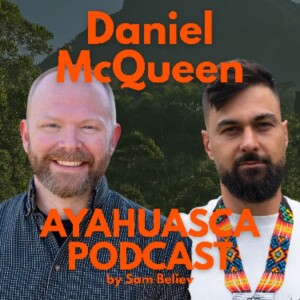
Most DMT experiences are famously brief. A person may enter an intense altered state, encounter vivid landscapes or apparent entities, and begin returning to ordinary consciousness before they have time to understand what is happening. Daniel McQueen believes extended-state DMT could change that.
In a conversation with Ayahuasca Podcast host Sam Believ, McQueen discusses DMTX, a method designed to maintain the DMT state through a controlled infusion. They explore entities, consciousness, cannabis-assisted psychedelic work, and psychedelics as tools for exploration.
What Is DMTX?
DMTX is short for extended-state or stable-state DMT. McQueen explains that the concept grew from work proposed by researcher Andrew Gallimore in collaboration with DMT researcher Rick Strassman.
Instead of smoking or vaping DMT, the approach uses an infusion pump to administer pure DMT into the bloodstream at a controlled rate. Because DMT acts and metabolizes rapidly, the infusion can be adjusted to maintain different levels of the experience.
According to McQueen, the dose can be increased, reduced, or stopped, allowing participants to return toward ordinary consciousness rapidly. This differs from smoked DMT, where the journey is intense but short.
Staying in the DMT State for Hours
McQueen says his group has facilitated around 30 extended-state DMT sessions. Some participants have remained in the experience for two or more hours, while one of his own sessions lasted about three hours.
The goal is not necessarily to remain at maximum intensity. Instead, facilitators can attempt to stabilize participants at different subjective levels. McQueen describes moving through experiences involving ancestors, entities, geometric forms, and more abstract states of unity.
He also emphasizes that the work remains preliminary. Individual responses differ, and even with precise dosing, he does not believe facilitators can fully control what someone will experience.
Encounters With Entities
One unusual aspect of the conversation concerns entities. McQueen says encounters with apparent beings are common in the DMTX sessions he has observed, although they do not occur for everyone.
Participants have reported human-like ancestors, animal or insect-like beings, serpents and dragons, geometric entities, Buddhas, and forms that seem completely unfamiliar. Others experience a presence without seeing a distinct being.
McQueen treats these encounters respectfully while acknowledging that he cannot prove what they are. He describes himself as having both a spiritual interpretation and a skeptical side. Whether the entities are independent beings, aspects of consciousness, archetypes, or something else remains an open question.
Can the DMT Realm Be Mapped?
Extended-state DMT introduces a fascinating possibility: instead of briefly glimpsing an altered state, could researchers eventually study different levels of it systematically?
McQueen says repeated sessions suggest that some themes and experiential spaces may be reproducible for an individual at similar dosing levels. He describes encountering ancestral imagery during two separate journeys at comparable levels.
That raises the possibility of combining controlled dosing with brain monitoring to investigate whether physiological states correspond with particular subjective experiences. McQueen describes much of this as theoretical and preliminary rather than established science.
Beyond Healing: Psychedelics as Exploration
For McQueen, healing is only one reason humans might work with psychedelics. He believes modern psychedelic culture’s focus on treatment can sometimes overlook curiosity and exploration.
He compares psychedelic exploration to earlier eras when people crossed oceans, climbed mountains, explored Antarctica, or looked toward space. Altered states, in his view, may represent another frontier for investigating consciousness and the nature of reality.
DMTX interests him because the experience can potentially be stabilized long enough for someone to orient themselves and examine it rather than simply being swept through it.
Cannabis as a Psychedelic Medicine
McQueen also discusses his long relationship with cannabis. Beginning around 2013, he started exploring whether cannabis could be used intentionally to produce psychedelic states rather than simply recreational effects.
His work eventually developed into cannabis-assisted psychedelic therapy. He describes using carefully structured sessions in his Boulder practice and approaching cannabis as a medicine and ceremonial ally.
He also acknowledges its potential for problematic use. Rather than treating cannabis as entirely good or bad, McQueen favors a harm-reduction approach based on intentionality, accountability, and understanding why someone is using it.
A New Frontier for Consciousness
The larger question behind DMTX remains unanswered: are these experiences generated within the brain, or do they provide access to something beyond ordinary consciousness?
McQueen does not claim to know. What excites him is investigating the question more carefully. Extended-state DMT may allow explorers and researchers to spend more time observing experiences that previously lasted only minutes.
For McQueen, that spirit of curiosity matters. Psychedelics may help people work through difficult experiences and change their lives, but they may also invite deeper questions about consciousness, spirituality, and reality itself. DMTX represents one experimental attempt to stay in that unknown territory long enough to look around.
Listen to the whole podcast episode here: https://open.spotify.com/episode/6XU1dkKvjBEGsGp05Z91Lm?si=yMgmwWxZQ9mL4l3ZV7Zjdg