
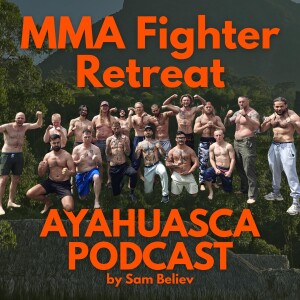
In this episode of Ayahuasca Podcast host Sam Believ (founder of http://www.lawayra.com) has a conversation with a group of MMA fighters, veterans, and researchers from the Athletes Journey Home Foundation. The episode features Ian McCall, Mark “The Shark” Irwin, Luke Jensen, and several fighters including Matthew Martin, Clinton Foche, Faith, Jared, and Fernando Marrero, sharing their stories of trauma, traumatic brain injuries, addiction, military service, and how ayahuasca may support healing and recovery.
We touch upon topics of
- 00:01–04:20 Vision of fighters drinking ayahuasca and creation of the MMA retreat
- 04:20–08:30 Ian McCall, Athletes Journey Home, and the purpose of the retreat
- 08:30–14:50 Mark Irwin’s psychedelic journey and fighting career
- 14:50–20:30 Ian’s experience with ayahuasca, ibogaine, and fighter healing
- 20:30–27:40 Group dynamics of fighters in ceremony and shared vulnerability
- 27:40–34:30 Luke Jensen’s neuroscience research and QEEG findings
- 34:30–44:10 Matthew Martin’s addiction, trauma, and ayahuasca experience
- 44:10–52:30 Clinton Foche’s traumatic brain injury and cognitive improvements
- 52:30–01:04:00 Faith’s military PTSD, feminine energy, and ayahuasca healing
- 01:04:00–01:14:20 Jared’s veteran journey, relationships, and inner transformation
- 01:14:20–01:27:30 Fernando Marrero’s life story, fighting career, and TBI recovery
If you would like to attend one of our Ayahuasca retreats go to http://www.lawayra.com
Find more about Athletes Journey Home at athletesjourneyhome.org and follow Ian McCall on social media.
Transcript
Sam Believ: You’re listening to ayahuasca podcast.com
Ayahuasca, LaWayra mis pasos Hi guys, and welcome to Ayahuasca Podcast. As always, with you the host, Sam Belyav. And today I have a very unique episode for you. So as opposed to our normal format where we have an interview with one person, this will be a collection of eight interviews pulled together.
Those are the interviews of the fighters that joined our Ayahuasca retreat for MMA fighters, as well as organizers and our scientific team. But first, let me tell you a story behind this event. So few years ago, I was drinking ayahuasca and I randomly saw a vision of Khabib Nurmagomedov and Conor McGregor coming to LaWayra and drinking ayahuasca, which for those who know the world of MMA a little bit is a very comedic vision.
They are both champions of UFC and they fought together and there was this bitter rivalry between them, and I thought for some reason in this ceremony that there is no better way for them to make peace. It was a very spontaneous kind of vision because I don’t really watch UFC that much. I’m not… I don’t really follow those kinds of things.
So it just came to me out of the blue. But as things happen sometime with ayahuasca, the meaning was not literal and now I can understand what that vision meant. Few months after that vision, I have stumbled upon Ian McCall. Ian is an ex-MMA champion and after finishing his career, he dedicated his life to bringing fighters and athletes to plant medicines to heal from trauma and also from traumatic brain injuries.
Few months after that vision, I stumbled upon him and I ended up interviewing him for the podcast. Then synchronistically, I stumbled upon him at MAPS conference where we had a booth, and he also had a booth only a few rows in front of us. There, once again, we spoke about this idea of making a retreat for MMA fighters only.
And after about eight months of planning and organizing, we finally pulled it off. And last week the event happened and now it’s over. At this event we had 12 MMA fighters, UFC fighters, bare-knuckle boxing fighters, boxers, wrestlers, jujitsu fighters. This group had a huge amount of world titles, Pan Am titles, national championship titles.
So a group of very talented and experienced fighters, all with traumatic brain injury and trauma. On top of that, we had two scientific teams, Onnit Sciences with whom Ian fully does his research, as well as Neuro Enlightenment, which is the team led by Luke Jensen who for last six months or so has been doing- QEG brain mapping and studies on effects of Ayahuasca on people’s brains here at LaWayra.
On top of that, we had Martha Busby, a world-renowned journalist in the psychedelic space who was writing an article about this event for Men’s Health, and Sam Lipman Stern, with whom we are working on a documentary about Ayahuasca, so we were documenting that as well. So it was a very action-packed retreat.
And honestly, there were lots of surprises. The first thing I remember thinking when we were organizing it is if you’re gonna get those 12 trained killers into the same space, there will be violence and aggression. On the contrary, it was one of the most open, most vulnerable retreats we’ve ever had.
Instead of having those huge egos and throwing their titles around or fighting each other, the fighters were all one cohesive group with a lot of support. Never in my life did I expect to see such strong men cry and be vulnerable, and I’ve seen a lot of vulnerability in this space, but this really surprised me, and the cohesion of the group was very special and unique.
A lot of people expect UFC fighters or MMA fighters to be rich and famous because that’s what they see when they’re on the peak of their career. But the reality is 99% of them have a moment of fame, and then they get discarded by society. They are the modern-day gladiators, where they sacrifice their health to entertain people for a shiny, bright second, and then they get cast into the shadows of being forgotten by the society.
With them, they take physical trauma, mental trauma- PTSD, and most importantly, traumatic brain injury, which leads to even more mental health issues down the line, addictions. A lot of them end up poor, broken, and living on the streets. So I’m very excited about the science that we have accumulated at this retreat to prove that Ayahuasca can be very helpful for those issues.
In this podcast, I’ll also have an interview with Luke Jensen to talk about the observations so far. So yes, guys, this is a very unusual episode packed with emotions, interesting stories. I hope you enjoy it. If you do, please let me know in comments to see if I should make episodes like this in the future.
This episode is sponsored by LaWayra Ayahuasca Retreat. At LaWayra, we combine affordability, accessibility, and authenticity. LaWayra, connect, heal, grow. Guys, I’m looking forward to hosting you. Enjoy the podcast. Hello, guys.
MMA fighters: Hey, how you doing, Sam?
Sam Believ: Who are you guys?
MMA fighters: My name is Mark “The Shark” Irwin. And I am Ian McCall.
Sam Believ: And how did you find yourself here in the Colombian Andean mountains in the cloud forest?
MMA fighters: We run the Athlete’s Journey Home Foundation. We are a non-profit scientific research group that was founded by Ian, who’s our CEO, and we provide psychedelic therapy to combat sports athletes who have suffered traumatic brain injuries over the course of their athletic careers, and we have a scientific team named Onnia Science that does data collection pre- and post-treatment, so that we can measure the effectiveness of these therapies and prove their medicinal and therapeutic benefits.
Sam Believ: Cool. And then who are you personally as a person?
MMA fighters: Why don’t you next? I am a former bare-knuckle boxing world champion and a three-time Hall of Fame Award winner, and I am now the COO of Athlete’s Journey Home. I’m Ian McCall. I’m a former mixed martial arts world champion and UFC superstar founder and CEO of Athlete’s Journey Home.
And I’ve been a pioneer within the psychedelic space for about a decade now, doing research and I guess all things psychedelic.
Sam Believ: Cool. So obviously we’re here to give ayahuasca to about, what? 12 fighters- … and then measure their brains before and after, work on both their mental health and also traumatic brain injuries.
This is g- just gonna be a short one because I have both of you on the podcast, and we have a full one-hour episode. So guys, check it out. It’s probably about, Mark, maybe 15 episodes back, and Ian maybe 50 or 60 episodes back. Wow. It’s been a while ago. But yeah y- just in short, y- your own journey with traumatic brain injury and psychedelics.
MMA fighters: I was a prodigy in fighting. I started martial arts at four years old, so I’ve been getting punched ever since, and I also had a traumatic brain injury in high school snowboarding where I was in the hospital for a couple days. I had a, a accidental drug overdose where I was on the operating table for 24 hours.
They told my brother I wasn’t gonna make it. So a, a lot of brain damage. Probably about I’d say five times that I was kinda knocked out in training. Maybe not really severe. I’ve never been put out cold, but the amount of concussions I’ve had is definitely in the hundreds. Yeah, I have a lot of brain damage, or I should say I had a lot of brain damage, and through this work I’ve been able to reverse course and not get something like an early onset dementia diagnoses, and then no more depression or anxiety or addictions.
All the things that plague people with TBI those are now gone.
Sam Believ: I think now not only you are not d- don’t have dementia, you seem to be pretty, pretty in a good shape. Yeah. And the way you speak and obviously not only helping yourself, but also the fighters. What about you, Mark?
MMA fighters: So I started boxing in my early 20s in USA Boxing’s amateur program.
I won a couple of state championships in California, and over the result of my amateur boxing career, I had countless concussions in my fights and in the training room. I had read that psilocybin mushrooms were good for traumatic brain injury recovery, so I started microdosing, which is actually what gave me the inspiration to turn professional.
I fought all of my professional fights under the influence of magic mushrooms. I started taking microdoses in my professional boxing fights in Tijuana. When I started competing in bare-knuckle boxing, I started taking much larger doses. I had the Knockout of the Year award in 2022 on five grams of mushrooms.
I had the, I won the world title on seven and a half grams of mushrooms in 2023. Ian was on my co- in my corner on five grams, and I had the Fight of the Year award winner on seven grams of mushrooms in 2023 as well. I was able to use psychedelics to achieve great thring- things in sport. However, I also incurred a lot of traumatic brain injuries along the way, and that’s what prompted me to get more involved with the research that Ian’s doing.
I used my last world title fight to advocate for the nonprofit and raise the money that we needed for our first research project, where we took eight athletes to Portland, Oregon, where we all underwent psilocybin therapy to help heal our traumatic brain injuries. And we have put on several retreats since then, and we have several more planned for this year, which I’m really excited about.
Sam Believ: Mark it was your first time with Ayahuasca, right?
MMA fighters: Correct.
Sam Believ: How is it so far? How are you feeling, and would you fight on Ayahuasca?
MMA fighters: I definitely would not fight on Ayahuasca. I think that would be very counterintuitive. But I must say that the medicine has been truly beautiful, as has this entire experience been as well.
It has completely reset my entire central nervous system. It’s helped me find a profound sense of love, sympathy, and empathy for myself, my brothers here at the retreat, and- hu-humankind as a whole. I would say that it has significantly altered who I am as a person to my very core, and I really can’t say enough positive things about this medicine, about the LaWayra Retreat Center, and I can’t thank you enough for everything that you’ve done for myself and Athletes Journey Home.
Sam Believ: My pleasure, Mark. What about you, Ian, huh? Obviously that’s not a first time for you. How is Colombia and Ayahuasca treating you, and how is your process going?
MMA fighters: Colombian Ayahuasca is enlightening. On a whole different level. I’m used to Shipibo shamanism or American, Native American shamanism, and maybe even some, some Central and Eastern, like European shamanism.
The, the music in it is magical. The band you have set up here is so good. It is joy- Child
Sam Believ: labor.
MMA fighters: And also you yourself, Sam, are an, an incredible artist. I can’t speak highly enough about that. The team you have here is beautiful inside and out. Everyone is so well put together, keeping us in check.
Having a bunch of strong savage fighters running around and talking too much and touching each other like everyone was like, “Hey, no, no more. Stop.” “Get your shit together,” it was very… That’s what we need. We need to be bossed around a little bit- … and to be kept in check because w- we will get out of control a little bit i- in a playful manner.
The medicine itself was extremely purging. You always purge on Ayahuasca, at least I do, but the amount of purging that happened and release that I found through that, the medicine maybe wasn’t as outer body experience-wise, but I think maybe I’ve done that enough already in my- my psychedelic, journey and career is whatever you wanna call it. But for here it was extremely introspective, and it was very… I was very pliable, and I was ba- able to work within the space very easily. Instead of just being blasted off, it was like, okay, these are the steps I go through to, to accomplish what I’m looking to achieve through this, and it was really beautiful.
Sam Believ: Thank you, and thank you for mentioning the music. And when I said childhood labor, what I meant is a joke because Fernando recently started to bring his kids into the ceremony, and one of them plays guitar beautifully. He only started- Really … recently
MMA fighters: I think a year ago
Sam Believ: or something.
MMA fighters: They- That’s wild …
Sam Believ: they’re all very talented. And his even younger kid what, he’s 12, 11 years old?
MMA fighters: At, at most.
Sam Believ: He plays the drums, but it’s, they’re enjoying it. It’s not labor.
MMA fighters: That was a big part of it, to see the family unit. Not just the boy band you guys have set up, of like multiple people playing.
To see the f- the family of men, of young men to father playing together and you can tell cracking a joke and sharing a drink it added an element of love to Ayahuasca that you don’t see from other shamanistic cultures. It’s just that’s void. Sure, you feel love through the spirit, but to see that on stage in front of us was it was just, it was really special.
Sam Believ: Yeah. My kids are also here. They’re too young now, but I’m hoping Adrian will be In, on the maracas sometimes,
MMA fighters: You have such good looking children, by the way. They’re so sweet and so pretty.
Thank you. Very nice. They
Sam Believ: have good looking parents,
MMA fighters: that’s why.
Sam Believ: Question to both of you how do you, how are you liking this dynamic of 12, savages, as you say, drinking Ayahuasca, sharing vulnerably? I’m personally enjoying it a lot, so I don’t know if you have, wanna share about this.
MMA fighters: This is my dream. This is how I create an army of people to push this message of healing, and it’s, obviously not just Ayahuasca. There’s mushrooms and ibogaine and all the other things, but specifically here, the way Ayahuasca has an… has… gives us the opportunity to bond like this is unlike other medicines.
Truly. And to have a group… we’ve got a handful of black belts here really dangerous folks- world champions … that are here. World champions, multiple. That just shows you the level of curiosity and the level of power this has and draw that it has to people- … that I’ve dreamt of for years now.
I’ve been… I brought this to the UFC, or at least mushrooms to the UFC in 2019. And then I was on HBO in 2020, and then brought another study to the UFC in 2021 or 2022 with the University of Miami. And it all fell through. It all didn’t happen, but at least I got the attention of people.
But now I have the army I’m looking for, and, this is patient one. I’m patient zero. This is patient one, Yeah, I think this is really the vision that we had all along, right? Is to bring fighters together and to help them heal, because we as a community are very severely afflicted by the work that we do, and there really is no, treatment course for us.
There’s nobody helping us. Nobody’s doing anything to help us recover from the injuries that we incur while on the job, right? We lay our lives on the line every time we step in there, and we significantly shorten our lives every time we step in there for, obviously for blood money, but also for the love and the adoration of the crowd, and to entertain the fans.
But when it’s all said and done and the lights go off, we’re left alone in the dark, and it’s a scary place to be. And so to be able to provide these type of medicines and to be able to help people… ian and I have seen firsthand, in real time, medical miracles, things that some of the best doctors in the world said was physically impossible.
We’ve been able to reverse symptoms of Parkinson’s, CTE, depression, suicidal ideation, and a host of other ailments through these treatments in only a few ceremonies, and we have several more planned for this year. So this is only gonna continue to grow and build, and we couldn’t be more excited, because the future is bright.
Sam Believ: So Ian the Parkinson’s patient, I think it’s a really cool story, and obviously he did Iboga treatment. And you said, Iboga healed your body or your head, and then the Ayahuasca healed your soul. Can you talk to us about that?
MMA fighters: Yeah. Ibogaine… I work at Beyond in Cancun, Mexico and- I felt it’s like smoothing out my brain.
It’s very grounding. It, that it’s not yeah, you’re shot into space, sort of trip. It’s a- Literally … literally, but it’s… you’re disassociated from it like ketamine- … because it hits the NMDA receptors, and it pulls you back a bit where you can view this from an out-of-body sort of thing, but not in a bubble.
Ayahuasca has you in this crazy bubble of the trip, where you’re just in it. Where ibogaine, you’re not, and it, you, it sits you down like a grandfather and it teaches you this is how you psychologically dog walk your problems and yourself through these situations.
And it was able to heal my brain. It was able to heal my addiction te- my addictive tendencies. My… I’ve had addiction my whole life, and, That’s crazy … but comparative to ayahuasca it didn’t do much for my soul. Emotionally, when I do ibogaine, there’s no emotion to it at all.
I just get to watch. I get to view it and go, “Okay.” It makes it… It’s a pretty simple trip. It’s long and arduous. I don’t… The body high, I’m starting to kinda get used to, but with ayahuasca, you, you have this more physical, emotional sensations and you you b- feel them on a level that is that is outside of any psychedelic.
Mushrooms touches on it a bit, and maybe not as intense as this. But the fighter spirit, the, the warrior spirit is very much healed and brought to peace. Or, a lot of ancient cultures, especially in the Amazon, when they would go, have, have tribal conflict, they weren’t allowed to come back into the tribal space until they sat with a shaman and healed, and that really resonates with me.
I think that post-career, the amount of people that are lining up for this is big, so we can bring these people home. We can let them heal that spirit, that soul, those emotions, and and find a new path in life, because that’s a big thing after you’re done what’s next?
What’s my purpose? So ayahuasca definitely gives you that.
Sam Believ: It’s beautiful, and it’s beautiful how we have different medicines and different traditions, and we can take the best from all of them and kinda create a protocol that can help a lot of people. And I know you guys do microdosing, hyperbaric chamber, and also supplementation.
All of it works and comes together. And we had a couple conversations. You like LaWayra and the format, and it seems to be very suitable for this audience as well. So what are you what are your thoughts on that?
MMA fighters: Taking people deep into the Peruvian jungles is just a lot to ask, and it’s scary.
A lot of people are very turned off by it. “Why would I wanna do that?” When you mention Colombia, you mention Medellín, it’s a very attractive place to a lot of people, for a lot of different reasons, obviously. But it’s just more accessible. And it’s … you always say it’s like ayahuasca for beginners, but I’m not a beginner, and it taught me amazing things.
I loved the process. And it’s it’s a little more playful, even though, we’re not allowed to talk, but there’s a fire. There’s just more elements to it. Th- being able to go sit by the stage and the kinda having a few different places to go, ’cause, with, with, let’s say like a Shipibo shaman, you’re stuck on your mat, and you don’t move.
There’s no interaction, besides someone blowing, agua de flora on you. There’s really nothing, so I think that this is, … It’s more palatable for a lot more people. What do you think? No. Yeah. I think what you’ve done here is really wonderful. The center is very beautiful and healing on so many levels, not just because of the medicine, but because of the entire experience.
It’s a very holistic approach that you guys here that includes not just the ayahuasca, but there’s yoga, there’s healthy food, right? We’re doing activities every single day as a group. We’re doing word circles, where we’re able to sit down and discuss- We have a gym … We have a gym that we’re in right now.
We’re in the gym right now. So there’s- It’s unheard of. You don’t do that when you’re somewhere else, Joe. Yeah. Yeah. So it’s a very healthy approach all around, physically, mentally, emotionally, spiritually, nutritionally, right? You guys really cover all, all aspects of it and check all the boxes, and it’s made it just one of the best weeks of my life, sincerely.
Sam Believ: Thank you so much. I’m glad you enjoyed it. I li- I like this project a lot. I, as, as I told Ian and you guys before, it all came from a weird psychedelic vision that I had randomly. I don’t watch UFC. I don’t know why. I just, in a ceremony, I was like Conor McGregor and Khabib Nurmagomedov should drink Ayahuasca so they can make peace.”
It’s obvious, right? Yeah. And then I met you randomly, and then I interviewed you, met again Maps, and now we’re all here. I know it’s not the last one. So both fighters and everyone with a brain injury, athletes, I think, So y- it’s like we obviously, we have people here that drink Ayahuasca 20, 20 times, 100 times.
We have people who drink Ayahuasca 15, 20 years. They all still love it. But I am trying to create an experience that is accessible for the first-timers, just so it’s less things that are scary. And I think for for athletes and specialists you wanna stay in shape, so you need a gym.
You wanna eat good food. You can’t just go full dieta for a month and lose your shape. It’s just not doable. So I think I think it’s a good match, and I’m really looking forward to bring more fighters. And I enjoyed myself. I wrestled today and hurt my back a little bit.
And you did a good job. We arm wrestled and, So it’s very cool. I like it.
MMA fighters: Yeah. Your entire staff works out with us.
Sam Believ: Yeah.
MMA fighters: Everyone comes and, we get a bunch of savages in here, and they’re pushing weight around. They’re ki- everyone does jujitsu. Everyone’s hitting the bag.
It’s like it… This is the exact sort of place that we need. O- outside of having mats and a bag space this is amazing. This is this is exactly what you want. Because, like you said, when you go through a strict diet and your body starts to deplete, as high-performing athletes we are so regimented through the process.
And it’s… and we have more than just fighters now. We’ve got, the gymnasts and we’ve got dancers, and we’ve got race car drivers and surfers and, and- Bobsled champions … bobsley- bobsled Olympic champions. From all over the planet, and these people don’t wanna degrade just to go do a ceremony.
They wanna build themselves healthier and bigger and faster and stronger through this medicine.
Sam Believ: Even my shaman works out, and I taught him arm wrestling. I beat him, though. He’s spir- he’s spiritually stronger, but physically I still got it. Cool. It was a hella fun experience. We’re looking forward for t- tomorrow’s day ceremony.
We’re not in the end yet. And yeah. Thank you guys for coming here, trusting us. Lots of fun. Thank you very much. Hi.
MMA fighters: Hello.
Sam Believ: What’s
MMA fighters: your name? My name’s Luke Jensen.
Sam Believ: Luke, tell us and… about yourself in 30 seconds.
MMA fighters: Marine Corps veteran. Tried Ayahuasca 10 years ago, and now I’m doing neuroscience research at LaWayra.
Sam Believ: Okay, so you’ve been a part of the, the last retreat that we’ve done for the MMA fighters, and obviously you were one of the scientific teams. Tell us about it. First of all, you drank all four ceremonies as well. Let’s talk about your own experience. How was it for you?
MMA fighters: It was really fun to drop in.
Maybe fun’s not the right word. I really enjoyed dropping in with such serious people. There is actually fun with Ayahuasca, and there’s seriousness as well, and all of them were really committed to their healing, which I was a little surprised about. Maybe unjustly, ’cause you think of fighters, you think of lots of egos, but they’re all very serious people, and just being in that community was very powerful.
I enjoyed the group dynamic immensely, and I think that they’re all gonna do a lot of good in the world, and wanna promote the plant medicines, because they had such powerful experiences.
Sam Believ: What about your own personal experience?
MMA fighters: The first night wasn’t very visionary for me, but it was very insightful.
It was very energetically cleansing, and after that first night … I don’t, I didn’t go to sleep at all that first night. I took a full cup, and it really affected me. I was kinda surprised. And-
Yeah, I really came into … Sometimes it’s not even mental. Sometimes it just feels different. Energetically, I felt lighter, and I felt my nervous system much, much more calm. I haven’t felt in a while, which I really greatly appreciated, ’cause it’s sometimes tough for me. And I think that shows you how Ayahuasca can help with PTSD, because it can directly calm down the nervous system.
And the next three ceremonies, since my first ceremony took so long, I took smaller cups. But each of them was very energetically cleansing more than anything. One ceremony, I think the last one, I was by the fire the whole time, just staring into a sacred fire, which was very powerful. I really enjoyed that, and just was one with the universe.
Sam Believ: So you reviewed the brain scans of the … Sorry, not brain scans, QEG brain maps of the fighters before and after. What have you found so far? What are the results after one week? Just tell us what are your observations?
MMA fighters: Our observations are that Ayahuasca’s really profoundly helps the brain, or regulates the brain is the term that we use, within a very short time.
So how we look at the brain is we look at the energy signature of the brain, the brainwaves. And by studying this, we can see where the brain’s, what we call, dysregulated, and it can be dysregulated in many different ways. Sometimes it’s a brain that moves too fast and it’s too busy, always thinking, never resting.
Sometimes the brain’s worn out, power levels are low. But what it seems what people are dealing with, it seems to help. Additionally- Ayahuasca seems to profoundly help head trauma in certain cases. We had one fighter with a lot of head trauma, high inflammatory pattern, and that was reduced significantly after just a week of ayahuasca, which is really a amazing finding.
Sam Believ: So obviously, and apart from the MMA retreat how many brain maps have you accumulated already just being here at LaWayra for the last, what, six months?
MMA fighters: No, I think LaWayra, we’ve dramatically increased our database of pre and post-ayahuasca QEEG brain maps, and I think probably around 250, maybe 300 brain maps.
I’d have to count them to see, but …
Sam Believ: Any preliminary findings? Any conclusions you can …
MMA fighters: that’s a good question. I really wanna go through the data and analyze it, and probably have to go through my mentor and maybe use some of his data systems. But we’re finding … A lot of things we’ve found that we’ve found before, now it’s getting confirmed, and I think the finding is that trauma stores itself in the brain.
So just like emotional trauma, the famous book, The Body Keeps the Score, the brain keeps the score, so trauma’s held in the brain. Ayahuasca helps release it. So I really think this is gonna change how we understand healing, and ayahuasca is gonna give us a whole new insight possibly into recovery from emotional trauma and PTSD and, maybe physical trauma like head trauma as well.
So it’s a very interesting time, I think.
Sam Believ: Thank you, Luke. Yeah. I’m looking forward for that science to come out. I’m glad to be part of it.
MMA fighters: Yeah. Thank you. Thanks for having me here. So my name is Matthew Martin. I’m from England, and I’m here on an Ayahuasca retreat. Tell us a little bit about yourself.
So I’m a professional bare-knuckle fighter. I come from the north of England. I’m over here at the moment with Athletes Journey Home doing an Ayahuasca retreat, hoping to heal some brain injury and traumatic experiences from childhood.
Sam Believ: Nice. You showed me some photos and there’s a video of you where…
and you can see your teeth being knocked out. Like, how did you get, how did you get into that kind of stuff?
MMA fighters: So I’m an ex-heroin and crack addict. I’ve been sober for three years today. I don’t drink, and I needed something to pour my energy into. So for years I’ve been fighting. For years I’ve been going through different stuff.
When I got off drugs, I needed something to focus my energy into, and fighting seemed like a good way to get into that. I tried glove boxing, didn’t excite me as much as the bare knuckle did, so I got into bare knuckle, and that’s where I’ve really found I’ve got a passion for.
Sam Believ: Yeah. Obviously you had pretty traumatic childhood that brought you into addiction.
I don’t know if you wanna tell us a little bit about that.
MMA fighters: Yeah. So when I was a child, I was sexually abused by a family friend for a few years. This resulted in me becoming a heroin addict from the age as a 12 year old till I was about 26, 27. So I’ve spent more of my life on heroin and crack than I have off it.
And when I got sober, I decided I needed to do some healing, and that’s why we’re on this retreat now to try and bring my brain back to what it was and progress on the spiritual journey that I’m on.
Sam Believ: Obviously you got quite far already, even before Ayahuasca, right? So how has it been so far?
You’ve been in for four days now. You’ve done three ceremonies. Talk to us about your experience. So
MMA fighters: for me, it’s been the most spiritually enlightening experience I’ve ever had in my life. Obviously we’re here with a really good group of people as well, so it’s made it easy to feel like part of the community, settle in quite nicely, and we’ve all got stuff in common.
So I suppose that for me was a nice little bit of an ease into it. The first ceremony absolutely blew me away, like in terms of it was more than what I expected. It was everything that I needed and honestly can’t thank the retreat enough for like being able to go through that process. So my first Ayahuasca experience was I had two cups.
And recently my missus missus and me have had a miscarriage. I got to meet my child and speak to him, and he told me that he was safe in heaven, it just wasn’t his time to be on earth, and to let his mum know that he was all right. And I got to speak to God, and he told me what my purpose was in life that he’s seen me pain, he’s seen how much I’ve been crying over my life, all the trials and tribulations I’ve been through, and he assured me that the war was over.
So for me, I think that was quite a grounding experience. Mind-blowing, and for some parts of it, very mind-bending, and I didn’t think I was gonna get through it, but a truly phenomenal, magical experience for me.
Sam Believ: That’s very beautiful. Thank you for sharing. And some people that are addicted, like AA programs for example, they kinda see everything as a drug and some of them will be like, “Yeah you shouldn’t do Ayahuasca because it’s it’s a drug,” and stuff like that.
What would you like tell those kinds of people?
MMA fighters: So this is… this exact conversation I had with someone before I come away. They were like you’ve been sober for so long, Matthew. Are you sure you wanna go and do this?” I said if I seen it as a drug, then I wouldn’t. But I don’t. I see it as a medicine.”
Like this medicine’s been around thousands of years and people are happy to stick paracetamol, codeine, ibuprofen in their body and they’re all manmade. This is natural, from the earth, God-given. And for me, people… If people have been using it for thousands of years and using it as a medicine, then why not still continue like that?
If it’s got the healing and it’s got the foundations of what it actually has, then we should be pushing this out there and telling people this is gonna save lives, it’s gonna heal brains, it’s gonna heal trauma. It gives people a really good foundation to be able to build upon. And you can go away and learn a lot about yourself, and I think if people see this as a drug, they’re very confused about what it actually is.
Sam Believ: Yeah. So yeah, I totally agree with that. It’s been a medicine for thousands of years. It’s only been called a drug for a couple decades. So obviously you’re going back home and two days after you arrive you have a fight. Yeah. Some people are really, afraid “Oh, I’m gonna drink Ayahuasca and it’s- I’m just gonna be so peaceful, I won’t be able to fight.”
On, on the other hand there is traditions where they would engage with Ayahuasca and then go to war. So how do you feel? Do you reckon you still got it?
MMA fighters: So I’m a big overthinker, and sometimes when I’m fighting, I can think about throwing a shot, and before I’ve thought about it I’ve took two or three shots to the face.
What I’ve learned with my experience with Ayahuasca at the moment is it’s slowed my brain down enough to be able to triangulate my thoughts- … which has given me a sense of peace in my head. So I’m hoping that transitions over to the boxing. I maybe don’t overthink as much then, and I can just get stuck in and- and really really just go into a flow state.
Sam Believ: Being in the moment-
MMA fighters: Yeah … both, both in life and in a fight … living in the present moment and- Yeah … and not overthinking what I’m about to do and just doing it.
Sam Believ: Nice. And I know you don’t only just fight and you work on yourself, you’re also, you speak and you go to podcasts and you talk to people in prison.
So what’s your message, if any? So
MMA fighters: my message is if anyone’s thinking about healing, to come on a retreat like this. And really sometimes you’ve gotta step out your comfort zone. Life and growth comes from uncomfort. So a lot of people, as human beings, we live in our comfort zones and we’re scared to try new things because we worry, and I think to step out your comfort zone really initiates growth, and an experience like this can really help move people forward.
So I think some people live in the past and they get these ideas and ideologies about things because we hear it in the news. We hear bad things. But really all it is propaganda. And I think if you are truly serious about healing yourself, come and experience something like this. Come and experience Mother Nature’s medicine.
Because what can be more surreal than that, man? Yeah. It’s from Mother Nature to heal you and to heal us, and I think everyone who has those sort of brain injuries or post-traumatic stress disorder and things like that, like this, this is a really healing process, and I’m feeling myself even after three ceremonies better than I’ve ever felt in my life.
So I’d recommend this massively to anyone. I also think for people on a spiritual level as well, man, like if you’re wanting to connect more, more on a spiritual level towards God or towards whatever you believe in, this is a great experience to be able to do that and look past yourself and be able to look from a different perspective and get the message.
Get spiritual message, man.
Sam Believ: Yeah. Start from healing and then get spiritually inspired as well. Just before we wrap up I’m g- I wanna zoom in on your ear.
MMA fighters: Yeah.
Sam Believ: I’ve never seen this before in my life. For those watching on video, he only has a little piece of your- his earlobe left. What happened there?
MMA fighters: So I got in a street fight a few years ago with one of my mates, and he grabbed my head, screamed that he loved me, and then bit my earlobe off, man, and spat it in my face.
Sam Believ: Yeah.
MMA fighters: And now I’m earlobe-less.
Sam Believ: He lo- he loved you so much that he wanted a piece of it.
MMA fighters: Yeah, he wanted a piece of me forever.
Sam Believ: I think I think they call it cute aggression, when you like something so much you squeeze it.
So that’s taken to extreme. I think
MMA fighters: that could be it, yeah.
Sam Believ: Matthew thank you for sharing. Thank you for trusting us with your experience. I think it’s all really cool, and I love your message. And let’s hope it spreads and we get less violence and more love.
MMA fighters: Yeah, definitely. And can I thank you as well for having us on this retreat, mate?
It’s been honestly the most phenomenal experience of my life. I’d recommend it to anyone, and I think anyone thinking about it, just bite the bullet and do it, man. What’s your name? Clinton Faucher. Clinton, how did you find yourself here? Crazy story. Crazy story. I had a traumatic brain injury from a car wreck about five years ago.
I probably have had concussions before but never diagnosed. I’ve been rocked or whatever. And I started going down this path of waking up and not knowing where I was. I call it my brain glitching out, where I would forget conversations and stuff like that. And I ended up coming to Mark after I got a scan done that showed that I had a traumatic brain injury, and I was desperate.
And I met him, I’ll never forget, at a restaurant at Huntington Beach. And as soon as he sat down, I broke down and started crying and asked him for help. And I started microdosing and it started helping, but we felt like I needed something different. And I was in a desperate mindset, to be h- honest, of whatever I could get or whatever I needed to try to get some sort of normalcy back in my life, I was willing to do.
And so they told me about this trip, and it’s been game-changing for me. So tell us
Sam Believ: before the microdosing, before psychedelics, before all the other stuff that you did what were the symptoms you were experiencing of that really bad traumatic brain injury?
MMA fighters: I… One time, I’ll just give you for instances, one time I was driving my daughter to school that was 15 minutes away, and she said, “Dad, I, I don’t think this is the way to my school.”
And I was 45 minutes up the f- the five freeway. I literally had no concept of what was going on. My brain would glitch out and I wouldn’t know what was going on. I started missing meetings with work. It affected my business. I had to hire a personal assistant that basically ran the business. I was just the face and the personality.
I was waking up and didn’t know where I was. N- not just confused, but had no idea. I had to set my alarms to say, “Hey, you’re at home and you’re okay.” I had to put sticky notes around my house just so that I could remember throughout the day of what was going on. I missed meetings for my kids’ school.
I literally was in a pure chaos state of mind
Sam Believ: It reminds me of this mo- movie Memento where, I don’t remember, but he had to have notes to remember who he was. Yeah. When, Or 50 First Dates. Have you seen
MMA fighters: that movie? Yes. So that was exactly- Yeah … that was exactly… And when, the other day when I was kinda confused, when Mark woke me up, and that’s when I told him when back in the day, I was waking up like that every day, where I was confused.
I didn’t know what was going on.
Sam Believ: How are the improvements so far? What are you observing with your condition?
MMA fighters: I feel and I’m a straight shooter, so I’m gonna say how it really is. I can tell the difference between my cognitive, and it’s only been three, four days. But I can tell that it’s similar to, like, where a battery if you take the post on a battery, and you put it up against it, it’ll kinda spark, but it won’t fire off.
And I feel like with Ayahuasca, the, the psychedelics, the microdosing was helping, but I feel like Ayahuasca gave it that energy boost of actually firing off and my brain being more calibrated, being able to know what’s going on around me, and being able to cognitively remember things better.
Sam Believ: Yeah. Knowing what you went through, and obviously Ayahuasca’s not a walk in the park, would you recommend it to other people in your jujitsu gym or fighters?
MMA fighters: I, 100%. I think one of the things is, like with anything, there’s these preconceptions, and there’s these assumptions. When I first did the research, I was like, “What the hell am I getting into?”
But being here, I can’t speak for other places, but I can speak for LaWayra. The staff- You, everybody that’s here made it so comfortable to come in that the Ayahuasca side of it, everybody keeps saying that it’s hard, and for me, it’s not that it’s been hard because I have trust in you guys, in knowing that you’re gonna guide me to helping me be able to heal.
And that for me is the ultimate goal. So I would, not just people in my jujitsu gym, but anybody who has had a brain injury, anybody who is
going through unprocessed, got PTSD besides the TBI, so they say I’m a unicorn in that sense.
Sam Believ: Yeah.
MMA fighters: Anybody that would ha- that has PTSD unprocessed traumas, or a TBI, I would highly suggest they come.
Sam Believ: Thank you, and thank you for trusting us, with your process. How do you feel being in this group of fighters and everyone like being vulnerable and open?
How does it feel for you? The, is it comfortable, the environment?
MMA fighters: I think you guys, again, not to reiterate, but I think you guys made it so comfortable, and I think this group of guys I think we’ve all seen so many dark days, and we’ve always had to be fighters in the sense of fighting and in life that I think all of our souls were just tired.
And I felt like that we all were in a common ground of, there was no ego. You’ve got multiple world champions. You’ve got multiple Pan Am champions in multiple different martial arts. You haven’t heard one time anybody talk about them being a world champion. You haven’t heard anybody talk about how great they are.
It’s all been people that say, “Hey, I have problems and I need help.” Yeah. And that for me has made this group so loving and caring, and made it even more easier to go along with the tough things that you have to face.
Sam Believ: Thank you, Clinton. Thank you for sharing and yeah, hope I’ll see you again. I know you’re loving Medellín, so I guess we’ll see you more often.
MMA fighters: You would definitely see me more often. Next time we’re getting you on the jujitsu mat.
Sam Believ: Yeah. Let’s do that. I wr- I wrestled today in the grass. It was
MMA fighters: fun. Now my back hurts. Yeah, like I need some proper training. Yeah.
Sam Believ: Take it easy. Cheers, Clinton.
MMA fighters: Thank you, brother.
Sam Believ: This episode is sponsored by LaWayra Ayahuasca Retreat.
Most of LaWayra if you’ve been listening to this podcast for a while. Some of you might have already been to LaWayra before. For those who don’t know us yet, we started LaWayra four years ago. At LaWayra we combine authenticity, accessibility, and affordability. LaWayra is currently highest rated Ayahuasca retreat in South America with more than 700 five-star reviews and an average rating of five stars.
If you come to LaWayra, you’ll experience powerful, authentic ceremonies led by our indigenous shaman, Fernando, in a very beautiful venue just one hour south of Medellín, Colombia. We’re surrounded by nature and have comforts like hot water, Wi-Fi. At LaWayra, our team has guided more than 2,500 people through this life-changing transformation of Ayahuasca experience.
At the same time, we keep it very affordable, so whether you’re coming for healing, clarity, or a deeper connection to yourself, LaWayra is the best choice. If it is your first time drinking Ayahuasca, you will love our three and a half hour preparation course and integration support. All of that is included in price as well as pickup from Medellín, accommodation, and Ayahuasca.
Visit lawayra.com to book your retreat or learn more. LaWayra, connect, heal, grow. L-A-W-A-Y-R-A.com. Hi, what’s your name?
MMA fighters: Faith.
Sam Believ: So you’ve been here for now for three ceremonies, right?
And you’re part of our MMA fighter retreat.
MMA fighters: Yes.
Sam Believ: When I first saw you I would never tell you’re a fighter.
MMA fighters: Yeah, I get that a lot.
Sam Believ: You’re, You have a sleeper build.
MMA fighters: A sleeper build?
Sam Believ: Yeah.
MMA fighters: What’s that? Like-
Sam Believ: It’s like people on internet they, they’re like super fit, but unless they’re flexed-
MMA fighters: Oh …
Sam Believ: then also you can’t see it. Yeah. Yeah. So you don’t look like a… You don’t look like you’re… your face is not super beat up and stuff like that,
MMA fighters: yeah.
Sam Believ: But you have a really cool story and you’ve been fighting for a long time. You’ve been knocked out. So- … first tell us about what got you into fighting.
MMA fighters: First got me into fighting is, so I used to be a bodybuilder, and then I walked into a UFC gym one day and took a kickboxing class, and it just started from there, and it helped me get a lot of energy out from trauma.
Sam Believ: And trauma, mostly PTSD from military, or do you think there was something before?
MMA fighters: I would say y- childhood trauma f- first, and then military trauma. I was a firefighter, so I w- I started off being a volunteer firefighter with my military unit. We would be the firefighters out in town in Maryland.
In that region it was only volunteer firefighters-
…
MMA fighters: Running all the fires, and so you see a lot of death, and car accidents, and fires like that. And then I went on deployment. We had a plane crash, and we lost some people, some aircraft fires, and then I got out and became a wildland firefighter, so it’s just a lot of cumulative trauma,
Sam Believ: and obviously, like this retreat, we have all male fi- fighters, and you’re the only woman fighter, right?
MMA fighters: Yes.
Sam Believ: And firefighting and military- … those are not traditionally w- what women do, so it’s w- what do you think what’s pulling you towards those kinds of risky, dangerous environments?
MMA fighters: I think it’s a combination. I do think I do have a lot of masculine energy- … but lately I’ve been getting into my feminine energy and balancing it. I think it’s very beautiful. Both are beautiful.
But also, childhood is in my family, masculine was more important.
Nobody really cared about the feminine. So I wanted, as the oldest daughter of six, I wanted to prove t- that I was worthy, and so from there, I just kept doing the most shocking things that I could think of to- … gain their approval, and so it’s not like- A good reason to do things.
But I’ve built up skills as a fighter, and now I enjoy it, and now I can’t just stop,
but I’ve been able to uncover a lot of that and realize why I started doing those certain things.
Sam Believ: And by their approval, who do you mean? Your parents?
MMA fighters: Yeah. My parents, yeah.
Sam Believ: Your mom or your dad more?
More who of them two?
MMA fighters: More so my dad, but honestly, yeah, my mom. She has a lot of internalized self-hatred of her feminine, I can tell, so it’s honestly both.
Sam Believ: That’s very interesting. I had, During the ceremony yesterday, which we shouldn’t have, but I did have a very low voice conversation with Ian.
It was… The energy was such.
And then he was talking about training with Mike Tyson. I was like, “It’d be lovely to bring Mike Tyson to LaWayra because then my dad would be proud of this.”
MMA fighters: Oh.
Sam Believ: He’s he doesn’t understand really what I do and how impressive it is.
MMA fighters: Yeah. He just
Sam Believ: doesn’t get it.
But if I could get this guy, ’cause, like-
…
Sam Believ: We only had two posters in my home ever. And one of them was of Mike Tyson.
MMA fighters: Oh, wow.
Sam Believ: And the other one was of Evander Holyfield. Yeah. He’s a big fan of boxing, yeah. But yeah, it’s like no matter how I… We barely talk and, we have a better relationship now and I worked a lot of it with the medicine.
But it’s like still there is this part of me which is “Oh, it would be nice to impress my dad.”
MMA fighters: Yeah.
Sam Believ: So it’s real interesting. That’s why I thought there this way. But obviously Ayahuasca is a feminine spirit. How has it been in your journey with connecting more to your feminine?
MMA fighters: Yeah. It’s helped a lot. I’ve had past ceremonies that have helped me work through that. I’ve had a ceremony where I connected with all my femininity, and after that I started wearing pink, and you’re not feminine because you wear pink, but my family, everybody made fun of anything feminine.
So I wouldn’t touch that color, just little things like that. And then I feel like it’s still a journey that I’m on of walking in confidence as a woman- … and not having to act like a man, to gain the approval.
Sam Believ: Yeah. It’s very interesting how we can get conditioned.
And it happens a lot, like, ’cause obviously we’ve… All, all men and women, we all have masculine and feminine. And it happens a lot with guys “Don’t cry,”
MMA fighters: yeah.
Sam Believ: And then for me, it took a long time drinking Ayahuasca, like, opening my… Feeling my emotions and crying again. So it’s and it happens with with the women as well, it’s where they’ve been s- get pushed in a- Sort of roles that maybe are not optimal or not balanced. So you you had PTSD from military, from firefighting. And then you got into Ayahuasca. How has your process been with, first, tell us about your PTSD, what symptoms did you have, and then h- how you encountered the Ayahuasca, and how your journey progressed, and whether you felt relief or not.
MMA fighters: Okay. Yeah. So the PTSD started off– And I didn’t understand I had PTSD at the time ’cause I was very young. I was, like, maybe 20 years old when it first started as a volunteer firefighter.
I would go into grocery stores, and the bright lights would give me panic attacks. I would almost pass out. If someone gets too close to me, I would tense up, and I would wanna fight them. I’d get so angry, and I’d think that they wanna hurt me, and this would happen, and I even went to the hospital one time ’cause I thought I was having a heart attack.
I didn’t know what a panic attack was. Nobody told me about it, and so that’s how it started, and then I, started having to go to therapy, and it didn’t really help. Talk therapy didn’t really do anything for me. So yeah.
Sam Believ: How did you find Ayahuasca?
MMA fighters: Okay. Yes. I found Ayahuasca…
I saw a few documentaries on YouTube just, I can’t even remember the names. They’re so old. And it kinda piqued my interest, but I was still in the military, and I actually got medically retired for PTSD in 2021. And I genuinely wanted to get better, and so I went to an Ayahuasca retreat in 2021, and I keep coming back.
And I find that my symptoms are lowered and a lot more, more manageable. They still exist, but I’m able to live a better life now and still work through those things.
Sam Believ: So you gave up on talk therapy entirely, or you-
MMA fighters: No. I went back into it because I did hit another depressive episode a couple of years ago.
And it It helped me stay in line. But I would say the Ayahuasca helped me actually get to the root of the problems.
Sam Believ: How did you end up in Luke’s documentary? So I interviewed Luke maybe 20 episodes before this. He’s the person doing brain mapping here at LaWayra, founder of the Neuro Enlightenment.
And I think the doc- his documentary now won best documentary on psychedelics of last year by some- yeah. Was it a synchronicity or like how? Tell us that story.
MMA fighters: Yeah, I would say it’s a synchronicity because I had a fight. I actually… Yes, this was the fight that I was in camp with Mark the Shark.
He was training for his bare knuckle world title, and I was training for a kickboxing fight in Kentucky, so I was gonna travel for the fight. Traveled. I got knocked out. That’s the whole story. It was actually a pretty bad deal.
And I decided to travel to Peru to see some friends and sit in Ayahuasca with them and see if it could help.
And then in doing so I asked if there’s any training around ’cause we’re in Urubamba of Peru. It’s like it’s… there’s not a lot to do, as far as modern-day stuff, but I did find a jujitsu group. Luke was a part of it. We got to talking. We connected on the fighting and being, both being veterans.
And then he invited to me to his retreat just a few weeks later, and then they brain mapped me. They could see where I got knocked out. It showed up in the brain map, and then we worked through that. We did a lot of brain exercises, Ayahuasca, Wachuma, and then we mapped after, and you could see the difference of the inflammation gone.
So I think I mi- I might have been his first case study for brain injury.
Sam Believ: That’s really cool ’cause obviously this time we have a group of 10 or 12 people, right? All
MMA fighters: with brain injury. Yeah.
Sam Believ: So obviously getting knocked out is a pretty obvious case of traumatic brain injury.
Like, how do, how does it feel getting knocked out, recovering, then what was the difference you noticed after working with the Ayahuasca?
MMA fighters: I definitely noticed more clarity and calmness ’cause I feel like, I was also going through other personal hard things at that time. It was just a big accumulation of a lot of emotions. The knockout was just one piece, and so I just felt so scattered and lost and going through a dark night of the soul.
And I couldn’t focus on things because of, ’cause of my brain. So yeah, after the whole process, I definitely felt more clear and calm and then able to move forward and do the work in real life.
Sam Believ: How do you feel being here in a extra masculine group, but all of them drinking medicine, obviously being v- very vulnerable and sharing and crying?
How does it make you feel? Or maybe your opinion of men, is it being influenced by that or no?
MMA fighters: A little. We have a good group of people, and I think very good men are here, and they care, and they’ve sh- they’ve shown a lot- me a lot of empathy and have helped me through things, so I really appreciate that.
Sometimes I do feel forgotten, dogs are going crazy, but but that’s what I’ve been dealing with my whole life- Yeah … and being in male spaces and, it’s not a male-only sport, but it is m- dominated by males.
Sam Believ: Yeah.
MMA fighters: Yeah.
Sam Believ: Yeah.
MMA fighters: It’s a little hard sometimes.
Sam Believ: That’s just how it is.
It’s like, Yeah. Society chose her w- for some reason, one or another. It’s just, that’s just how it is. Do you reckon it’s being triggered here in ceremony for a reason, because you need to process that feeling outs- outside of the ceremony? The-
MMA fighters: I think it’s possible, and I was just thinking about this.
My intention coming in here in the first place was to work on my voice, because I withhold a lot. I, I feel like my throat chakra is blocked.
And some things have been happening, and it makes me wanna speak out more, so maybe that… Maybe it’s happening on purpose.
Sam Believ: You are speaking now.
MMA fighters: Yeah.
Sam Believ: Which is a great step, ’cause a lot of people are not, would not be able
MMA fighters: to do it.
Sam Believ: Yeah, it’s very interesting. How do you like it so far? ‘Cause obviously it’s… I think it’s your first time with the Colombian ayahuasca.
MMA fighters: Yeah. No, I do like it. It’s a lot stronger than what I expected.
Yeah, ’cause I, I just feel every time I drink it, within 20 minutes I’m dropped in, which is very unusual for me. So yeah. And I feel like two ceremonies ago was pretty insightful, so yeah.
Sam Believ: Good to hear. It…
MMA fighters: Yeah. I feel, I do feel like two ceremonies ago, I didn’t say this in the word circle, but I realized ayahuasca’s playing a trick, or almost te- doing a test on me, where she gives me options and I choose, but I didn’t realize it.
And I… At the end of the night, I was frustrated, and I was mad ’cause I didn’t get this amazing change it, within me.
But I didn’t get that because I chose this, the easy options that I always choose every day.
And that’s… and she kinda li- laughed at me, and she’s like who are you mad at?
You should be mad at yourself.”
Sam Believ: Yeah, ayahuasca can be playful and have humor, and also can be tricky, and it’s a very interesting medicine.
I’m glad you’re here.
MMA fighters: Yeah.
Sam Believ: I’m glad you’re enjoying it, and there’s still one more ceremony to go. Have you ever done this ceremony before?
MMA fighters: No. No, I’m I’m nervous, but I’m excited.
Sam Believ: I think you’re gonna love it.
MMA fighters: Yeah. Thank you.
Sam Believ: Thank you. Thank you for sharing.
MMA fighters: Yeah. Thank you.
Sam Believ: Hello.
MMA fighters: Hello.
Sam Believ: What’s your name?
MMA fighters: My name is Jared Fichetta.
Sam Believ: Jared, tell us about yourself.
MMA fighters: So I am a Marine Corps veteran martial artist with a strong wrestling background.
I wrestled from probably age of six. Through my Marine Corps career I wrestled at the senior level, the world international level. And now I compete full time in jujitsu. So I’m a jujitsu brown belt. I’ve had some amateur MMA fights, mixed martial arts fights, and I also do a sport called combat jujitsu, where there’s palm strikes mixed with jujitsu.
Sam Believ: Nice. So you’ve been here for one week-
…
Sam Believ: Drinking ayahuasca. Let’s talk about your experience.
MMA fighters: Yeah. Yeah, it was incredible. From the moment I got here the, the land really sets the setting for anybody who’s you know, looking into retreats or want to maybe follow a curiosity, really the set and the setting, the people that are hosting the retreat are the thing that makes it, that makes the experience what it is.
Mixed in with your own personal intentions and process. But I will say having been at– I think this is my fourth retreat center that I’ve been to and all of them were beautiful in their own way, and all of the people I trusted and so they all went very well. But this one has a very unique flavor to it in that the land is phenomenal.
It’s very well-maintained. It’s a gorgeous property. The waterfall on the property, the animals on the property, but then the people here, the hospitality, just the intention that goes into every little detail from the way that the ceremony is set up, from all the little rules and having things the way that they are the schedule.
It just made everything flow so naturally. There was never any pressure, and everybody had a space to get to know one another and just relax, and really relax into the space. Time to relax on the front end and time to relax on the back end in between ceremonies. This was really good. And then personally for me, my ceremonies went beautifully.
I really enjoyed the fourth ceremony. Doing a day ceremony was ver- It was new for me, and it was, yeah, very profound.
Sam Believ: How did it feel for you specifically sharing space with other people that are also fighters?
MMA fighters: Yeah. The energy of the room always matters and I’ve been very fortunate to sit with some really beautiful people in my, my time, and it’s just re- always really cool to get to dive deeper into the human experience and all, all the different pathways of life that can take somebody.
But this one, having the unique bond of being fighters, whereas I’ve been in retreats where I’ve been all veterans, which is really cool, and it’s a great place to serve, and it’s a unique place. But fighters, it’s a bit different, right? You have this high-level performance mindset. It’s almost like the special operations level of the military or something like that, where they’re such high performers and they think in such a unique way that it made for a really unique experience.
Everybody came in here with some pretty Phenomenal accolades and achievements but really because of their process, it felt like everybody let that sort of egoic presence kinda go, and then really surrender to the medicine. And there’s like a h- a sense of there’s this higher purpose, right?
So Ian being the sort of leader of this whole thing in Athlete’s Journey Home really set the tone for the why, the purpose. It’s yeah, we are here to do our internal purpose, but why? We do our own to- internal purpose so that we can become the best versions of ourselves, so that we can show up in our community, show up in our families with a full cup, and be able to yeah, really have this deeper connection with source and know that, there is a work higher than us, a higher power, something else leading the whole thing.
So I feel really honored and really just grateful to have met everybody that I’ve met. They’re gonna be people that I’m going to work with for years to come, I’m sure of it. And yeah, I c- I can’t say good enough things about the, the group that came.
Sam Believ: And obviously you started working with the medicine a while ago, and I’m assuming as a veteran, it’s like a mix of PTSD and traumatic brain injury.
How are your results so far? Obviously you must be doing it for a reason. What are you observing? What are your hopes for this space?
MMA fighters: Yeah. Yeah. Yeah, two years ago I started this journey with Ayahuasca in Peru and then started working with the Yage tradition after that, and that’s been the majority of my ceremonies since.
And I will say that my life really opened up. I do think that once you commit to this process, you are committing to an opening of sort of an energetic release valve or something like this. But as you’re doing it, and if you have the support and the integration coaches and the, It’s really the support, but also the sort of inner resolve to just kinda meet spirit halfway.
There’s always gonna be this at least for me, there was this beautiful shift, and it just, I noticed the shift, okay, things were shifting and I can I felt it in my inner state, my attitude towards life, my appreciation for things. And it gave me more confidence to look deeper at things, look more at where I was misaligned, more at where I wasn’t kinda meeting the standard that I know that my soul really asked me for.
It was constantly asking me for. So you just, you open this valve and then you have more images to work with that are coming up and out, and you have to be, it’s that much more important to be honest with yourself. So when I got out of the military, I not only was leaving this really secure foundation that I left because I felt abused, like I felt like the system didn’t care about me and it was ready to discard me at any point.
And I loved what I did. It was a great time, and I have certain people that I just I’m so glad I met in the military. But as I was getting out, it really affected a rela- my relationship with my ex-wife. We got a divorce, so that also triggered a snowball effect of things, ’cause I had been with her for…
It had been 13 years, so it’s a long relationship really weaved into my life. And so to untangle some of these things from my past took a little bit of time, and it– and I’m just so grateful I had Ayahuasca to help me, to work with me, and be really graceful at times. And sometimes she was hard, and sometimes I was purging my guts out, but that’s what I needed, to really know that things were happening, that there were things inside of me that toxins that I got from being exposed to whatever in the military or whatever’s put in our food or whatever’s put into our consciousness energetically through media or whatever it is.
It’s like the more I did the process that doing the integration on the back end and changing my habits while my brain is more in a plastic state, like I have, I’ve changed my relationship to almost everything. My parent… myself we’ll start with, and my parents, and then how I relate to women, specifically romantically, and how I relate to cannabis, substances, these, all these things.
It’s like a lot of things I was able to just observe the relationship more often and observe the conversation that’s going on in my head. And I feel like things just kinda got, like if it was a computer, I thi- feel like a lot of the junk data just gets wiped, and I don’t really know where it went, and I don’t really care, ’cause then you have a more open space to start to put good things back in and- more of, more in tune with what I actually want to be, what I actually want to show up as in the, in, in my life. So yeah, the medicine’s been phenomenal for me in the last two years.
Sam Believ: Last question, like what would you say to someone, let’s say fighters or veterans or just so let’s say like extra masculine guys that would be like, “Yeah, this, this medicine is just like some hippie stuff.”
Like that’s maybe afraid it’s gonna take away their edge or make them soft.
MMA fighters: Yeah. Yeah, I hear that a lot from guys. They’re like, “Oh,” like esp- there’s this, my buddy who’s a fighter who has been wrestling with the idea. He’s like I just don’t wanna lose like you said, my edge,” or “I don’t wanna like this is what keeps me sharp, this is what keeps me going,” and all these things.
But I always challenge and say “But you’re s- you’re creating so much suffering and so much… Like you’re coming to me with the, this problem and this problem.” But it’s and usually it shows up in relationship, right? Their, it shows up in their relationship to the feminine a lot of times, and I learned this, a lot about this in my Jungian master’s program, where it’s like men have this relationship to the world through their anima, which is their projection of what the feminine is.
Which, the feminine can be just Mother Earth matter, or mother, or it stems from the mother, but it a lot oftentimes gets projected onto a romantic figure or something like this. And so we have this imbalance that we see in our external world. “I can’t get it right with my girl.” “My kids hate me,” or like they just don’t get, and you feel misunderstood.
And I think a lot of times what that is we’re overma- or I don’t know if it’s over-masculinized, but I think we just emphasize the wrong aspects of masculinity without this Balancing effect of the right sort of relationship to the feminine, what it, the feminine is. ‘Cause we all have it inside of us.
Our psyches are feminine and masculine, always going back and forth, mixing. It’s this all chemical process that’s going on. And so I think the medicine for me, what it did was allowed me to reconnect with that more sensual, like earthy part of myself, like maybe as a frequency, maybe it was part of being in the jungle, maybe it was the medicine, maybe it was all of it.
But I was willing to look at where I was really missing the mark in my relationship with women, first and foremost, so that I could look at relationships a little bit more finely tuned. And I think that really helped me realize that when I’m balanced and I’m being more of who I truly am, that actually makes me a better fighter.
It’s not that I’m not s- I’m st- I’m still have my own conflict that I can choose my conflict a little more intentionally maybe.
And I think it’s made me a better fighter. It’s made me a more calm fighter. It’s made me a more present fighter. It helps me select things out of desire and wanting to do something, not out of fear be, that I’m gonna be forgotten or left, or that s- I’ll become irrelevant or something like that.
It’s because, no, I wanna do it. Because I want to make my mom proud, I wanna make my girl proud or whatever it is that’s like the reason, the core reason. So I would just say jump into it. Have some, some of like desire to feel into a little bit more, have a more rich life, and have more of that like, yeah, maybe that relationship with the femi- feminine could be, what you always maybe hoped it could be or something like that.
Sam Believ: Yeah, ’cause Ayahuasca is a sort of feminine spirit, and I think it helps with that as well. Thank you, Jared. Yes, Sam. Thank you for sharing. Thank you for coming. Let’s hope this, Let’s hope more people will wanna join us.
MMA fighters: Absolutely. Thanks, Sam.
Sam Believ: Hello,
MMA fighters: Hello. Who are you? Fernando Marrero.
Sam Believ: Tell us about yourself, Fernando.
MMA fighters: Oh, man. Man, I’m a kid, from the other side of the tracks from inner city Philadelphia, Pennsylvania. Poor, disenfranchised, impoverished family. A lot of disadvantages, pretty much all the stereotypes that, one in America in those types of conditions would be kinda categorized in, that would be me, and one who’s, not supposed to make it, not supposed to be here.
But, by the grace of God and, just so many different things, I don’t believe in circumstance, just by grace, man, and I’m here. I’ve overcome, championed a lot of obstacles.
Sam Believ: So you you had a hard life, obviously, a difficult start. Yeah. What got you into fighting and what you do now?
Tell us that story.
MMA fighters: Absolutely. Yeah, so around that time, I got, When we came out to Los Angeles, I couldn’t really find a, high-paying gainful employment or whatnot. I got tired of the bullshit jobs, the security jobs, and, the different, whatever I had to do to, make ends meet.
And then I said, fuck it. Let me go ahead and go back to school. What can I do?” And military members, veterans, we’re creatures of habit. Structure, order, discipline, whatever. And you know what? Fuck it. I decided to re-enlist. So I, this time I chose to re-enlist into the United States Army.
And I said, “Fuck the Air Force,” went to the Army, got in the Army. And then from there I went ahead and decided to go to school. I had the option to revert to the National Guard component of the US Army, to where it’s part-time to where I’m still a civilian but I just report for duty training one weekend a month, two weeks in a year.
They pay for my college. At the time I was attending Santa Monica College. It’s a junior college community college in Santa Monica, California, Los Angeles metro area. It was about 2004, 2005. From that point on, Right around 2005, January 2005 I got orders to deploy to the war in Iraq.
I, okay there goes school, deferment, had to drop out, whatever deferment or whatever, pull out, withdraw. And then I went through my training. I was at Camp W.G. Williams in Riverton, Utah, right outside Salt Lake City some, for some field training for my MOS which is my military occupation specialty assigned when I was in the Army.
I was a cannon crew member, 13 Bravo field artillery. So we worked with tanks, howitzers, you know, lobbing, big-ass rounds of, artillery downrange because that’s what I was gonna do in the war, blow up buildings and shit and whatever, in the shit, in, in, in the field.
So this was, like, early to mid-January. I was going through my training, getting ready for deployment and everything else, and then from that point on there was a situation where I guess my ex-wife, my first wife from in Philadelphia, my kid’s mom, and she had a whole bunch of other kids as well, a whole bunch of different men.
She had all of her kids taken from her from social services it was DHS, Department of Human Services in Philadelphia. And all the kids were put into group homes, foster homes, into the system, became wards of the state and all that. And they were young. They were babies at the time.
And then I was fighting back and forth all of, you know, 2004, flying back and forth from Los Angeles because I found out late 2003, and then trying to, get custody or whatever. And then finally she had fucked up one last time or whatever, and then I was awarded custody of both… first of my son, Fernando, because my son, Jonathan, the Olympian, I didn’t know he was mine.
First time I met him, he was four years old. She was pregnant. She was, messing around with other guys and one particular guy in devi- in, in particular who was alleged to be the father. But of course DNA, court systems, they have to estab-establish paternity. I became the father out of a, a plethora of possible fathers, potential fathers.
And then from that point I got custody. Before I got custody, I got hurt. I got hurt in my training blew out my shoulder, torn rotator cuff, separated shoulder, superior posterior labrum, so that pretty much got me medically disqualified, medically booted from the US Army as well as the war in Iraq.
I guess that was a blessing in disguise, but, as a young man, your ego, testosterone, the camaraderie, the brotherhood, you wanna be out there with your brothers or whatever. But who knows? I probably would’ve came back in a pine box, and I wouldn’t be sitting here talking to you right now, so everything happens for a reason, I believe divinely. And then shortly thereafter, I got the word, and I was awarded full custody of my son and then subsequently finding out that Jonathan was mine. And then so they had to do what was called an interstate compact. I’m sorry it’s taking so long, but it’s just the big story leading up to it.
It’s such a dynamic story or whatever. And they had to do what’s called an interstate compact to where once I got awarded custody, the state of Pennsylvania and city of Philadelphia had to coordinate with the state of California, where I was living at this time and established, and the city of Los Angeles with their social services department.
They come out to my home, and then my girlfriend at the time, my former partner, they investigate. They, make sure, okay, he’s this. His finances, his home, everything’s intact, in order. Oh, this guy’s a great guy. He’s Army, this and that yada, yada. So everything checked out. Three months later, I remember the date still, March 22nd, 2005, I flew out to Philadelphia, met with the social worker, head social worker or whatever.
Suzanne Barth was her name. I don’t know why I still remember her name, such an poignant time in my life. Downtown Center City, Philadelphia here comes Suzanne Barth, the social worker, along with my two sons, Fernando and John, and they were four and five years old at the time, just little bo- little boys, little babies.
They had one book bag each, a teddy bear each, and that was it. Grabbed their hands, went to go see some family, said goodbye to some close family members. Went to Philadelphia International Airport, got on the plane, and never looked back. Flew to Los Angeles and now from four and five, and here they are 27 and, 25 almost and just a phenomenal story.
So from that point on, it’s like, okay, now, fuck, I’m injured. I’m out the Army. I’m fighting the VA and the US government for some sort of benefits, healthcare, whatever. That’s a- another story, but it’s something that’s very predominant in America when it comes to veterans or whatnot. And just trying to do…
What can I do? So I started doing… I was a big guy from playing football. I rehabbed the shoulder as best I could or whatnot, got to a point to where, I’m lifting weights again. I’m getting strong. I’m started doing bodyguard protection bouncer type work, Hollywood nightclubs.
That, that was a big thing in the nightclub scene at the height of its… nightclub scene and popularity in Hollywood and Los Angeles at the time And a lot of the bouncers were from internatio- or international from different countries from actually Latvia, Russia, North Ossetia- … the Netherlands.
And they were, like, cage fighters or kickboxers, Dutch kickboxers. And they were like, or so a lot of Brazilians, and they were like “Fernelli, you’re a big guy. You ever thought about fighting or whatever?” And, he invited me to some of the gyms. And my first because I was always the athlete, always the football player, I fought in the streets, stuff like that, but I never had a martial arts background.
So I was like, “You motherfuckers are crazy.” That was my initial, instinct or whatever. I’m like, “I don’t know if I wanna…” You know what I mean? But then went around to some of the gyms, got invited to some of the gyms, ended up settling down at the Academy of Martial Arts Team Freedom with Coach Ahmad Reese down in South Los Angeles 43rd and Crenshaw.
And basically it was a little dungeon in the hood, South LA, South Central LA. And basically he’s, comes from a lineage and a pedigree of phenomenal fighters and tacticians and minds in the sport and in the industry back then during the pioneering days when it was just no rules, no holds barred.
And he took me up under his wing and gave me everything. He birthed me into the game, and then he allowed me to branch out, and I branched out to different schools, trainers, and the who’s who. I’ve trained with and been around and come from that lineage. And I just started fighting. I sta- I started my amateur career.
Wasn’t considered amateur. It was called smokers. Basically it’s like non-sanctioned, illegal, underground-type fights where you fought for free, you fought for little money, or there was gambling involved, organized crime, shit like that. And then, you made a little money or you made a lot of money depending on what, whatever.
And then my last fight, I fought actually the underground non-sanctioned smoker fight. It was called the Ring of Fire in Monrovia, California. I blew my knee out, tore my ACL and PCL. That was 2008, January 2008. Ended up losing the fight by decision, but actually was, it was I’m a warrior.
I’m gonna die on my shield. And actually, was going back and forth with a blown out knee and finished the fight in full mount and just beating the guy’s face in with a blown out knee. He got the decision. So that was the only blemish on my, on the unsanctioned, unofficial record, amateur background of seven and one, so seven wins, one loss.
Had to get knee surgery. It was brutal. It was rough. Two years out the game, 2008, 2009, 2010 looking fully recovered, training with the who’s who of, MMA and BJJ from, Royce Gracie and Pat King was a black belt under Royce Gracie. The Machados trained with the Body Shop, Antonio McKee and the who’s who that come Rampage Jackson and, Savant Young and Lateef Williams and some of the great guys that came out of Body Shop, Jesse Juarez, Brett Cooper.
And then from that point on just bounced around. And then around 2009, 2010 or whatever, I was in another relationship. Unfortunately, that seems to be the recurring theme in my demise, women and, bad relationships. And, this particular woman we dated for, we were quite serious.
She became pregnant. I lost my job. She came from a well-to-do family. My background, whatever, wasn’t really so accepting of me or my background because I guess didn’t fit the status quo, what they expected and their expectations, what they thought she should be and then, or who she should be with.
And then from that point forward lost my job. We had, arguments, whatever. And then basically treated me as if I was, insignificant, irrelevant, a bum, couldn’t make any money or whatever. And then she decided to get an abortion behind my back at an abortion clinic in Los Angeles.
Found out from her mom. Her mom called me. I was frantic, whatever. I ended up calling down to the abortion clinic, talk to whoever, trying to see what we can do to stop it or whatever. And then whatever, representative or whoever was on the phone intake or whoever got a little flippant at the mouth and, I’m already in not a good state of mind and I felt disrespected and they said some, bullshit.
And I said, basically, fuck you. Who the fuck do you think you’re talking to? I’ll come down this motherfucker, beat your ass, drag your ass up and down the street, blow this motherfucker. You know what I mean? Just hey, let’s take this shit outside, motherfucker. That’s how I was and young and, ego and testosterone.
They called the cops and I was charged with terrorist threats. And I ended up serving a year in LA County Prison Supermax because of that. No criminal background, no nothing, never been in trouble with the law, whatever, but just something just from your emotions getting the best of you or whatever.
But still, I didn’t think, I guess that type of punishment should have fit that type of situation or the crime or whatever. It was all bullshit. But just from that situation, ended up taking 10 years from my life because five years probation and then 10 years without my guns and professional licenses, bodyguard, things that I needed to actually, what I was doing to make money and provide for myself and to provide a good quality of life for my kids or whatever have you.
So I basically had to build myself up again from the ground up. So I was incarcerated for a year from 2010 to 2011, got out. And then from 2011 all right, let’s go ahead and pick up this MMA thing back up. Got back in shape, hitting the weights again, all that, whatever, get back into fight shape, fight camp.
And then finally yeah, I ended up having my actually, yeah, my pro debut was actually before I went in. So that’s 2010. I lost my professional debut. It was at, R- Respect in the Cage. That was a promotion in California out in Pomona, California. I was supposed to fight a guy.
We were equally matched. We were blue belts or whatever. He’s a ex, ex-Marine, or he was active Marine, but he got orders deployed to Afghanistan or whatnot at the time. So they put a last-minute replacement in which was… I was outmatched as far as experience and skill level. Steven Martinez great guy, phenomenal guy.
And then finally, I had a series of injuries and, some brain trauma and all that or whatever accidents, and just from sparring and concussions and military, whatever the fuck. So I ended up finally getting a fight 2014, my second pro fight, Built 4 Domination in Arizona, Phoenix, Arizona, against former UFC fighter, Jordan Johnson, who actually, we were both starting our careers and coming up at the time.
So now I’m even more in a deep, dark depression, starting my career upside down, zero wins, two losses, which is very mentally, fucked up, and it fucks with you or whatever, and you start questioning your abilities and everything else. But you come back. I’m just one of those type of, fighters, soldier, whatever.
Hey, I finish and I follow through what we start. Like I’ve been through the fire, been through worse, and we’re gonna pull ourselves out this bitch. So took some time off from the head trauma and everything else and came back, and then two years later, 2016, now I’m at Black House, and I’m growing and even more, and now I just turned into this fucking animal monster or whatnot with so much a- rage and anger, and I just always fought with a chip on my shoulder, even predicated more so off my press my past prior, tr- life experiences and childhood trauma and just life conditions.
And so 2016 get an opportunity with another California promotion called Gladiator Challenge. So there’s a few of them Gladiator Challenge, King of the Cage. They were real big in California. And Ted Williams, who was the promoter his son Teddy Williams Jr they gave me an opportunity, gave me a shot.
I started, going on a fucking tear, and I went on a 10-fight win streak, won two world titles and basically ended up finishing my career with Gladiator Challenge. I was trying to, a few opportunities, tried to book with LFA, RFA, LFC, and then they merged and became LFA, and then things, negotiations just fell through.
And then never really got the push or the opportunity to go to Japan or Shooto or RIZIN or DREAM ’cause, at this time, Pride was already defunct. Didn’t get the opportunity or the advocacy, that voice, the, that mouthpiece or whoever to really say, “Okay, yo, you need to look at this guy.
Let’s get him in.” It’s a lot of nepotism, gatekeeping, politics or whatever, and I just wasn’t part of the in crowd.
Sam Believ: How is, Obviously you were, you’re a fighter and you probably got quite a few head punches. Obviously, football, all of that is a traumatic brain injury-inducing kind of sports. Tell us about that.
Obviously we were doing the retreat plus science on traumatic brain injury. How- … how do you feel? Do you reckon there is an improvement there? Obviously, science will come in later, but for now, N of one, what do you feel?
MMA fighters: Absolutely, man. I truly immensely feel there’s been an improvement.
I have so much more clarity. I don’t have the brain fog that I used to have. I still have some lapses in memory or whatever, but shit, that’s just given the nature of my life and the sports and, work and life experiences or whatever. But there’s been a tremendous amount of improvement.
There’s so much more focus, so much more clarity. I’m not as on edge. I’m not as triggered. I’m not as angry. I feel that, I’m more confident and hopeful for, the future for a lot of things, both personally, professionally, and even though I’m going through things personally right now in my personal life, which, happened, last summer, started last summer.
And, my wife and I, we’re currently estranged and we’re separated for, since last August. And, and then from, my former partner, my son’s, surrogate mom, she passed away around that. But everything was just kinda this snowball effect, and it just… things in life personally or whatever, and I just was overload and almost checked out and almost snapped and just lost it and crashed the fuck out.
But by the grace of God and, being a part of the MMAFA, the Mixed Martial Arts Fighters Association, which is a union that we’re trying to establish for the world of MMA and fighters and trying to get the Ali Act passed in the world of MMA because, fighters are overly exploited by a lot of promotions- within the world of MMA, just like in boxing or just any type of combat sports or whatever. Fighters get taken advantage of underpaid, underappreciated, disrespected, and just, now they’re left, minds are broken, bodies are broken, and, now they have internal struggles and just disrupted lives and broken relationships within their family dynamic.
But after that, just, it, it’s just, I just feel so much more clarity. And then within that, it’s crazy because, me and Ian McCall, that’s how I got in this, and he’s part of the MMAFA as well, and we have similar circles. And over the last 20 years, we’ve always had similar circles, but we never crossed paths, and, just divinely by MMAFA, he just, put, in the in the group and “Hey, I’m doing this work. I’m doing this.” And for any of the fighters, I really employ, a lot of fighters, with macho ego, “I don’t need that shit. I don’t need no help,” or you don’t feel like there’s a safe space to really talk about that.
And but I knew that and espe- especially even more so what I was experiencing, last summer, like that was my breaking point. And I reached out to Ian, I’m like, “Hey, man I’ve done shrooms before. I’ve done, cocaine. I’ve done all types of, you know, things to, distract me from, the ills of life.
And, I’m interested.” You know what I mean? I’ve always seen documentaries on ayahuasca, you know i’ve always heard about stuff like that, and I feel that there’s like an ancestral connection. I come from a Latino background heritage, and also Native as well, Cherokee and Taino.
And my grandfather, Santiago Marrero going back to Puerto Rico, and he’s also, of Taino lineage native indigenous lineage. And I said, I need to heal.” And I think, individuals respectively, like at some point, we are responsible for our own path and our own healing.
We are the authors of our own destiny. And how is this chapter, how is this life gonna end for us, and I didn’t want it to end, because I have, two young kids. I have a four-year-old son. He’s autistic. I have a three-year-old daughter, my baby girl. I love them to death from my current wife right now.
And I just I gotta be here for them, and just like I was there for, my previous two sons from my first wife and, here they are doing great things. My oldest is in the military. He’s a grown man living life, doing everything for himself. And then my son Jonathan, the first Olympian in my bloodline, in our family.
That’s, what, probably less than 1% of 1%, a fraction thereof who can actually say that they made it to the Olympics and let alone has accom- accomplished so many other things. So from that point on, I just, reached out to Ian and we talked and, we really connected and bonded.
And then even more so coming down here, we just connected and bonded and it’s an eternal brotherhood along with everybody else here.
Sam Believ: You’ve been listening to ayahuasca podcast dot com. As always, with the host Sam Believe, and I’ll see you in the next episode. I hope you enjoyed this episode. If you’d like to support us and Psychedelic Renaissance at large, please follow us and leave us a wherever it is you’re listening.
Share this episode with someone who will benefit from this information. Nothing in this podcast is intended as medical advice, and it is for educational and entertainment purposes only. This episode is sponsored by LaWayra Ayahuasca Retreat. At LaWayra, we combine affordability, accessibility, and authenticity.
LaWayra, connect, heal, grow. Guys, I’m looking forward to hosting you.