
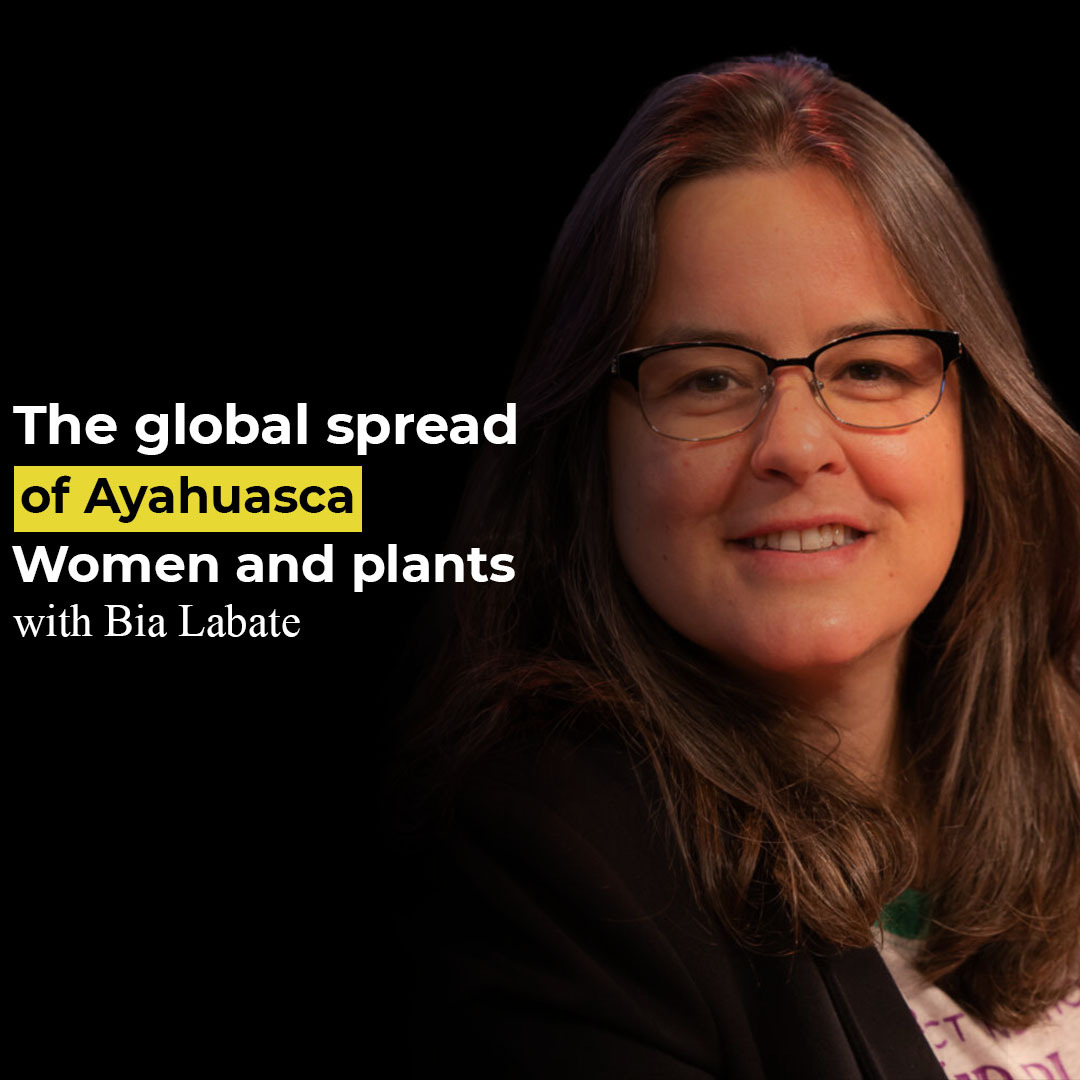
In this episode of Ayahuasca Podcast, host Sam Believ (founder of http://www.lawayra.com) has a conversation with Bia Labate, a Brazilian anthropologist, activist, and one of the most influential voices in the global psychedelic movement. She is the executive director of the Chacruna Institute, editor of 28 books, and a champion of Indigenous rights, equity, and cultural integrity in plant medicine spaces.
We touch upon topics of:
- Bia’s early psychedelic explorations and road trip across the Americas (01:02)
- Her first Ayahuasca experiences and academic journey (02:41)
- Pre-Google era of plant medicine research and early stigma in Brazil (03:23)
- Ayahuasca’s paradoxical rise in the digital age (07:54)
- Loneliness, vulnerable connection, and the appeal of Ayahuasca (09:51)
- The evolution of Ayahuasca use in Brazil and globally (11:42)
- Comparing Ayahuasca traditions: Santo Daime, UDV, Shipibo, Huni Kuin (16:32)
- The limitations of comparing traditions and the food-culture metaphor (19:28)
- Why Bia has published 28 books and her methodology (21:49)
- Creating legitimacy for Ayahuasca as a field of study (24:38)
- The tension between spiritual practice and entrepreneurship (30:51)
- Ethical complexities of running an Ayahuasca retreat (32:16)
- Integration circles and her mixed feelings toward them (35:39)
- The founding, mission, and programs of Chacruna Institute (42:16)
- Indigenous Reciprocity and Psychedelic Justice initiatives (44:37)
- Chacruna’s conferences, education, and publications (47:01)
- Women and psychedelics, invisible labor, and cultural dynamics (50:58)
- Menstruation taboos in ceremony and cultural relativism (55:44)
- Ayahuasca’s origins and Colombia’s historical role (59:21)
- Ayahuasca’s global spread to places like Hawaii and Australia (01:03:08)
- The cultural mission of Chacruna and decolonizing psychedelic narratives (01:09:02)
If you would like to attend one of our Ayahuasca retreats go to http://www.lawayra.com
Find more about Bia Labate at http://www.bialabate.net or on Instagram @labatebia. Learn more about her organization at http://www.chacruna.net.
Transcript
Sam Believ: You’re listening to ayahuasca podcast.com.
Bia Labate: I had a, an important role in creating this field work framework of discussions for the universe of ayahuasca, helping to legitimize ayahuasca as a field of studies because we’re also stigmatized within academia and even in anthropology, that is a science, not soft, so to speak, science that is not considered so serious by, biomedical researchers.
But even within anthropology, that there is a whole openness towards the otherness. Other cultures, religion, tradition, indigenous anthropology study, this kind of thing, exotic things that are not very common. But even within anthropology, in the early years, we were quite ridiculed for our studies. For example, you go to your defense of your master thesis and the professor ask, are you gonna be serving that little tf.
Afterwards, which is infantalizing and ridiculing your serious academic work. So our work, our consistency, our faith was part of a movement to legitimize ayahuasca as a field of work, of research.
Sam Believ: Hi guys, and welcome to Ayahuasca podcast. As always, we do the whole assembly. Today I’m having an interview with Bia LaBatte. BIA is a Brazilian anthropologist and leading voice in psychedelic culture. She’s the executive director of the Chacruna Institute, where she champions indigenous rights, equity, and cultural integrity in psychedelic spaces.
With over two decades of experience in ayahuasca and psychoactive research, she authored 28 books and is a key figure in global convert conversations on plant medicines and decolonization. This episode is sponsored by Awa Ayahuasca Retreat. At Laira, we combine affordability, accessibility, and authenticity, Laira connect, heal, grow.
Guys, I’m looking forward to hosting you. Be welcome to the show.
Bia Labate: Hi, thank you. Thank you for having me and for the kind words.
Sam Believ: Bia, let’s let’s start with your story. What what brought you to work with with Plat medicines and ’cause I believe in one of the interviews you said it was, it felt like you were dragged into the vortex.
Bia Labate: I don’t know what interview is that? It’s a vortex. I’m not sure it’s a word that I use a lot, but yeah, basically, like so many other people in this space, what drove me to plant medicines was a personal inter curiosity, a kind of spiritual inquiry and a taste for adventure and for. Finding new things and traveling and learning about other cultures.
And so I had the chance to try mushrooms and peyote when I was backpacking in my 1920s in Mexico. I did a big road trip across the Americas, traveled for one and a half year and was very open. And, in that kind of pure early years that you’re very wanting to change the world and full of love and hope and have more freedom and more time and more naivete, still like young heart. And it was very influential and really changed my perspective on life and on being human, and on being here in the planet. And took a huge turn since then and later on went to the Amazon and tried ayahuasca. And had different experiences both in the San and UDV context and with proven Vemo or Misti Smo and then Tibo and others, and have since then, devoted my whole life to studying and researching, publishing, advocating, sharing, bridging, all of that.
Sam Believ: You said you were very excited and you wanted to change the world. I believe you, you are changing the world through your work because I think you, your work reaches a lot of people. So it’s not too far from what came to be. And for me, it also started from a road trip through Americas.
That’s how I ended up in Colombia. And then later on found Ayahuasca or Jahi, how it’s called here. You started working with Ayahuasca 30 years ago. It was back before it was a saying. I think Google did not exist. Can you tell us about. Back then, like how did you find your first ceremony? How was it?
Bia Labate: It’s funny that you mentioned the topic of Google because I remember I was on this just returning from Alpa, like right now, last month and I had been, the last time I had been in Alpa was 25 years ago in the year 2000 doing field work for my PhD. And I remember going to a little internet cafe and asking a local like, what is Google?
It’s just going in the middle of this little town in the Amazon. And he is let’s boy, fus, let’s move. It’s very easy. And showing me how to put a word in Google and it, appearing the options on screen. So it was curious for me to have that experience in the middle of a small cafe in a jungle town.
Yeah, and I guess, I’m 54. It’s not like when I think I first had contact with the internet when I was 26. We had, I had a blog at an early age as well. I started a blog in 2004. But for us experiencing the worlds like that was not exotic. It was just the world the way it is. I feel the constant overwhelm, also learning about AI and Bitcoin and NFTs and everything.
It’s very hard to catch up. There’s a lot going on all the time. In a way, it was different to travel because you couldn’t like research online and you couldn’t be in communication with your family. This big road trip, I disappeared for three months. My, my parents resent me for that until today.
I did write a few letters that got lost in the mail which was unfortunate, but I didn’t call, you had, it was hard to call as well. But it was good. It was it was what can I tell you? It was some good in years. I felt a lot of love and a lot of it was a great privilege to, to have these experiences, to go and to find out, be curious, and just go by learning and asking questions.
The key is trying to learn the language, talking to people, just asking question, putting yourself in the position of a student and, not the center of the action, but you’re there to listen. To learn.
Sam Believ: Yeah. I think, there’s a, the internet is blessing and a curse because now we can research everything about the place we go to and to such an extent that we don’t have this surprise or this awe and amazement of coming there because we’ve seen like some videos, they, because they’re edited, they even look nicer than the real life.
And same with io, like people that shop at my retreat for example they’re full of information and a lot of it is not a good information as well. And then you have to not just teach them, but you have to reprogram their beliefs and understanding of it. And I it’s funny ’cause I can imagine, you googling your first word and it would be interesting if it was your first word you Google was ayahuasca, but I’m sure it wasn’t.
Bia Labate: I mean there wasn’t a lot of things about ayahuasca like it is now as well. I saw witness in my own life about all of this explosion. I’m not the first generation that. Watch this explosion. There are, researchers, anthropologists that went to the Amazon on the sixties. I’m not talking about early explorers as well, or Richard Spruce who found the brew, or I’m talking about more contemporary generation of researchers.
I have a professor, Jean Langdon. She went to the Amazon, I think 1971 when I was, born others, Michael Harner and the folks that wrote the Yaha letters, Ginsburg. And but it was it was not as I say, there wasn’t all these offerings and there wasn’t all these sites and you couldn’t really shop online like you can.
And I agree with you. It’s a paradoxical time actually. You today, you have to pay. And good money to be offline. Like you have to go to a special retreat where you cut yourself. It’s those paradoxes. We have never had so many means of communication on so many fronts. Every single person has a lot of different methods of communication, and yet we have this kind of epidemic of loneliness and this connection.
So it’s impossible to think whether there’s a a connection between those two things. And this anxiety for new technology is completely like not replacing the lack of need for slowing down and nature, which is also a big issue for people, especially from cities. And I think that’s also a lot of the appeal of the ayahuasca experience for a lot of people is this sense of remembering something, of connecting to.
Generic feeling of being a human and belonging to a planet and having a purpose and a meaning and feeling connected to the stars, to the universe, to the moon, to the invisible world, to the world between, beyond us, to this living web of connections, this breathing, planet earth full of this beings that we are in relationship with and our other fellow humans are kinship.
And I think that’s also why ayahuasca is such a boom and so desired, which doesn’t mean that it can’t be object of the same, to the same colonizing processes that we’re talking about here, to which is frankly related to the advent of big cities. And, we’re not drinking water from rivers and.
I’m sorry, I’m a little bit going all over the place here. I’ll go back to your questions. You have what?
Sam Believ: It’s okay. There’s no fixed rules on what you can talk about, what you cannot talk about. We like to let it flow, but what you talk about loneliness is a big thing. It’s like we have hung some friends on Facebook and we have all those people around us, but we are lonely and lonelier than we ever were before.
And we have a lot of people coming here. And they, there’s a group of people that they’ve never met before and through Ayahuasca and also through vulnerable sharing, they end up really connecting to such an extent that we have groups that people met each other for the first time and now they travel together.
They do things together. There’s something missing in our society. Which makes this vulnerable connection possible. And I believe part of it, part of the issue is the internet because everyone is so perfect on Instagram. So everyone thinks, oh my God, everyone is perfect except for me. So when people come and they share vulnerably and they actually talk about the problems, then they can, through that imperfections, they stick to each other.
And yeah, there’s definitely an epidemic of loneliness. But one question I wanted to ask you is you come from Brazil and Brazilian? I, based in statistics, Brazil has highest percentage of people that worked with ayahuasca. It’s an astonishing like 0.8% or something like that, which is still very small amount, but it’s more than any other countries.
So like growing up in Brazil, were you. Were you hearing about Ayahuasca? What was the perception like? Or is it just same as everywhere else?
Bia Labate: No, it’s not it’s not something that, everybody goes to school and have conversations about ayahuasca in high school to now, yes, more.
But when I grew up it was a bit demonized, frankly. It was a bit persecuted and pathologized When I was in high school, we heard a lot about a cult in the Amazon that, gave people, brainwashed people. And there were a few scandals that happened or in the early days as well with people that left their families and moved to the Amazon and cut ties or, accidents or things.
And then there were some celebrities that. Came out and talked about it, but they were also a bit stigmatized. There’s a lot of media sensationalism. So it was more, it was not entirely normalized. It’s not something that you would talk, in your family meetings. This is for me, the eighties, the nineties I think it, it expanded from beyond the Amazon in the like eighties to cities like Sao Paulo and Hu hug Janero.
And then in the nineties it became more and more popular. I think early two thousands you could say that there was this explosion. When I did my master thesis, you had only, mainly like in the big cities and the indigenous folks that lived in villages they used the ayahuasca among themselves, but they were not traveling.
To the big cities. There were a few events like the Eco 92 summit in huge janero. There was like some movement, but in general, the traveling groups of indigenous visitors to the city started in like 2003, four, 2005. Now 2025, it’s 15 years later. You have an explosion of everything on all different modalities.
But this is all to say that you could follow this process. In my lifetime, I was witness of all of these changes. For me, when I wanted to do my master thesis, it was called the reinvention of the use of ayahuasca and urban centers. I had to take a subway and talk to somebody that would agree to tell me, as long as I kept him anonymous, meet in this neutral spot somewhere that gave me a telephone, that led me to somebody that would be willing to talk to me.
Because I wanted to try to research what was happening in the margins besides and UDV, which were considered like the main official churches and the, so to speak allowed or permitted by law. There’s some gray areas, but they were holding this place of tradition in the imaginary, in the larger social imaginary cultural references.
And so anything beyond that was really edgy. That’s like 1998, to 2000. I launched my book in 2002. It was still pretty not. There were like five people you could be counting on that. And today there’s like dozens and hundreds of ceremonies each weekend. Same in the us I have witnessed similar expansion in places like New York or Los Angeles, here in San Francisco, in the Bay Area Hawaii.
There’s some spots that are, more concentrated, but I’m sure there’s also just a lot that we don’t know out there.
Sam Believ: So Co Columbia is actually the second country in that list of percentage of ayahuasca use after Brazil. Which is not surprising because there’s also every weekend in every big cities, there’s couple different shamans coming and serving medicine and they have their own circles.
I’ve only been exposed to Colombian version of Ayahuasca and Colombian tradition, so I’ve never I don’t know much about Santa Diamond in UDV. And I’m sure my listeners also it would be interesting if you could tell us, ’cause you worked with different shamans, different traditions in different countries.
What differences you notice between, let’s say Peruvian tradition Shabo tradition, or I forgot the other tribe that you work with? Ka
Bia Labate: KU is, they, the name they gave themselves and they the self denomination and the nickname by the Portuguese. The one, the way they were renamed is Ka Kaa.
But yeah, that’s a very like big. Question for a lifetime. The AMI traditions and the UDV, they’re similar in, they hold a lot of similarities. In a kind of more structural generic sense, you could say. They come from a sort of similar metrics, which is a combination of aminian shamanism and Christian influences popular Catholicism and also some Afro religion elements.
From ble. There are some elements of European is artism and so you could say that they drink on the same source, but the rituals themselves are very different. For example, Santa Dmi has a ritual that is dancing that can take many hours on this kind of standard dance to, to, to the side, to that side, similar and.
Similar. It’s repetitive and with the lights on and there’s another ritual that you sit and you close your eyes and it’s more like a meditation. And the UDV has individuals a chance, not like Dime has collective chorus. The UDV has just one person singing, you could say, reminds you more of IDOs from like Peruvian traditions.
My experience in with TS and in Columbia, I have I’ve been three times, but I’ve also sat in ceremonies abroad outside of Columbia. I guess I, I don’t mention that in my bio because I forget, I have done so many things I forgot. Yeah, I think it’s more festive in a way that, it has can have the harmonica and it’s more like it expansive in a way, should people is normally.
At night and those are at night too, but like with the very dark and very introspective and silent and really pointing towards that inner healing. And I feel that other indigenous traditions also when you queen, are more like, I don’t know how to say it, like festive or celebratory, but it doesn’t mean that it’s not healing.
So anyway, this kind of question is the kind of question that I don’t love. Just like people can go, they can have their, experiences. It’s not my job to translate all of these things, into words. There’s lots of books. It’s a lifetime. It’s you’re saying what’s the difference of the food in one country to another?
It’s it’s a whole other tradition and it’s. It is good to think about these things as like food, nutrition. It’s just this innumerous ways of cooking, innumerous, ingredients, innumerous. Each cook is gonna have one tip, is gonna have one angle. It’s like the, this pot of culture, knowledge, generations, insights, layers, traditions, people, voices, sentiments, ethos.
It’s a lot of things. It’s, it’s a whole universe. And once the more you get involved, the more you think you don’t know anything. And actually the last, you feel comfortable in talking about it. Because it’s also like something you can really express in words. And it’s just a very magical and powerful and enchanted understanding.
It’s a whole paradigm to see the world if you go deeper in this path. It’s also not our job to tell everybody to do it, and it’s not for everybody. Anyway, I hope that answered a bit.
Sam Believ: Yeah. The yeah, it’s the, there’s definitely this I think it’s called Danning Kruger Effect, where you, the more you know, the less you realize, till you actually know more.
You, this like this graph and people that have one ceremony, they’re like, oh my God, I’m a shaman now. And the people who’ve had hundreds of ceremonies and they’re really work and that, they’re like, oh my God, I know nothing. ’cause it’s so complex. And I think the reason you get asked those questions is because there’s not that many people that have had your experience and exposure to so many different traditions.
And also there’s not that many people that wrote so many books as you did. You wrote 28 books about, close to this topic. So why so many? What, what has driven that level of contribution?
Bia Labate: I didn’t write 28 books. I published 28 books. So I wrote, I co-wrote, I co-edited, I edited, there’s like different modalities of book production.
And I think it’s been a passion, what can I say? It’s, one thing led to the other, my, my recipe for my, for being so prolific. And the reason why I have done so much is because I have really a method of learning by doing. So if I’m interested in a topic, I’m just gonna create a book around it and try to learn by creating it.
A way to think a book is like you think what has been done, and so you map. What, where is the discussion at? And even if you write a book proposal for publishers, you have normally to do some kind of session called competing books. And that session, if you look at it in a loving way, and not in a negative way, is like a chance for you to examine the literature, what exists, what is out there.
And so then you can say, I’m giving you an example. I don’t know there’s a bunch of book in the seventies. There’s a bunch of book books by people that died. There’s a bunch of book in Spanish. There’s a bunch of, things on pharmacology on this specific aspect, but there is not this and that.
So that’s a gap. Then how do you fill that gap? And then you map everybody that’s working on that gap on their different contributions and you compare what are, the pros and cons of it. And then maybe you have five people that are very doing similar work on this one trend, but then this one is more, generic and speaks better to a wide range.
So by learning what everything exists. For example, our peyote book that we did when I was living in Mexico, I spent about six months mapping all the things that had ever been published about peyote on all fields, history, pharmacology indigenous uses, legal matters. And then we create a book collection that is a, representative of this whole, for example, now I’ve been really wanting to do a book about, the new indigenous Urbans uses of Ayahuasca in Brazil because my master was about the expansion of Central Diamond UDV to the big cities. That first wave that I mentioned before. Now there’s a new wave since mid two thousands of an explosion of a new phenomenon. So there’s a lot of different thesis out there.
If you create a collection and you get the best of what is out there, you really help launch the fields, you create the framework for the conversation. So I’m not the only one, and it’s not just me. There’s a other people doing this, but I had a an important role in creating this. Field work framework of discussions for the universe of ayahuasca.
Legitimate helping to legitimize ayahuasca as a field of studies because we’re also stigmatized within academia and even in anthropology, that is a science, not soft, so to speak, science that is not considered so serious by, biomedical researchers. But even within anthropology that there is a hole.
Openness towards the otherness. Other cultures, religion, tradition, indigenous, anthropologists study, this kind of thing. Exotic things that are not very common. But even within anthropology, in the early years we were quite ridiculed for our studies. For example, you go to your defense of your master thesis and the professor ask, are you gonna be serving that little T afterwards?
Which is infantalizing and ridiculing your serious academic work. So our work, our consistency, our faith was part of a movement to legitimize. I was ’cause of field of work, of research, and I have co-hosted in the Brazilian Anthropological Association in know working groups on religious and traditional and sacred plant uses combined with other social phenomena that.
Is also stigmatized and marginalized. And we have had these working groups for many years. So it’s three, three days of conversation. And each day is a different topic and you have seven papers each day, and you have people coming from all over the country. And when we first launched this, there was, hardly any persons.
And now we always have to reject a bunch of thesis. I have a publication that I did, I think 2008 or something that was the reference. It was a balance of the field of references, academic references that were ever published about ayahuasca. And we tracked down over 500.
This is it would be very hard to do such work this day. I have done a lot of work of keeping up with the bibliography and it exploded as well. Realities after. The literature is after reality. So the reality goes faster and then the researchers go trying to catch up. And so there was a time that we could map rituals, churches phenomena, and the literature.
And then there is an explosion of all of that. I got overwhelmed, I also had a kind of burnout of trying to keep up. And it’s been like, like drinking ayahuasca itself, there’s been different waves. There’s moments of deep enthusiasm, deep love for the studies, and there’s moments that it feels a little stuck and uninteresting.
And then, I’m just coming back from a diet with ayahuasca and it was very interesting because the maestro told us, don’t read, try to silence your mind. But, if you read something, it’s going to, you should read something spiritual. And then there’s this library full of books of ayahuasca and I’m thinking, I’m not gonna read a book a, a book about ayahuasca because that’s academic for me.
I’m gonna start to have thinking about like references and why was this coded? Anyway, after a few days, my friend got the book and bought it and gave it to me a book, and I decided to read. And then I started to read the book in my diet and I started to think it was so extremely interesting and I started to laugh a lot and myself, because basically I was thinking, wow, so interesting to read about.
I was like, like I came to day one all over again. I was completely fascinated with the study of ayahuasca and thinking about the diet I was doing and reading the book. And then I had a book, a big book diet. I was thinking a lot about all the books that I published and how I want to publish other books and how other.
Teammates in Karina should be, have a chance to publish their books and came back with a bunch of ideas of new books and extending, that book, vision to colleagues. Inna and seeing the need to digitalize materials. Anyway, this is really nerdy. I don’t know why you got me talking about all of this random, very obscure academic interest in Ayahuasca books.
Sam Believ: This episode is sponsored by Lara Aya Retreat. Most of Lara, if you’ve been listening to this podcast for a while, some of you might have already been to Lara before. For those who don’t know us yet, we started Lara with my wife four years ago. At Lara, we combine authenticity, accessibility, and affordability.
Lara is currently highest rated Iowas retreat in South America with more than 635 star reviews and an average rating of five stars. If you come to the wire, you’ll experience powerful, authentic ceremonies led by our indigenous shaman. Fernando, in a. Very beautiful venue. Just one hour south of Meine Columbia.
We’re surrounded by nature and have comforts like hot water wifi at La Wire. Our team has guided more than 2000 people through this life-changing transformation of Ayahuasca experience. At the same time, we keep it very affordable. At the moment, we have retreats starting at as lowest as $645. So whether you’re coming for healing, clarity, or a deeper connection to yourself, the wire is the best choice.
If it is your first time drinking Ayahuasca, you will love our three and a half hour preparation course and integration support. All of that is included in price as well as pick up from Metagene accommodation in Ayahuasca. There are no hidden fees. Visit lara.com to book your retreat or learn more. Lara Connect, heal.
Grow L-A-W-A-Y-R a.com. No, but that’s that’s what you enjoy talking about. And that’s the whole idea. I don’t want it to be boring for you. You mentioned that you’re on the right now, so can you maybe talk to us about, so I, you learn by doing and you learn by doing. If you wanna learn something, you write a book about it.
I learn by doing, but when I’m fascinated with the topic, I start a business about it. So I started an now retreat, which is very successful and very beautiful. But I struggle a lot with the balance between my own spiritual journey and the business and entrepreneurship, which is a very different energy, almost opposing.
How do you balance your academic pursuits with your own spiritual work? Writing all those books. Do you ever find yourself in a ceremony where you’re like deep with the medicine and having your own experience and there’s like a narrator voice what am I gonna write? How am I gonna describe this in the book?
Or something like that.
Bia Labate: That’s a really good question and it’s a really dense question for me because it’s a question that goes back, 30 years of my life. And it’s the essence of everything for me, how to combine all these other aspects. I do wanna cheat a bit by your question and just say that wanna encourage a reflection about Ayahuasca businesses.
What you said about yourself is interesting and there’s a chapter in a book of ours that’s called Global Ayahuasca Entrepreneurship or something, and it’s talking exactly about how the business of ayahuasca is different than other businesses. Because in a lot of industries you have all these investors or people coming in and trying to create.
Profit, a lot of the ayahuasca center centers and related economies, let’s say the paraphernalia, the textiles and paintings and CDs and all, tobacco or things that go together with it. A lot of it is started by people like yourself that fell in love with ayahuasca and then created a ayahuasca business and ayahuasca retreat.
And then there’s this paradox that, a lot of people feel like I wanna drop out and I’m tired of capitalism, individualism, consumerism, shallow, western society, and I’m gonna go to the Amazon, drink ayahuasca and help others do the same. But by doing that, they’re also bringing this economy.
To the world of Ayahuasca. And then there’s also these paradoxes that are associated to this growth, which has not always been positive for local people, and sometimes have even increased the difference between foreigners and locals. And also, frequently locals are in a position of less power and are not like the leaders of the retreat or end up working as, chauffeur or maids or, cleaners or the generic shaman, but not a real active agent.
So that’s an interesting discussion about the economy of ayahuasca. I don’t know anything about you or your center, and I’m not trying to get into any merits here. I’m just saying that’s a good discussion. And I think that a paradox for founders of centers, it’s also they are I’m an advisor to a few centers.
I have helped Misti Vegeta for over 10 years as assisting him with issues and. More recently had other experiences, helping in the foundation of a retreat and consult with retreats. And it’s a big challenge for retreats as well to find this balance. Like you want to announce you want to market because you need clients, but you can’t say this is going to work and, pay and your success is guaranteed.
And there’s a lot of issues around marketing and whether it’s like ethical to try to push on people to drink ayahuasca because it’s not for everybody. And there can be like situations where it’s not helpful and there can be problems like just with putting it in social media and making claims.
So I have, helped people try to navigate where to find a balance of. Echo Ayahuasca businesses. That is not like making it a panacea, is not trying to fish for new beginners all the time to just, and yet have to keep it rolling. To pay the staff to pay the people that are involved. And I think all of this balances between, I can make a joke, I was like 20 years fanatical for Ayahuasca and nine years fanatical for Una.
The joke is Una is the nonprofit, but it’s named after Ayahuasca. So in a way I never got out of it. But yeah, I’m just gonna say I had different phases. I had phases where I was completely in love and enamored and thought that was the ultimate thing of humanity. I had phases where I was very disillusioned, especially with the patriarchy, the politics, macho leaders and lack of transparency and problematic leaders, I think the main challenge is like charismatic leaders that, people tend to project on them like all the, benefits from the experience, lack of, clarity on, on, on a lot of in integrity issues and not to talk about sexual abuse, which is happens.
And then I have phases of being re enchanted. And, as I said, I’m just coming out of this experience, which was so incredible. I had moments of deep happiness, of deep contemplation and deep gratitude. I had a journey through my life that is just unique that it’s hard to get. I don’t know how, you know how to get something like that.
It is really my path. And I feel, I feel really blessed. I feel really lucky. And one thing that I have struggled with is this integration circles because from where I come from my early ages, my early years in Ayahuasca, there was never integration. And we learned not to talk a lot about it.
It’s personal and intimate. So it would be some kind of like spiritual voyeurism, to spiritual nudism, to look at it and try to see what everybody else is doing. And just feeling a lot like people like. Competing with each other who had the best experience. And looking at the other one and saying, oh, he had that, he saw that, I didn’t saw, see that?
And like seeing that create, expectations on people because they would hear other people sharing and then they wanna feel that, and then they’re treating ayahuasca like it was some kind of jukebox that he put a coin and a, a music spits out and sometimes it doesn’t work and it’s not like that.
So I’ve struggled with integration. I’ve also struggled with learning, understanding what people say in English, like the next day of a ceremony, feeling like tired, didn’t sleep well, and have to sit in this circle for hours to listen what people have to say. But I also try to keep a open mind, and I know a lot of people like that and need that and feel for them.
It’s so incredibly like wild and novel and a lot of people also just like a lot of awareness around like therapeutic basic processes to see, oh, I’m feeling this, and then interrogate inquiry. Oh, why am I feeling that? What does this come from? And just be so immediately touched by your own feeling that you don’t, realize that this comes from other things.
Like just seeing people discover basic things about therapy and self-knowledge through their ayahuasca experiences or thinking about eating, what are they putting in the bodies? So I think a lot of these retreats have a lot of are important for people and I can understand the value.
And so I think by this answer I’m saying like, different people need different things. And for me, some of the integration stuff has raised my more critical intellectual mind and I don’t like it very much. So you ask me how do I feel, integrating different aspects. What I’m looking when I go to an ayahuasca retreat is not like talking about ayahuasca and integration and this self-reflection.
I’m looking for a silence in my mind, not talking about it. It’s true that I read a book, so it’s complicated. There’s a lot of angles, I can always tell you that particularly this thing of I have felt anxiety when I was forced to integrate and talk. Because then I start to be in the experience thinking about what I wanna say the next day.
Oh, this is a good thing I could quote. Tomorrow and then create this weird eco inside your head when I like more, to pay attention to the music. Anyway, was that very confusing?
Sam Believ: No, it was a great answer. You definitely want to lower the place, touch lots of topics that I myself would wanna talk about.
Like definitely the business of Ayahuasca is is is a friend of mine who, he’s a marketing expert and he works in lots of businesses. He said this is the most difficult business model out there. It’s just too complex. I think people do it, they definitely do it coming from the place of a bit of zealously, this is amazing, and they can save the world and they get very motivated and that’s kinda what happened to myself.
The word circles. Yeah. We do word circles, but we kinda limit the time to three minutes per person, so it doesn’t get too, there’s not too much of this spiritual exhibitionism as you talk about look at me. But it does tend to create connection between people and helps them memorize the experience they went through by talking about it.
It goes from short term memory to long-term memory, and then builds the connection between the group and the people that having a similar experience. They start supporting each other. So there’s but I can also see, I’ve definitely, I even noticed myself sometimes in the ceremony like, wow, this is great.
I’m going to share about this tomorrow. So it’s inevitable. I think for, even without word circles, people tend to think this way because they, they do wanna talk about, and yeah, the danger of charismatic leaders as well. I’ve had facilitators that. Did that, they tried to get all the attention that they tried to be the person, or, some shamans are like this as well.
So that, that’s something I’m acutely conscious of, and I try to actively avoid that. It’s not about one any given person. It’s just about you and the medicine. Even myself as a founder I’m not that involved. So people can’t, some people do still like, think oh my God you’re so great.
You did this for me. But I try to avoid this because I think for me personally, it’s actually not comfortable to be like somebody, grabs you by the hands and they thank you. For me it’s difficult for me. It’s easier to receive criticism. But let’s talk about Jauna.
You mentioned Jauna it’s your organization. I’ve heard lots of great things about it. Tell people, what is it about, how was it born and. How can they, why and how can they support you as well? Maybe some people that are listening would like to do that.
Bia Labate: Yeah. Thank you. Una is a 5 0 1 C3 nonprofit organization based in Northern California with strong ties to Mexico and Brazil.
So we have a very diverse team. A lot of Mexicans, Brazilians, and Young Gen Z Americans, some new team members in Europe as well. We produce like mainly public education and we have different programs. One we called the Indigenous Response Initiative of the Americas, that we give small grants like s Money to 12 different organizations throughout the Americas.
The criteria to join that is that it’s like indigenous led and has like a track record of. Know actions and it’s collective led, and it’s also grassroots and not already, like on the circuit of big philanthropic dollars. And that is a really cool project. We’re trying to keep our donations completely unconditional of them, sending us decks or marketing materials and keep the bureaucracy very low.
So trying to do what we call decolonizing philanthropy, supporting soverty self-determination, the projects and the leaders on their own terms. And then we have two, the program, psychedelic Justice, which we, it’s mainly empowering voices of people of color. So indigenous, black L-G-B-T-Q, queer immigrants, women.
And so platforming giving visibility, in conferences, in publications. So that’s like our stars in our conferences. And we have produced different materials as well. We have our book Psychedelic Justice. We have women in psychedelics, we have queering psychedelics. We did a big work on the intersection of the queer movement with the psychedelic movement.
Were very influential in like bringing this together and created the two conferences called Queer and Psychedelics, and then a big publication around it. And also a lot of materials around racial justice, trying to teach like white people to self-reflect about whiteness and how to be a better ally And social justice questions.
And the other program we call Protection of Sacred Plants and Cultural Traditions, and we’re trying to create critical conversations and awareness around the globalization of. Things like ayahuasca, peyote, mushrooms and the expansion. Teach people about their religious rights. We have a important resource called the Guidelines for Religious Freedom Restoration Act, and Best Practices.
We also have a few workshops and courses for psychedelic churches trying to help people self-organize and have accountability and peer-to-peer dialogues and awareness around topics like conservation and reciprocity extraction, cultural appropriation. So creating a lot of critical conversations and what we call legal harm reduction.
So we have, it’s a lot of years and many different fronts. We have a lot of volunteers. We have a program of interns. We have a membership program. We have a fiscal sponsorship program. We have. Original books and publications from peer review to like online articles that are shorter and for a wider audience.
RIN is a big network. We have Op Operated started organically as a blog to publish articles from academics in more accessible formats, and it grew into different programs. So had a lot of influence of social justice movement in the US California particularly. And yeah, we’re very enthusiastic.
We have an annual conference called Psychedelic Culture. I would like to invite everybody to come. We’re gonna do it for the first time during bicycle day in the Bay Area next year. And we have a certificate on ethics, reciprocity, and ceremony. Or the name is Ceremony, ethics and Reciprocity. We’re working on.
A training for religious professionals. Right now for clergy, like a psychedelics 1 0 1, we’re creating a new book on psychedelic humanities, and we have also a new book on indigenous voices. I can go on forever. We have a lot of different programs. It’s a big school, it’s an incubator of ideas, people, new generations, leaders, thought leaders.
It’s a community based, it’s a mix between community, media and university. In between. It’s not as hermetic and hard to get as universities, but not as like loose. And with lack of expertise as just like any other community member self invented organization. We have a lot of people, experts and.
People with a strong history in the field. We have four different websites. We have a branch, Toch, Latin America, that will publish articles in Portuguese and Spanish. So we try to give back and, be connected to our roots. As a Brazilian who lived and worked many years in Mexico, I have both ties, strong ties to both countries, and we have the psychedelic justice, the psychedelic culture website, the Chana website, and the indigenous reciprocity website.
We also have different Instagrams for all of those. And just keeping afloat is a a huge task keeping existing on all of these different fronts. We have a network of about 80 people but employees. Employees, very little. It’s a lot of volunteer work.
Sam Believ: I can imagine how difficult it is. And it’s very important the work you’re doing.
So thank you so much for it. It’s someone has to have those conversations because normally we just try to avoid them. And like I know what bicycle day is, and I think most people do. But what is the date, specific date for bicycle day?
Bia Labate: I think the conference is gonna be 17 to 19, and I believe that bicycle day is on the 19th, the day that Albert Hoffman experienced LSD on a bike ride.
Charan is more related to plant medicines, sacred plants, or there’s different ways to call it. Not all of us don’t love the word psychedelics necessarily, but we are part of this larger spectrum of the psychedelic ecosystem. We are the ones advocating for indigenous voices, voices from the global south for anthropology and social sciences for more holistic ways of learning and knowing.
And that’s at the core of what we do.
Sam Believ: So April 17th to April 19th, just to clarify one of the topics you work on explore is women and psychedelics and there is this like how do you balance women’s rights and making women feel comfortable in a ceremony and sort of the indigenous tradition approach, especially around the time where women have their period.
’cause it’s seems pretty universally very difficult to navigate. Like we have our ways we do it and it’s works and we’re very democratic when it comes to that. But I don’t know if much about it or something you can share. ’cause sh you should probably know more than anyone ’cause you wrote a book about it.
So yeah, let’s talk about this topic. If you can.
Bia Labate: The book woman in psychedelics is recognizing different indigenous indigenous, non-indigenous researchers are not researchers like women as leaders. And we’re trying to give visibility. If you think historically and this is an example I draw from my dear friend and colleague who’s also co-editor of this book, Erica Duke, Dr.
Erica Duke. Historically, women would participate in think about the early research in the fifties, sixties, seventies, on the psychedelic research that women would sit. Together with their husbands. And they would help the husband create a protocol. They would help cleaning, they would help setting up the space.
They would help comforting and talking to the people. They would help the husband who’s afraid to participate. They would help the folks follow up, integrating the experience of everybody, the manuscript, manuscript writing, like they had all this presence, but their name was not on the paper. So there’s all these figures or we talk about Albert Hoffman, but we don’t talk about his assistant that also was the first woman to try LSD.
So it’s trying to give voice to this invisible. Leaders and a lot of men that go on heroic journeys had women sitting for them, taking care of them. Like this people of color, the brown people, women, people that are taking care are in the vaccines that are invisible. It’s like the big heroic guy that climbs the Himalayas, but the locals that carry his bags, they are not, figured in National Geographic as the leaders who conquered, but they’re going up and down every day, and so it’s a bit that spirit. There’s all this people behind the great deeds that we don’t we don’t see. And we, Chana, I have a wife, I’m queer woman. We are led by women and we like to pay attention to women’s leadership. And we did this book first in Spanish and it was even harder to try this.
Find his voices in Latin American places like Peru, Columbia. Brazil, what are the women leaders, both in plant medicine and psychedelics. But this is not to say there aren’t women doing important work on all areas from and it’s not just women related areas like giving birth or helping to die or helping to take care, but other kinds of leadership and why don’t we know them?
They exist. So this book is trying to elevate that and I don’t see any I don’t see much of a contradiction or tension with the topic of women not being able to sit in ceremonies when they are having their period. I think I see it as an anthropologist that’s part of cultural traditions and have cultural like reasonings.
I don’t think it’s I personally don’t see as just like an oppressive. Branch of patriarchy, and I think there’s a lot of reductionism in just projecting our values to other cultures. If you understand the logic behind those prohibitions, it’s part of a larger whole that has you know, a lot of aspects like this economy between men and spirits with this, all these exchanges and shamanism being this source of mediation between realms.
So there’s a lot of taboo, so to speak, related to hunting or ways to debone the game and what species are you allowed to hunt and what is how many, different animals. Are you allowed to take? And what are the correct ways to taking them down? And the logic of this economy of exchange between us animals, the ancestors, the invisible world.
And one of the things that are said is that like spirits don’t, like maybe this the smell of dead blood. They like perfumes and there’s a way to seduce them to talk to them. There’s all these other explanations, these logics of exchange, of donation, of reciprocity with this set of web web of life that are like the native explanations for this prohibitions that have to do with the same idea of the diets of creating this dialogues, this with the, world of the.
Species, the plant species, learning how to incorporate that knowledge, that sentiment being that plant that has an agency, that has intentionality, that is alive, that is a being that is ultimately like a human, like you, that has a culture, that has, a personality, has an understanding, losing your humanity and being in dialogue with this plants and letting them sit on you and teach you and following the tests, the prescriptions, the different periods and trying to be more open and sensitive to things like dreaming and, just deeper forms of knowledge, embodied forms of knowledge that this traditions take that I don’t think is just.
Saying men want to oppress women, and yet, yes, perhaps there are some social complications. And there are, there has been also processes of women from different indigenous communities that were not allowed to take diets and that have fought their rights. And they are leaders of diets right now.
And our big leaderships, men wanted to be protective of women and were con, worried about women being able to take care of children and didn’t want to force them to go through this difficult experiences. But women have also advocated for their rights and have changed traditions. So there’s a lot of ways to look into it.
And it’s a big complicated topic. I think the best way to go about it is if you’re going to a certain tradition, try to get informed and try to talk and ask the rationale. And listen and pay attention and not just bring your own ideas, to the mix.
Sam Believ: Yeah. Thank you for this explanation. I agree with this as well.
We, we have to like, find the balance, but we can’t just come to a tradition and only take the things we like and reject the things we don’t like. And it comes in a package. And then from the, in the spirit of you saying, there’s women behind all the men doing cool things. Yeah, my wife is a co-founder of the of the Wire and she, we have crickets together and we started from the beginning, it was just me, her, and the shaman.
That’s it. And we did everything from cooking, cleaning, to washing buckets and, definitely would not be possible without her. But she’s definitely not in hiding every group that comes, they meet her and she’s still in charge of everything, all the hospitality related stuff of the running, the retreat.
So she’s not listening to this podcast because she doesn’t really speak English, but I keep telling her to listen because I mention her a lot. So if you’re listening, I love you. One last question, which is really interesting for me because in one of the interviews that I’ve heard of you in preparation for this podcast, you said that there’s some reason to believe that Ayahuasca originally comes from Columbia and Amazon.
Like where can I find more about it? Like, where did you find about it and, where, like how did they manage to figure that out?
Bia Labate: There’s a large discussion about this. It’s not something set in stone and it’s also a little bit controversial. I think maybe you could try to have some indigenous speaker come to your podcast.
And it’s been more and more those of us that are studying this topics are learning that indigenous people want to have they don’t need the voice of anthropologists. And we’re happy to continue to be allies and support our indigenous partners and friends. But I think it would be good to get also, like indigenous speakers on your podcast.
So I’m just gonna suggest that you find an indigenous scholar and speaker and invite with the same questions. There’s different theories and it’s a kind of controversial topic and I’m perhaps, I’m just gonna leave it like that. Okay.
Sam Believ: Anyone specifically you wanna recommend that interview on the topic?
Somebody indigenous.
Bia Labate: We can talk more offline, but we have a bunch of resources in Chaa too, recommending different people of color. We have a page, people of color. We have another one psychedelic indigenous voices in the psychedelic Renaissance. I think that’s, I would even ask you why you’re interviewing your own local healers.
Sam Believ: We have I have a podcast with my shaman. I think it’s about 10 episodes ago. But I don’t think he knows those things. I asked him like, he knows the story of creation of ayahuasca. Like they all have their own story. But that, that’s from, that’s, I would like to hear that answer from the anthropologist, but
Bia Labate: But that’s the exactly the problem.
Like what is the timeline? Are we talking about stories of creation? Are we talking about like you found a ceramic pot in the Amazon with which date? What is the science that we’re listening to? That’s the challenge because the immemorial narratives, they don’t match necessarily what’s, are we gonna consider like Richard Spruce who named Ayahuasca or, you know what I’m saying?
There’s different stories. And this question became political of different epistemologist, different timelines.
Sam Believ: Let’s assume we don’t really know, but yeah. It comes from Amazon. That’s let’s settle at that. But yeah, I’ve heard you
Bia Labate: the UDV says that it was from King Solomon.
So they have their own original myth, which they don’t think is a myth. They think it’s a historical timeline.
Sam Believ: King Coleman, like from Israel as in maybe using their own plants like mimosa and something like that.
Where do they get the V from if it doesn’t grow there?
Bia Labate: That’s you go into the story of them, they have their own narrative. But yes, I agree with you. It comes from the Amazon and it’s also spread, all over, you have plantations now in, in places like Puerto Rico or. Maybe a bit of Florida, Hawaii, have different people studying the DNA, trying to figure out how it migrated one place to another.
Sam Believ: It’s really cool. The Hawaiian Aya Astoria, I interviewed Dennis McKenna maybe a month ago, a bit less. And it’s, it is basically was I believe it was his brother that brought the ayahuasca from Peru to Hawaii and now it’s spread all over. It’s it’s crazy how one person’s actions today can change the world 20 years from now.
Bia Labate: It’s a variation of what I was saying. We’re all witnesses of this expansion. When I was telling you my timeline, what I did in my masters, what I did, my PhD, this work in Una, it’s all different phases of the Ayahuasca movement. I’m friends with Kat Harrison. She went to the Amazon in 1976.
She is ex-wife of, terence McKenna, who’s passed, she was there in 1976. That was on Google. I was five years old. And yes, Terence and Dennis brought Ayahuasca back and they planted. And Ayahuasca is a plague, if you will, in a more like strictly ecological terms in the island because it’s a species from the outside and it grows very fast and it’s taken over.
It’s very interesting because, it grows very fast. It’s a kind of really vitamin land that it has a lot of properties and it grows fast and it takes over. And also a lot of people have land and they can grow their own ayahuasca. In their backyards. So it’s a very interesting scenario where you have a lot of different people growing ayahuasca everywhere, and you have a whole economy of ayahuasca being brewed in Hawaii and shipped internally to the US because it doesn’t pass immigration.
So there’s less risks of it being caught. And so there’s this whole economy of people creating planting, ayahuasca, harvesting and cooking and spreading it and going to other islands. Also, Australia has a lot of ayahuasca plantations. It’s a global phenomenon at this point.
Sam Believ: It’s a plague, but it’s a beautiful plague.
And yeah, because in Amazon, the soil is very infertile. It’s very hard. So it’s a plant that’s used to less nutrients. And then you. Spring it somewhere where there’s lots of nutrients and hot weather and it probably grows very quickly. But yeah, when I heard you mention in Columbia that Ayahuasca might come from Columbia and Amazon, I just felt really good because I’m on the, a bit of a mission where when I first learned about Iowasca, I thought it’s something you do in Peru.
And then I was already living in Columbia back then or being here for a long time and it was completely unknown. So I’m trying to sorta spread the word and educate people that Ayahuasca is from Columbia and it’s actually very traditional and it’s absolutely much more traditional than Costa Rica, which doesn’t really have anything to do with Ayahuasca traditionally.
And that Richard Ulti came here to to do his research and, dennis Dennis and Terrance, they came here looking for this other plat medicine as well. And then Narcos happened and it dero it and arose that part of the history. So when you said that I got excited and I Googled it and apparently there is definitely a discourse about that.
I am a little bit emotionally invested because I just hope to prove that Ayahuasca is in Columbia as well. And our website is still active.
Bia Labate: But it is in Columbia, you don’t have to prove that it, so you have, have different indigenous rights that are considered part of cultural patrimony in Colombia.
It’s also the constitution in Colombia has, is really one of the most advanced in the matter of indigenous voices and recognizing a bit some. Rights to nature and, autonomy of indigenous people, you’ll have different recognitions of ayahuasca in the health system. It is deeply IBI in the culture of Columbia.
It’s very strongly documented. And I have a colleague I just talking to her, she’s working the, like national history and anthropology or archeology patrimony department in Columbia. And we were just talking, there’s a whole reality that I don’t know who you’re hanging out with, but in my book, nobody’s questioning that Ayahuasca is deeply, part of Colombian life.
And I think maybe you’re just like influenced by, English speaking guests that don’t have knowledge. Because in, in the world that I hang on anthropologists and lovers of this kinds of things, we all know about this. It’s. I think we lack, we lack pride, frankly. And that’s a common Latin countries.
It’s still stigmatized. That’s the thing. It’s still seen as a, not a part of culture, but it’s on foundation. And think about like Mexico. It’s built, it’s an civilization builds with sacred plants, different psychedelics, if you will. Foundational, tobacco is across all the Americas.
It is part of our culture in deep sense. All of this plants about, and the stories, the myths of origin that tell how the van came to be are frequently inter winged with the story of creations of these plants and these immemorial times where, you know. Maybe there wasn’t this distinction that exists between an animals and men, or, things like rivers and mountains.
And so there’s another way to tell the story, the stories that we tell ourselves. Chana is trying to give visibility to this narratives and to the storytelling and retell the stories that we tell about ourselves, about the psychedelic movement or the psychedelic space, or what is psychedelic healing.
Putting these voices in the forefront, putting this time of this type of knowledge in the forefront. And it’s a rich universe. As rich as the experiences itself, the culture, the traditional knowledge associated to it.
Sam Believ: That’s important work to be done. And what you mentioned about Colombian indigenous people, I, yesterday I had a meeting with the mayor of a nearby town, and then we visited an indigenous community called AMI. They traditionally used to work with mushrooms, not with ayahuasca. The tradition got lost.
Now they’re re rediscovering it, and they, there was the government just bought a big piece of land in that sio where they’re gonna do another, has gudo indigenous reserve for some displaced families. So it’s definitely very active and very real here. Which is really cool and I would love for you to connect me with with that Colombian person that does that.
So it’s really exciting for me. Bea Bea, we’ve been going for a bit more than an hour, which is not what I promised you. Let’s start wrapping up. Anything else you wanna talk about or maybe mention where people can find more about you, your favorite book you publish, they should read, or anything like that?
Bia Labate: You can follow me in lab at Instagram. I’m also on LinkedIn and have our sites and psychedelic culture, indigenous reciprocity, charan, Latin America, encourage people to become a monthly member. We have lots of perks and we’re really nice community. We also have our internship program.
We have a few positions open. We’re always looking for donations to make our work sustainable. And we also ask for donations for our indigenous response to program. I invite everybody to come to our conference. We launch like a really nice newsletter that comes on and off, and I have my own website.net and it’s a real pleasure to be here.
Thank you everybody for listening, and thank you for inviting me and yeah, sending much love. Pick hug from San Francisco.
Sam Believ: Thank you bm. Guys, you were listening to our podcast. As always, we did the host, Sam, and I will see you in the next episode. I hope you enjoyed this episode. If you’d like to support us and psychedelic renaissance at large, please follow us and leave us a like wherever it is you’re listening.
Share this episode with someone who will benefit from this information. Nothing in this podcast is intended as medical advice, and it is for educational and entertainment purposes only. This episode is sponsored by Lara Ayahuasca Retreat. At Lara, we buy affordability, accessibility, and authenticity. The Yra Connect, heal, grow.
Guys, I’m looking forward to hosting you
the.