
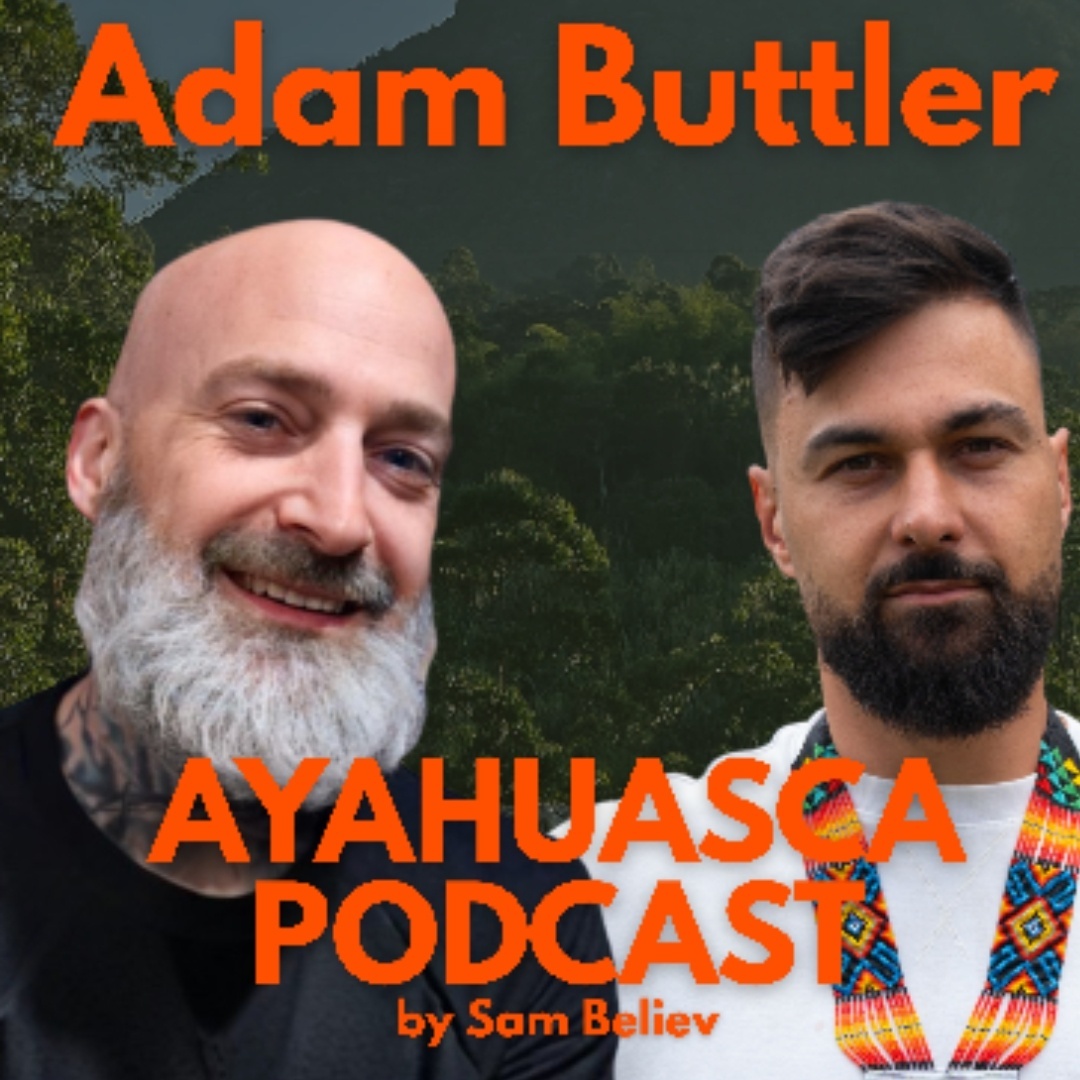
In this episode of Ayahuasca Podcast, host Sam Believ (founder of http://www.lawayra.com) sits down with Adam Butler — psychedelic philosopher, researcher, and author of Butler’s DMT Field Guide. Adam shares his transformation from addiction, depression, and a suicidal breaking point into a life built around self-knowledge, meditation, and consciousness exploration. We cover the differences between ayahuasca and smoked DMT, safety/containment, “midlife crisis” vs depression, entity/spiritual protection, and how to integrate extreme experiences into real-world change — plus a lighter look at creativity, leadership, and relationships.
Timestamps / Topics
- 00:01 – 00:50 Intro: Adam Butler, Butler’s DMT Field Guide, “DMT-saturated perspective”
- 00:55 – 03:27 Adam’s background: alcohol removal, depression, suicidal ideation, life “on paper” vs inner collapse; mushrooms as the start
- 03:28 – 06:12 The DMT “last resort” moment and first breakthrough: perspective shift, present-moment relief, not a magic pill but a turning point
- 06:12 – 07:55 Oliver update (LaWayra GM story) + Sam’s question: am I in a midlife crisis?
- 08:06 – 12:34 Midlife crisis vs depression: “indicator lights,” pressure buildup, avoiding explosion, alignment vs masking with work/alcohol/pills
- 12:34 – 17:11 What heals? neuroplasticity vs spiritual process, “instruction manual” feelings, vibration/hum, expanded senses, getting out of your own way
- 17:11 – 24:00 Smoked DMT vs ayahuasca: duration (~7–8 minutes), intensity, “no hangover,” multiple sessions in one sitting, pros/cons of each modality
- 24:00 – 30:41 Safety + spiritual protection: why containers matter, sitter/space-holding, intention/reverence, entity risks, disclaimers around solo use
- 30:41 – 36:48 Sam’s position: no gatekeeping, but sequence matters; risks of DIY ayahuasca; responsibility to prevent backlash in the “renaissance”
- 36:48 – 40:44 Adam agrees: cautious approach, book as conversation starter, recent entity-heavy session = why first-timers shouldn’t go alone
- 40:44 – 46:33 Fun/esoteric side: “recognition” of DMT, jester/entities, body “diagnostic,” future-self feeling, being “moved” to another space
- 46:33 – 52:08 Integration: inner compass + accountability, practices that sustain alignment, psychedelics not for everyone, nature retreats as medicine too
- 52:08 – 55:00 Beyond therapy: creativity, science, politics/leadership, relationships + intimacy (with care), enjoying being human
- 55:00 – 56:36 Where to find Adam: socials + free PDF offer; closing
If you got value from this conversation with Adam Butler, please share it with one person who needs to hear it. And if you haven’t already, subscribe / follow the show so you don’t miss the next episode.
Where to find the guest (Adam Butler)
- Instagram / social handle: @booksbyadambutler (this is his main handle across most platforms)
- Email (for a free PDF copy of his book): bo***************@***il.com
- Book: Butler’s DMT Field Guide (Adam also shares access directly via email)
Transcript
Sam Believ: You’re listening to ayahuasca podcast.com.
Adam Butler: In my case, I needed to dissolve pretty much everything in my life and then move forward. But the alternative is you either explode, do drastic things like I was gonna do, or you just, for 20 years, you’re a miserable person. You have a horrible relationship. Now, I also on paper, had everything going for me.
I had the high paying jobs, I had multiple houses. I had fancy sports cars. I had beautiful women, but I had so much chatter and negative stuff going on in my own brain. I started with shrooms and I was getting really good therapy and really good inner reflections and that deep shadow work. But it really wasn’t until DMT that I would say I had that life-changing epiphany.
DMT really had saved my life and had that transformative effect, whether it be a DNA download or an upgrade, whatever it was. But it was this instantaneous conveyance of information that completely changed the perspective of, you can’t run from your psyche. I was really forced to shine that proverbial mirror up to myself.
You’re more than your physical body and that you have more than your five senses.
Sam Believ: Hi, guys, and welcome to Ayahuasca Podcast. As always, with you, the host, Sam Belyev, and today I’m having a conversation with Adam Butler. Adam is a psychedelic philosopher, researcher, and the author of Butler’s DMT Field Guide. Known for his DMT-saturated perspective, Adam has explored the medicine hundreds of times to bridge the gap between clinical science and real-world experience.
After a transformational personal journey overcoming addiction and mental health struggles, he now focuses on the intersection of neuroplasticity, deep meditation, and human potential. Through his writing and advocacy, Adam provides practical guidance for safe exploration, helping others navigate the extreme limits of consciousness to achieve profound self-awareness and healing.
This episode is sponsored by LaWayra Ayahuasca Retreat. At LaWayra, we combine affordability, accessibility, and authenticity. LaWayra, connect, heal, grow. Guys, I’m looking forward to hosting you. Adam, welcome to the show.
Adam Butler: Thank you for having me. I’m excited to have this conversation for an assortment of reasons.
Sam Believ: Adam I know a little bit about your story, and specifically about how DMT played a role in saving your life. So te- tell us the story of your transformation and what brought you to this line of work.
Adam Butler: So I guess my, my big transformation and really my introduction to psychedelics happened around age 40.
So I’m 45 years old now, so I’m kinda f- four or five years into this journey of first removing alcohol from my life, and I know you’ve talked about that in, in a prior episode, but that was a, a major aspect of my personal journey, which was just, having that self-awareness and understanding that needed to be, taken out of my life.
But I started my exploration with shrooms, and at around 40 years old, like I mentioned, I hadn’t experienced psychedelics for probably about a 20-year break. I had done some LSD and shrooms in college, but prior to that they really weren’t even on my radar. But I was going through a whole assortment of things and, we can get into the specifics of it, and I kinda go over some of the bullet points in my book.
But similar to a lot of the people that come to you, and it sounds like, a little bit of your origin story and y- your buddy Oliver that we mentioned, in, in your beginning podcast, that I was in a really dark, depressive funk. And not to put it lightly, I was suicidal and I was really at a dark place.
Now, I also on paper had everything going for me. I had the high-paying jobs. I had multiple houses. I had fancy sports cars. I had beautiful women. Anything that, that a, a man typically would want. But I was just… I had so much chatter and negative stuff going on in my own brain, and I had multiple ha- events happen in my life over, a sh- relatively short period of time where I lost several relationships I lost several jobs.
I got a restraining order. I threatened to kill a person. That it got really bad, and all of this kinda culminated in me needing to do a, a deep self-reflective journey, and I started with shrooms. And I got… I started that journey because I was hearing a lot about the therapeutic value that other people are experiencing, and I decided to go that route first, and I was getting really good therapy and really good inner reflections and that deep shadow work.
But it really wasn’t until DMT that I would say I had that life-changing epiphany
Sam Believ: Nice home. You tell a story about having DMT and then if you don’t go, if the DMT wouldn’t work, you were planning to go to the forest and not come back, right?
Adam Butler: Yeah. And I’m, I’m– I try to say that in a colorful/poetic way, but there’s really no way to mask how dark and what a shitty place I was in.
And, in retrospect, it was really all to my own making, and I can say now several years into this journey and having some hindsight into it I really was my own worst enemy. I was the, the worst thing going on in my life. And it wasn’t so much even alcohol or my relationship with money or with, and relationships with women.
It was really just my lack of self-knowledge, my lack of self-love, my lack of understanding and, really I was looking for external solutions to all my internal problems and it was driving me nuts. And really the– and not just necessarily say that they were two complete different categories between the shrooms and the DMT, but I think with shrooms, the, the big takeaway for me was, and some of them I went pretty deep, pushing seven, eight grams and, going and doing several doses within those sessions.
And so you can’t run from your psyche. You can’t run from the scars that you need to address. And I was really forced to shine that proverbial mirror up to myself, which helped take ownership of where I was and what my issues were. But I really had no ability then to move forward with a game plan.
And I think the similar story to literally everybody that I’ve talked to that have– that’s come across DMT or Ayahuasca is that it got put into their lap, that it got brought into their life synchronicity, synchronistically-wise, multiple times. And that happened to me and it, it happened so that a, a friend of mine offered it to me and, that’s when I had that, that incredible experience that first day.
And again, I’ll be happy to go over the details of it, but it ended with multiple sessions over the course of about an hour and a half that ended with me having just a completely different perspective shift and an understanding of myself relative to time that allowed me to not have the stress and anxiety about worrying about past or future events, and I could really just live here now.
And like I said, that was years ago, and now it’s not that was a magic pill and everything in my life is perfect and fixed. Just the opposite. It’s trying to spotlight on everything that was going on. But now I can move forward in a way that is beneficial to myself not detrimental.
Sam Believ: I’m happy it worked for you and it found you where it needed to find you. And I’m also… it’s funny that you in preparation for this podcast, you went to the very first episodes, which were filmed long time ago with me and Oliver. And back then I had only knew Oliver for a few days.
He came to the retreat, and I just liked the way he spoke about things. He was very eloquent. And currently at the moment, he’s actually a general manager of LaWayra. He came back several times to volunteer and then about six months ago he joined us as as a general manager. He unfortunately had to leave because of some visa and tax issues, so he’s kinda now working remotely.
But that, that story had the happy ending. And I wanted to do an episode 100 podcast with him kinda saying “Look how… where we started and where we are now.” But he was away, so I kinda… I think we’re at episode 110 or something like that now. But just so you know the… what was the outcome of the story.
But- I wanna talk about midlife crisis because I’m 37 years old now, soon to be 38, and recently, specifically, a lot of things in my life started falling apart and I started reading Dante’s Divine Comedy, and there it’s a journey about a midlife crisis person. A midlife crisis apparently happens on average somewhere between 35 and 45.
So I’m wondering if I’m in it or it’s just something similar. But j- just tell us about it, tell us for people that are listening that might, might be going through something similar how to spot it. What’s… what is a midlife crisis and what is just a normal depression or something?
Adam Butler: I’m glad you, you ended it with that question of how to spot it because listening to that conversation with you and Oliver years ago you guys were all hitting on it and I wrote down some of the things that he said about how he got brought to this and brought to you and again, many people because of pain, because of sickness, because of a, a feeling of meaninglessness.
And in hindsight, and again, not that I’m some enlightened soul and that I’ve figured this all out, but I can say now that living in a way that is completely opposite to the way I used to be, and I say, very happily and confidently that I’m very comfortable in my own skin and that I live my, my days now full of joy and contentment.
And I guess how do you spot it when things aren’t going right is that you have all these indicator lights and you have all of these stressors that most people think of as annoyances, but they’re really your own physical body or your own spiritual body or your own mental anguish telling you like, “Hey, you need to listen to me.”
And sometimes I use the analogy of like indicator lights on an automobile where they’re telling you when the oil’s low or when the, when it’s too hot or when the, oil… or excuse me, the tire pressure’s too low. And I think life gives people those indicator lights, but in society, the easy thing to do, or not easy, but what most people do is mask it with alcohol like I did, or take a bunch of prescription pills, or just work 70, 80 hours a week.
Or, if you’re making five grand a week, it’s okay. Or you know what? You have five or six kids, so of course you don’t have time to address these. And I think that happens for year after year, and it comes to a point where just people can’t take it anymore.
And I guess my kind of advice to people is you don’t have to, let it get to that pressure point where you lose your job, you lose your wife you piss off your kids so that way they no longer talk to you. Or unfortunately, like myself and so many middle-aged men they think that suicide’s the best answer.
And I think there are multiple ways that you can use that pressure relief valve to release that pressure before it gets to that level. Now that being said, I think It, it’s not just a matter of relieving the pressure so you don’t explode, or, “Hey, don’t just, don’t just drink alcohol like I did and, you have to addre- address these issues.”
It’s really a matter of using that to a- addre- address what you’re doing in life and how you’re aligned. And a lot of people don’t necessarily know what path they need to take, but I think if they follow their gut and their intuition, they know when things feel good and feel right, and when things feel aligned.
And, there’s some kind of woo-woo corny ways of wording it good vibes or good energy or… But people feel it, and people feel it within themselves. And so kinda I guess the long, rambling answer is just that everybody will know some of the things that they need to address.
But the hard thing is that sometimes that may mean you need to get a divorce, or you need to quit your job, or you need to move to Colombia and start an ayahuasca retreat. Or, like in my case, I needed to dissolve pretty much everything in my, my life and then move forward, and that can be very challenging for a lot of people.
But the alternative is you either explode and do drastic things like I was gonna do, or you just, for 20 years you’re a miserable person. You have a horrible relationship. You live in a loveless, sexless marriage. You work at a job you hate, and you just live a shitty existence as opposed to living an existence that’s aligned with your purpose and full of contentment and joy.
And I think that’s… And everything that I’ve kinda heard you and your guests talk about, y- not once have anybody really saying that, “Hey, I’ve figured the perfect path and this is the way, and this is… You have to do it exactly like me.” It’s kinda just the opposite. We’re all gonna find our own way, and we’re all gonna figure out what’s works for us, and that’s kinda the beauty of this path, is that there’s multiple ways to kinda unlock the human potential and unclog that, that funk.
But ideally you do it before you explode like I do.
Sam Believ: Yeah. First of all, congratulations on finding the way out and not taking the easy way out in the in air quotes. I don’t think it’s easy karmically speaking, but yeah, some, some people that end up killing themselves in that kind of crisis.
Yeah for those who might have suicidal ideation I just highly recommend before you do it, try ayahuasca. ‘Cause we had we had so many people that would buy a one-way ticket to LaWayra and, Then after, after going through this experience telling us like, “Yeah, I was openly suicidal,” and and now I’m like, “I can’t even fathom the idea of it.”
‘Cause it just shows you very quickly how beautiful it is to be alive. And but while you’re in that space, it’s so hard to change the way of thinking. That’s where I think psychedelics come in because it’s such a strong intervention. So let’s talk about that. You you’re in a very bad place and you engage with mushrooms and then DMT and it helped you come out of that funk as you say.
What is… what do you think is the mechanism of that healing? Is it something about neuroplasticity or is it something more of a spiritual process? Like what do you think helped you there?
Adam Butler: Oh, that’s complex answers to that, the very complex question. And I think it’s an assortment of things. So I think first, the psychological mirror that gets held up w- in any type of psychedelic exploration, and I think for me it was shrooms. Ayahuasca, and I’ve done ayahuasca several times, so I know it’s similar to that, where that’s a really reflective inner journey where you’re forced to go through things that you may have tried to run from in the past.
So that there is a psychological aspect to it. But I think there certainly is a, a physical and physiological aspect of it, to it as well. And ultimately, that’s what really attracted me to DMT in particular, was that it is naturally produced in our own bodies and, the, the term being endogenous.
And that’s what a lot of the, the original studies, why they were interested in it, because it does seem that this molecule does, it’s metabolized differently and it does do something that, that is, is clearly profound. And To your point I think it allows for not only neuroplasticity and, I’m not a doctor, I don’t know necessarily how to prove these things and there’s a lot of words whether it be neuroplasticity, neurogenesis, where you’re actually, growing new neural synaptic connections, whether you’re removing blockages.
I u- use the analogy all the time of kind of removing plaque and somehow, some way just things get removed out. But a- as you well know the DMT experience is very visceral, and it’s all about vibration, and it’s all about this hum in this energetic field and this kind of expansion of your natural five human senses.
And when your body gets into that flow state and into that connective state, and you’re just in that beautiful, blissed-out, hummed, literally vibrating state th- there’s so much that, that can be exposed and shown about how your body can really work. And you mentioned again in that ear- that earlier interview that it, you felt as though it gave you an instructional book on how to work your body.
And those are some of the things where I’ve had several experiences where you feel like you, you really do learn how your human body is supposed to function, and not only how you think it should function with the normal stuff like breathing and blood flow and whatever the normal stuff, but you realize that you have so many more expanded abilities and so many more expanded whatever potential, and that you can connect to energetic fields and vibratory information in so many more ways than just your normal five senses.
So when you allow yourself to do that I think with the proper intention it can only be an expansive experience, which hopefully would allow for growth, which al- which allowed for me to stop banging my head against the wall and just stop being an asshole. For me, it was really that simple.
Just stop being a jerk, stop being mean to yourself and to other people and get out of your own way. But unfortunately, that seems to be a really common blockage for a lot of people.
Sam Believ: So I’ve I’ve never tried DMT in like a DMT pad or smoking DMT kind of way. I’ve only engaged with DMT through, through Ayahuasca.
So the obviously once again we’re not recommending anything to anyone that’s everyone’s an adult. So talk to us about how, what is that experience? And I know it lasts a little shorter. What do you feel, see? And talk to us about how, what’s, what are the main differences between Ayahuasca experience and the pure DMT experience?
Adam Butler: And I’m assuming your audience is gonna be a little more learned when it comes to this, this space and this topic, but, I can’t tell you how surprised I am w- with how, not necessarily naive, ’cause that implies a, a, a kind of like ignorance, but a lot of people just have no understanding of DMT.
Is it Ayahuasca? Is it not Ayahuasca? Is it do you drink it? Do you smoke it? And I think part of the conversation, and that’s why I appreciate your podcast and ultimately why I reached out to you to ultimately, be asked to share my story with you, is because I think it’s important to talk about the differences.
Because again, psychedelics are not for everybody. DMT is definitely not for everybody, and, depending on who you are, Ayahuasca may be the right way or it may not be, and smokable DMT may be or may not be, and I think it’s important for people to have the information. I really appreciate that, that conversation.
As you mentioned, DMT is the active ingredient in Ayahuasca combined with another bind the MAOI that allows your body to metabolize it in a prolonged period. I think the– So I guess the big difference is, you drink or ingest Ayahuasca. With an NDMT, you’re smoking the, the crystal straight up or you’re putting it into a, a, a, a tobacco pipe and you’re inhaling it like that.
And I think there are pros and cons to both modalities and both experiences. As you mentioned, though, when you smoke DMT the experience typically lasts about seven or eight minutes, and it’s extremely intense and, depending on how m- how many hits you take, you can go f- a full breakthrough experience, a full blast-off, but it really is less than 10 minutes, and then you come back and there’s no hangover, there’s no re- residual feeling.
There’s no, your body really does absorb it, and I think it is because it is endogenous and it’s not some foreign substance. But you have this, this ability to go extremely deep and to see. And we could spend hours and hours talking about what in these experiences, but, you, you– the person, for the first time, to touch that, to tap that, to see that, to have, to experience what it’s like to have the, the veil removed and to, to connect with source and all of these amazing things that people talk about experiencing, but then to come back, to be safe once again with no hangover.
And in my particular case- I did about seven or eight sessions the first day that I was exposed to it, and th- there’s a couple points, I think, along that path that, that are potentially valuable for somebody that’s looking to potentially get into this. So the, the first the first hit that I took, it just really felt– and it tasted natural.
It felt innate. As much as your body starts vibrating and humming, and as much as there’s a lot of weird sights and sounds and instantly your body starts responding to it, but it wasn’t fearful. It wasn’t frightful. It wasn’t like I was being poisoned. It really felt like I was going back to a more natural state, and that first kinda experience was it, with it.
There wasn’t any entities. There wasn’t any profound breakthroughs. It really was just, “All right, cool. This feels really nice. There’s this vibratory hum,” and your body can obviously get hypersensitive. But it wasn’t until I pushed it several sessions until that, that kinda last breakthrough session that I did kinda have a conveyance of information, and it was more than just the colorful sights and sounds.
And that’s, that’s when I say that DMT really had– that it saved my life and had that transformative effect because– A- and again, people talk about it, to try to talk about whether it be a DNA download or an upgrade or a, how- whatever it was, but it was this instantaneous conveyance of information that completely changed the perspective of my life that I needed changing.
And the, I guess the, the beauty of all of that is that you can have– I had seven or eight really deep psychedelic sessions in the matter of two hours in one day and this is where I’d like to kinda, talk about the differences and how there, there are different, the pros and cons and value to each kind of modality.
But in my particular case, I needed that blasting. If I didn’t have the breakthrough that I had, I was, like I said, gonna– I was– That was gonna be my last day on this planet, so I needed that shakeup. And it– and I hope people aren’t as in deep of a place as I was, but the truth was is that’s what I needed to have happen.
But so I guess, there there’s the beauty of having that s-seven-minute session by yourself when you need it. But then I also can really appreciate the several weeks with a group of 20 people where you can have that kind of community effect and all of the things that you’re building and sharing and doing.
I’ve also experienced in other ways too. I think there’s a, a combination there, but for some people, one of– maybe it’s more accessible to do what I’m doing. For some people it may be more accessible to do what you’re doing. But I think ultimately what I’m trying to do is just share the story that there is a light at the end of the tunnel, that there are ways of gaining access to this.
And again, as much beauty as there is in the retreats, and I’ve done the retreats and I have several booked not Ayahuasca retreats, but other, meditation retreats. But for some people, they may not have the money or the time or the passport or the ability to do that, where, in my book I have recipes about making their own, not only their own DMT, but I have Ayahuasca recipes and what I call DMT brew. Because, as traditional Ayahuasca really is typically two ingredients, where you can make a, a DMT brew with any DMT-based plant and any, any MAOI. And I talk about basically just saying that this doesn’t have to necessarily be something that’s either kept in the closets or held out in the jungles, that it can be with reverence and respect brought back into people’s lives.
Sam Believ: Okay.
Adam Butler: Knowing that’s a dangerous and, and-
Sam Believ: Yeah. So- …
Adam Butler: narrow path to walk, and that it’s,
Sam Believ: again, not for everybody. Yeah, but the, the disclaimer I def-I don’t recommend doing Ayahuasca without a shaman. I don’t know much about DMT. I do know quite a bit about Ayahuasca. And whatever, whatever psychedelics you choose to engage with, just make sure you have safe, very safe container, and don’t do it by yourself.
And yeah, I, Yeah, I don’t recommend, definitely with Ayahuasca, don’t do it, don’t do it by yourself, because I’ve seen things where if there was no container and there was no shaman, there would’ve been negative consequences. But once again I don’t know how similar or different DMT is. So talk to us about if someone engages with DMT in, let’s say- they do it by themselves which I think is not good.
At least have a friend or someone, because any psychedelic experience, right? Just from the point of view of losing control and maybe, jumping off a balcony or something like that, just like a very basic period of time where you’re unable to protect yourself from external things. What do you think about the sort of more esoteric things like, the reason in the traditionally in the ceremony there is a shaman is because they protect the space from entities, energies, and they help not just from the point of view of physical safety, but also spiritual safety. What should people do to protect themselves spiritually, like, when they engage with these realms?
Because obviously those, those realms there, they’re not empty, and the things that exist there they’re not always helpful. Sometimes they’re might be neutral, might be negative. So is there any- anything in your book that you tell people about this?
Adam Butler: So yeah, and that, that first day that I did push DMT pretty far I did have my– one of my, and I consider him my best friend, my brother, who was there, and he did hold that safe space for me.
And being respectful of the term shaman, obviously that, that’s a, something that is beyond what typically people can just say they can become. But my friend really what he did for me was just hold that space, give me… And he didn’t– It wasn’t a matter of, “Hey, what did you see?
And let’s try to integrate what you learned, and tell me what you saw.” It really was just knowing that he was there with the intention of protecting me, of keeping me safe of really making me feel comfortable. And I would say n- 99% of my psychedelic experiences, I do have somebody there with me.
And a lot of the times it’s just my girlfriend and I, and we’ve– we have become that safe space for one another, and we’ve go through the routine and go through the intention of going through being that for one another. And and I do– Actually, before I get onto some of my own practices, I just recently had another really good psychedelic experience that was, maybe my first kind of like retreat-like setting where I did have a husband and wife team that was there to hold space to, to, basically set the, not only the environment, but really be there to guide my soul and to help with the experience.
And as well-versed as I am in my psychedelic adventures they taught me so much and shared so much with me, and it was so beneficial to me that I have a, a whole new appreciation and understanding of what it means to hold space for one another and how powerfully grounding and helpful that is.
And that, that’s only something new that’s been exposed to me in the last few weeks. And I say that with appreciation for what it sounds like you’re doing, that you’re really allowing this, this safe environment for people to explore this. But yes, and I agree with your point, ideally find somebody that you can feel safe with.
And again, it’s not there to be a therapist or that you need some big tough guy to physically fight off demons. It’s just, it is nice to have somebody there that has your best interest, in mind around you. And then for me personally I really just make sure I get into that, that sense of gratitude and thankfulness certainly respect and reverence.
And with each session, I typically try to have some sort of why am I doing it? And sometimes it may be just to go in and give respect and reverence. Sometimes it may be for can I have, some creative infl- input to get into a flow state. Sometimes it may be can I get advice for my next path or whatever it may be.
But I’m never doing it just because I’m, it’s– I’m never doing it really in a recreational party setting. Every time that I’m exploring psychedelics, it’s with the intent of expanding my consciousness, with learning more about myself, and always giving respect to that, to the medicine and to the molecule.
Because I think that’s one thing that I definitely wanna convey and that there may be listeners that will, would maybe be like if it doesn’t have the ceremony and the ritual that, that you provide, or that it doesn’t have the generational shaman history that you have, and that it’s not the truly what you’re providing, plants from that area pr- made by a shaman,” and that I’m potentially saying, “You can do this in your bedroom and you don’t need the shaman.”
And I’m– I, I don’t wanna say it like that because I do have… You need all of those things. You need to try to somehow replicate the intention that you guys are providing, and ultimately I know that we or I will fall short. You know what I mean? That there, there’s no way that I’d be able to provide with one person the ceremonial ritual aspect of a group of 25 people being served by a, a shaman who’s been doing that for his entire life.
Sam Believ: But
Adam Butler: what you can do is try to try to protect yourself as best
Sam Believ: you can Have you ever sat with the medicine with Indigenous shaman? This episode is sponsored by LaWayra Ayahuasca Retreat. Most of LaWayra if you’ve been listening to this podcast for a while. Some of you might have already been to LaWayra before.
For those who don’t know us yet, we started LaWayra four years ago. At LaWayra, we combine authenticity, accessibility, and affordability. LaWayra is currently highest-rated Ayahuasca retreat in South America with more than 700 five-star reviews and an average rating of five stars. If you come to LaWayra, you’ll experience powerful, authentic ceremonies led by our Indigenous shaman, Fernando, in a very beautiful venue just one hour south of Medellín, Colombia.
We’re surrounded by nature and have comforts like hot water, Wi-Fi. At LaWayra, our team has guided more than 2,500 people through this life-changing transformation of Ayahuasca experience. At the same time, we keep it very affordable. So whether you’re coming for healing, clarity, or a deeper connection to yourself, LaWayra is the best choice.
If it is your first time drinking Ayahuasca, you will love our three-and-a-half-hour preparation course and integration support. All of that is included in price as well as pickup from Medellín, accommodation, and Ayahuasca. Visit lawayra.com to book your retreat or learn more. LaWayra, connect, heal, grow.
L-A-W-A-Y-R-A.com.
Adam Butler: I have not. No. No. White people that have been trained by Ind- Indigenous shaman but not No, and because honestly, so I’m 45 years old. The, up until a few years ago, this was so far removed from anything in my life. I- it was just rat race, make money, have material we- wealth, gain all the things, and it really wasn’t until a few years ago that I started exploring all this.
So I have and I try to convey this when I speak about it. I have full humility and I know that I don’t have all the answers, and that I know I’m kinda learning along the journey. But I do feel like at this point there are valuable data points for me to share with people, and it seems to be aligned with what a lot of people are coming out of this story and narrative with is, that the answer’s within, that we can all find it on our own journey, that it’s not gonna be easy, and that ultimately these, these plant-based medicines, if done properly, can be a catalyst to really set off some transformational change.
And-
Sam Believ: So-
Adam Butler: That’s… Yeah …
Sam Believ: I see what you’re saying, and I agree largely. I I definitely invite you to come to La Wayra to try an indigenous container, just out of curiosity, just to once again widen your scope. And I am definitely not, I d- oh, I don’t like the, the gatekeeping or censorship of certain things, but at the same time, I want to just tell my opinion about more psychonaut way of doing things.
So here’s what I believe. Sometime in the past, there were people that discovered psychedelics, and they… There was a first person that took psychedelics without a shaman. That’s just how it must have happened historically, and it’s totally okay, like citizen science, finding out the way to work with those substances yourself.
Obviously, like if you can do it legally and responsibly, and eventually you will get to the point where you will… If you work with those substances, you kinda will step on a shamanistic path. It’s inevitable because those medicines will teach you that. There is merit to both views. Obviously, as you say, let’s say somebody can’t…
They can’t come to a retreat and container with the shaman, and all they have accessible is a DMT pan and a friend to sit there with them. If they’re in a really bad position, nobody should tell them not to do it. But if they’re… If people do have a choice and options I would say leaving those more psychonaut things just slightly later in your journey when you already have experienced the plant medicines or psychedelics in a container so that you know better how to do it, and you don’t like, freak out.
Because if you’re experiencing that for the first time, or you never felt it before and you’re in an unsafe place, and no- there’s nobody there to support you, it just can be very challenging. So I would say I see a lot of merit in, in, in psychonaut’s work, and I’ve interviewed a few psychonauts, like people that took 30 grams of mushrooms, and it’s it’s a sort of more fun, more adventurous, more like Wild West side of psychedelics. But for people like specifically looking for healing, just there must be sequence to that. Because with like obviously you have a certain information and the sample size of people you work with and yourself, but like here we’ve had close to now probably 3,000 people that came through our doors and had different processes.
Wow. And I can see what can happen when someone take too much medicine and might need help with therapy or- deeper sort of s- more esoterical like entities and things that need protection or removal or deeper understanding. So I just wanna make sure that people walk away from this episode with curiosity, but also like reverence and care.
Because kinda what happened in the previous psychedelic renaissance with Tim Leary and LSD is it was taken too quick and too free, and then it resulted in society reacting in a bad way, and then we kinda, we were sent back in space. So I just hope that people that do engage with those substances, they do it in a very gradual way.
And if reading your book is one of the ways of doing it, but DMT obviously is not a tr- traditional plant medicine. But when it comes to Ayahuasca, like and seeing so many different traditions and having more than hundred experiences myself I just don’t like the idea of people cooking their own Ayahuasca and doing it in their basement because of knowing how many Po- potential dangerous things there might be in it.
From just a simple thing of somebody drinking ayahuasca, lying on their back, vomiting and drowning in their own vomit just because they don’t have people around them to protect them. It’s a– Those are extremely powerful tools, and I understand that if your choice is suicide, death, or doing it by yourself or without the container, yes.
But if it’s, if you have time and space, definitely get experience first with someone, and then eventually you get to the point where, like with ayahuascas eventually you get to the point where a shaman will tell you’re ready to drink by yourself or even you’re ready to serve it to other people.
That’s what I… Just a disclaimer, because I don’t wanna say what you say is wrong or I disagree completely, but at the same time kind of being a bit more responsible with the information we put out there.
Adam Butler: So I actually agree with everything you s- you say. And I agree that if people– This isn’t something to make a rash decision.
It’s not something that you just jump into. A- and if you have the ability to plan and to have the support, I really agree with you. And I actually just personally had an experience the other day that kind of con- confirms this where– So ac- actually, I don’t wanna just jump to that because I don’t wanna just pass over what you said.
And that, that’s why I’m– I wanna have conversations like this because I don’t have the answers on how I present this information in the best way. I know I’m presenting potentially recipes that, that need respect and reverence, and knowing that they– there is potential for abuse, and that these aren’t something that everybody should have access to.
And again, I don’t pretend to say that I have all of the, the answers to that. What I’m trying to do ultimately by having conversations with people like you and, all the people that have been there and done that and walked that same path is, yeah, how do we navigate this conversation where we can approach it with more information, more humility, more openness but try to remove some of the taboo and stigma to it?
But I mirror that. So if you can– And even before I got into the DMT, so again, I was doing shrooms for several months. I read as many books as I could. I listened to as many podcasts as I could. I tried to educate myself as much as I could to feel at least somewhat comfortable. So it, it’s not something that you just jump into.
And by all means try to get that support staff, try to reach out and- U- ultimately, yeah, if you can reach out to people like you that, that are able to provide that support. The story, I guess I just went really deep the other day, and now I’ve done it hundreds of times. I’m very comfortable with some of the, the extreme experiences.
But ultimately, I had one that had some kind of entity interactions that were really not scary because I’ve experienced those things before. But for the person, if that would’ve been their first experience and if they would’ve been alone, it would’ve been horrendous. They would’ve been a, that would’ve been a horrible introduction to DMT and it would’ve not helped them, I don’t think.
So- to your point it’s not something that I think anybody should just go make and grab and start ripping it in their own house, and that, that’s not necessarily what I’m suggesting people do. I guess it, it’s more just if this book can be the beginning of a conversation, if this can get piquing interest, if this can start an intellectual curiosity, if this can then bring you to, more of the refined literature like the Rick Strassman and more some of the, the more academic studies out there, and then maybe ultimately to the people like you that have been doing this now.
Like you said, for you to say that you served thousands of people, that’s fucking amazing, man. Congratulations and thank you for… Because without even hearing that the stories of people leaving your place, like I, I guarantee you, you’ve truly saved lives, which is exactly why you’re doing what you’re doing and ultimately why I’m trying to share my message.
But knowing that there is, yeah, this very delicate balance of life and death on the line of how do we talk about these subjects. But yeah I don’t wanna say approach this with an absence of caution and just go full bore psychonaut mode and just try everything. I n- but I do also wanna maybe say that, like I, I went to the Monroe Institute for over for, it was a week’s stay to do kinda their meditation technology.
I have a darkness retreat booked next month where it’s gonna be four days in, in full darkness. I am doing other modalities to try to get a better understanding of where I’m at, but yeah, to your point it’s not for the faint of heart, and it does take some practice and requirement and help and support.
Sam Believ: Yeah. I think the, the word psychonaut describes it itself. It’s s- like astronaut. It’s like you, you’re going to an un- unknown, to certain kinda adventurous spirit, and I guess people who do go that psychonaut route they’re open for for the difficult and dangerous things that also lie in their way.
But let’s now with the, with that sort of more serious things out of the way with disclaimer and trying to do our best, making sure people understand how dangerous it can be, let’s talk about more fun side of it. What are the sort of more interesting, more crazy esoteric things you’ve encountered through DMT?
‘Cause I know you speak about things such as like remote viewing, holographic matrix, toroidal fields, all those things. Let’s talk about that.
Adam Butler: Yeah, so I’ve got, hand- handfuls of really colorful, exciting stories. But I think b- for– to paint the picture overall how it could really help people you can imagine what your body could be like if it, if all of that plaque is removed, and that you know that you’re more than your physical body, and that you have more than your five senses, and that you’ve been shown, like you said, you’ve been given a guidebook or handbook on how to use it.
You can imagine just how amazing w- everyday walking life can be. So beyond even all of the, the crazy psychedelic experiences, I think the point of going to these psychedelic realms and having these experiences is to try to, come back and integrate it into everyday life, where you can see the, the beautiful in the mundane, so to speak.
And that’s… The– as, as much as I love going into these crazy psychedelic spaces, I guess it’s really more how my body has been refined when I’m not in the psychedelic space to still see the expansiveness of that kind of realm. But I guess maybe some of the, the highlighted interactions would be, again, that, that first day the first session when I instantly ingested it for the first time there was an instant recognition that I had tasted this and smelled it and felt it before, and it brought me back instantly to when I was a, an adolescent, you know, I think probably around 10 years old, and it just was a, a very vivid feeling of, “Wow, this has been in my body before.”
So that is just weird relative to any other psychedelic I’ve done. Typically, when you’re doing shrooms, it’s like, “Oh, fuck, the poison’s kicking in,” or LSD, you know something’s happening that, that is foreign to your body. But this, that just recognition that this is normal, natural, and don’t be scared, that was surprising because as, I heard about how intense it was, and it is intense, but it wasn’t– it was comforting in a way as well.
The end of that first day was when I had that epiphany download, which, again, to have something shift a stubborn 40-year-old guy who was set in his ways to instantly come out of it with a perspective shift, that physiological change was, was– that set the cascade of being open to then the further exploration.
I guess some of the, the cool things– So I’ve had all the, entity interactions with the cool kind of jester-y fun beings that are there to play and show you around. Those are really fantastic. But I think the, the most memorable ones are the ones that show you, like it sounds like you had, where they’re showing you how to operate your human body to its fullest potential.
So it’s almost like they’re going in and taking over your physically your body and- Showing you just really what a fantastic instrument it is. And, maybe to go back to the car analogy, where, you thought you were just this dud of a car with no features that had 100 m- horsepower that was shit, where it teaches you wow, you really are this amazing supercar race car.
And those experiences are life-changing because y- you know how divine you are and that you really are more than your physical body. And then just a couple more rambles. I guess one really cool one was I did have what I thought an interaction with my f- my future self, which the takeaway from that was, really a lack of fear of death.
I feel very comfortable that my energy will transmute into something beyond just this physical body that I am now. But, tho- those are interactions that are pretty tough to, to kinda come back from and be like, how the hell do you put that into context?” But it was– It wasn’t me with a longer beard.
It wasn’t me just older. It wasn’t all these other kind of en- entity beings. It was really my– a very comforting sense of my consciousness that was coming back to do a diagnostic check on myself. And, I guess the, the one that shook me a couple weeks ago where I was saying like, “Oh, shit,” was most of my interactions are, you’re laying in bed, you’re sitting there, and you’re experiencing what comes to you and/or, and/or, your consciousness blasts off into this DMT space.
This time, really, it felt like I was picked up and taken out of my room, and I was in a physically different location. So– But again it wasn’t scary because I was in this same vibratory hum that I had felt before. But again, you can imagine for other people being like, “What the fuck? I just got picked up and taken out of my room.
Where am I?” But those are the type of experiences that they don’t happen all the time. A lot of times it’s more just inner reflection, but sometimes you do have these crazy interactions that really can’t be explained
Sam Believ: Yeah. So what do you what is your take on the integration and how is it different with DMT?
Obviously, it’s a very short, very powerful experience. Like what’s your advice on like transforming that v- visionary experience into like life-changing routines, let’s say?
Adam Butler: I, and you saying like people that go through that experience I think the experience itself is the greatest teacher on what has to happen in the future.
As much as you or I can be there for guides, I think anybody that touches that divine that connects with that inner sense of self, that finds that self-knowledge and that self-love, Hopefully, and it seems to be the story of the people that I’m, running across, it almost becomes easy and self-perpetuating to stay aligned with that path.
Now, I’m not naive to the fact that there’s– we have to live in this society and that there’s gonna be taxes and bills and all the bullshit that people have to deal with. How do you continue along this path where you don’t self-destruct or get to the path where you’re so stressed out?
And I think it maybe goes back to those triggers and those symbols that we talked about before. You know when your body feels good. You know when you have goosebumps that, that you induce. You know when you’re around people that make you feel good. You… And I– But then also you get, in my opinion, people that have that gut feeling when things aren’t right or they feel the dark energy or see the dark cloud around people.
And I… My biggest kind of advice to people is find out what works for you. So whether it’s spiritual practices, religious practices, meditation, yoga, using medicines on a continued basis, all of those may be appropriate for each individual. And I think it, that’s the fun part is that this is gonna be a unique path for everybody.
But find out what makes you really feel good. For some people, it may be playing music, maybe writing, it may be creating art, it may be holding space for other people to do these plant-based medicines. But I know, like for me, it wasn’t just working in a job that was just to make money. It wasn’t drink 12 beers a day.
It wasn’t be a jerk to everybody. Like there are clearly things that don’t help you and don’t help society, and unfortunately most people just ignore those. Where I think you get a taste of the truth that psychedelics show you. I think when you have, when you look at yourself in the mirror under, under– with that truth serum and there’s no way of lying to yourself ideally people will come back and know intuitively what they need to do.
But I think it’s important to, have a mastermind group of friends and family to hold you accountable. I think it’s important to share these experiences with other people because they are a lot just to keep within. And I think once people are on the path of exploring themselves and knowing that they’re worthy of taking the time to figure shit out that, that’s a big part of it.
And I do wanna… Because we did say, and I– as much as, this is what you’re sharing in my books about it I really do believe that psychedelics are not for everybody, and that there are many other ways of reaching this sense of peace and this inner contentment without necessarily using medicines or these types of modalities.
I think the, the biggest thing though is to know that you’re worthy of it, that people, that to take the time and, even if people went out and spent three weeks with you and didn’t do any type of plant-based medicines, but were just out in the beauty of nature where you can listen to the birds and the chirps and, you’re connected and your phone’s away and people’s computers away, that’s what I think is really important that most people just haven’t done and don’t, wouldn’t even…
It’s not even on the radar. “Oh, how could I go into the woods for, or in, into the jungle for two or three weeks and not have my phone or computer?” It’s like that’s exactly what you need to do. Yeah. So I, it’s more just people realizing that they’re in control of their lives, that they have the ability to find that inner joy and contentment, and if psychedelics are a modality that calls out to you, I think explore it in a safe and respectful fashion, and if it doesn’t, listen to that as well.
But this, I don’t think that the data points are going away as far as how many, that this does help people, and my kind of goal and my passion is really just to share my story to let people know that there are different ways other than drinking or wanting to drive off a cliff, and that, there’s ways of exploring yourself, and that DMT and Ayahuasca are one way of doing it.
Sam Believ: Yeah, there’s many ways to get there. The analogy that I like is if wellbeing or the enlightenment or sort of nirvana is at top of the hill then, or a mountain, there’s many different paths to climb that. And psychedelics do tend to be a bit of a helicopter all the way to the top for a short amount of time, and then they take you back, and then eventually you have to find some other way up there, be it meditation or yoga or journaling or therapy or whatever that works for you.
So on that note, let’s, Yeah.
Adam Butler: Can I add too? ‘Cause you did say, to necessarily end it, if we can bring some levity, because we did go on some of the, the darker or some of the more dangerous aspects of it. I think now, so y- and you asked how do you integrate it into your life where the, the plan isn’t necessarily that you constantly have to be doing psychedelics and you constantly have to go, be going back and, tapping into these these medicines.
It’s ideally you figure out a way that you just naturally run in a holistic beneficial way. But I think psychedelics can be used other than in a therapeutic way. And I mentioned how I don’t– I’ve never just used them in like a, a rave setting or a party setting. But I do have a chapter in my book about transcendental sex, art, and science, and that I do think there’s a, an application of psychedelics to expland, expand, excuse me, not only intimate relationships, like actually using them in a sexual setting if it’s done with respect, in ritual, with, with open communication.
But I think just the ability for relationships themselves as couples to use psychedelics to allow that type of communication to really grow is important. But then just from a, a societal aspect too, what… how can science benefit from thinkers that have been expanded by psychedelics? How can politics can…
how can politics can benefit from all the politicians having more sympathy or empathy? Where, the, a lot of the story people come out of these retreats or sessions that they have a sense of love and connection and oneness, where, like these, these are aspects that if actually overlaid on society could have dramatic and lasting effects to help- What I think, the world needs, which is solving some of the ailments that are help- hurting a lot of people.
But there is, I focus mostly on mental health and suicide prevention and shed in dark- shedding light on the darkness. But there’s the other side of it, where once you’re on the other side of that and life is good and you’re not in a dark place, that now it can be fun to use these to walk through the woods and connect to the animals, to sit down and write and feel like you’re flowing and channeling some other, greater source, and then to have interactions with others that are just on way deeper levels than just verbal communication.
So there, there’s a lot there that I think psychedelics can help humans just expand enjoying being a human.
Sam Believ: Yeah, start with connection and healing and then proceed to growth. That’s, For sure … that’s our retreat motto. Connect, heal, grow. And, Love it … I wish everyone gets there to the growth part and spiritual exploration.
First we need to do some healing and some cleaning, but I’m an optimist. I think good things are coming for our society if we become more conscious. So Adam, thank you for the episode. Thank you for all the information. Before we wrap up where can people find you and more about your work?
Adam Butler: The handle on most of my social media is Books by Adam Butler.
My Instagram is probably the most active. And if anybody does want access to the information in my book, I do always offer a free PDF copy. So if anybody wants to email me, it’s bo***************@***il.com. And, if people want access to my story it, it’s there. And other than that, yeah, I f- I feel like 2026, there’s a lot of opportunities and a lot of collaboration and a lot of me being a middleman to a lot of different aspects of this story, in- including you.
And again, I really appreciate your time and your perspective because it’s a perspective that I don’t necessarily get to talk with all that often. And I think it’s important to just have an open, respectful comma- conversations. And so I’m around. People are gonna be seeing my face a lot more often.
There’s a lot of cool stuff happening, thank you. And I am open too, if anybody does want, to personally communicate, that’s probably one of the best part of being an author talking about this subject, is dozens and dozens of people have reached out saying that my words have helped, and then them sharing their stories really give me the ammo to keep doing what I’m doing.
Sam Believ: Thank you, Adam. Thank you for this episode. Guys, you’ve been listening to Ayahuasca Podcast. As always, with you, the host, Sam Bolia, and I will see you in the next episode. I hope you enjoyed this episode. If you’d like to support us and Psychedelic Renaissance at large, please follow us and leave us a wherever it is you’re listening.
Share this episode with someone who will benefit from this information. Nothing in this podcast is intended as medical advice, and it is for educational and entertainment purposes only. This episode is sponsored by LaWayra Ayahuasca Retreat. At LaWayra, we combine affordability, accessibility, and authenticity.
LaWayra, connect, heal, grow. Guys, I’m looking forward to hosting you.