
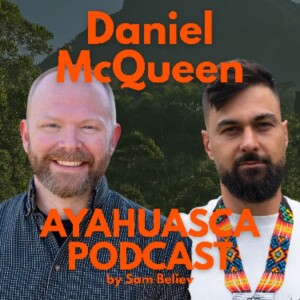
In this episode of Ayahuasca Podcast, host Sam Believ (founder of http://www.lawayra.com) has a conversation with Daniel McQueen. Daniel is a psychedelic specialist, author, and pioneer who co-founded the Center for Medicinal Mindfulness in Boulder, Colorado. With a master’s in transpersonal counseling psychology, he has spent over a decade at the forefront of the psychedelic renaissance, notably developing cannabis-assisted psychedelic therapy and leading groundbreaking work in the field of extended-state DMT.
We touch upon topics of:
- 03:12 – The transition from Western mysticism to grounded psychotherapeutic practices.
- 05:45 – Balancing indigenous ceremonial traditions with modern clinical settings.
- 09:30 – Defining DMTX: The technology behind “stable state” extended DMT journeys.
- 11:15 – The unique ability to “turn off” or pause a psychedelic experience using infusion pumps.
- 13:50 – Safety, medical alternatives, and the duration of extended-state sessions.
- 16:20 – Encountering entities, spirits, and the “presence” in the DMT realm.
- 20:45 – Facilitating communication and gaining direct access to the creative brain.
- 23:10 – Descriptions of entity forms: From ancestors to geometric and insect-like beings.
- 25:30 – Reaching cosmic-centric states and universal bliss through increased dosage.
- 28:15 – How spirits “taught” the team to refine the DMTX medical protocol.
- 31:40 – Theories on the non-physical, higher-dimensional nature of the DMT reality.
- 35:00 – The potential for mapping the DMT realm and using AI to stabilize brainwave patterns.
If you would like to attend one of our Ayahuasca retreats go to http://www.lawayra.com
Find more about Daniel McQueen at http://www.medicinalmindfulness.org
Would you like me to generate a catchy title or some promotional social media posts for this episode?
Transcript
Daniel McQueen: DMTx is just a short term for what we call extended state or stable state DMT. They figured out that they could use a medical device called an infusion pump, which basically pushes medicine into the bloodstream at a very s- specific rate. And because of the traits of pure DMT, it’s a very fast-acting and metabolizes quickly, and there’s no tolerance.
This medicine can be put through an infusion pump, and a client or a journeyer can simply stay in the DMT state for as long as they’re called to. With smoking or vaping, you go up, you’re in it for a little bit, and right before you really get your orientation, you start coming out of the experience. It’s really fast.
That’s the biggest complaint of smoking DMT. We’re able to stabilize higher dosing, higher concentrations in the bloodstream. And so some of the things we can do with this technology is we can level people out at different dosing rates, which are subjectively different experiences. We can dial it down if it’s too strong or too fast, and then you can turn it off, which is completely unknown in the world of psychedelics, just be able to turn off the medicine.
And people come down in a matter of a minute or two. You’re listening to ayahuasca podcast.com.
Hi, guys, and welcome to Ayahuasca Podcast. As always, with you the host, Sam Beliaf, and today I’m having a conversation with Daniel McQueen. Daniel is a psychedelic specialist, author, and educator who has been at the forefront of the psychedelic renaissance for over a decade. He’s the co-founder and executive director of the Center for Medicinal Mindfulness in Boulder, Colorado, the first legal plant-based psychedelic therapy center in the United States.
With a master’s degree in transpersonal counseling psychology from Naropa University, Daniel has pioneered innovative modalities for healing and self-discovery. He’s most widely known for developing cannabis-assisted psychedelic therapy, a practice that utilizes intentional high-dose cannabis protocols to elicit profound psychedelic states for trauma resolution and personal transformation.
This episode is sponsored by LaWayra Ayahuasca Retreat. At LaWayra, we combine affordability, accessibility, and authenticity. LaWayra, connect, heal, grow. Guys, I’m looking forward to hosting you. Daniel, welcome to the show. Hey, thanks for having me, Sam. I appreciate being here. Let’s start by getting to know you and your story and what brought you to work with psychedelics.
Yeah. That’s the big, that’s the big question. I think like many of us, I had a curiosity of altered states of consciousness. When I was younger, I was interested in mysticism and out-of-body experiences and ESP and and psychedelics emerged out of that space, like this, from this Western mysticism approach.
There seems to be a good overlap there. I really value psychedelics in that way and what they elicit. And then the other side of it is, I think like many of us I came into the profession for healing. I saw real potential for healing. And I had my own healing process to move through as well.
But I’d say fundamentally it was curiosity that brought me into psychedelics. I was always this way. I was always interested in meditation and things like that. So it was just a natural progression for me. I got my master’s in counseling after working in the underground f- psychedelic field for a while and being an apprentice.
And I realized that we needed to balance out the psychedelic spirituality approach with grounded psychotherapeutic practices and education around mental health. And so I feel like I hold that both/and really well in our program. I… And that’s my primary orientation. I identify as a ceremonialist.
I pray with the medicine. And but I also really value the, the therapeutic healing aspects. Sounds like like a good balance. I was curious and since you s- you mentioned s- more ceremonial approach with your DMT work, do you, … do you use any shamanic tools or maybe like smudging the space or is there anyone that kinda acts, does the role of a shaman?
As the, takes the, that role? Yeah. Yeah. Yeah, for sure. We talk about the extended state DMT, but also regular, working with regular DMT. This is all legal in Colorado now un- in certain containers. So I was, like I said I was trained in the underground, and so there’s definitely an overlap between that and indigenous practices.
But I also have a pretty good rooted relationship with indigenous communities, and I have in my past. So I learned to pray in the Native American church, right? And so even though I don’t, I’m not identified as indigenous at all, there’s a deep respect there and also a desire to honor the mi- the worldview and the mindset without being culturally appropriating.
So we… i, like I said I also come from kind of a Western mysticism and alchemical and Jungian approach, and I think there’s a great amount of overlap there. So we, so what that looks like in our ceremonies and our practices is we honor the cardinal directions and our spirit allies and friends on the other side, but we don’t use indigenous language.
We use… I personally use acknowledging skillsets and capacities and things. We honor the earth and the sky, our ancestors, and then we also have altars and candles and offerings to our ancestors and elders and spirits. And as far as smudging and things go, sometimes there’s sage in these spaces.
It’s, it depends. Like we do have a small community of folks and that include indigenous folks. But we also have, use other incenses as well, from other world traditions. And then energetically, shamanically, I think, that’s a worldview, and I’m not a materialist. I believe in energetic influences.
I believe in the need to create a sense of safety and and out of respect. And so that always is like permeating the space even if we’re not like actively engaging in like explicitly visual shamanic practices. But most… Our team is alway- has always been comprised of e- either indigenous or African practitioners, and so they’re bringing these elements into especially the DMTX work because that’s a, group process.
That takes a group of us. So that’s where I am with the ceremonial aspect is Honor it, acknowledge it, and also be very respectful of the cultural traditions that are associated with them, right? So let’s let’s talk about DMTX. I think it’s it’s very cool. You basically, you created a technology that doses people with DMT so they can have- extended DMT experiences as opposed to vaping. Obviously- … ayahuasca with the m- plant medicines with which I work mostly, it’s also an extended DMT state- Yeah … but it has other mixtures. And so this is pure DMT, and it’s more visual. So talk to us- That’s right. … About this. The- Yeah
the idea and development of it and ’cause I listened to a podcast about this with you on it, but it was like- … a while ago, so I’m sure things have changed. Yeah. We’ve really developed it. It’s pretty amazing. Again we thought we would have to leave the country. We were looking at retreat centers in Costa Rica, Jamaica to host us because D- places where DMT is accessible and allowed.
But then the law changed here in Colorado under the Natural Medicine Health Act, and that legalized naturally extracted DMT, not just ayahuasca, but it actually says DMT in the law. In Colorado, it legalized it for personal and spiritual use, and, that’s related to our church and, these endeavors.
But for those who don’t know yet, I’ll just very briefly describe what it is. DMTX is just a short term for what we call extended state or stable state DMT, and this idea was proposed by this scientist named Andrew Gallimore, who partnered with Rick Strassman, the original researcher for DMT, to get the data.
And they figured out that they could use an inf- a medical device called an infusion pump, which basically pushes a particular medicine into the bloodstream at a very s- specific rate. And because of the traits of pure DMT, it’s very fast-acting and metabolizes quickly, and there’s no tolerance. This medicine can be you- put through an infusion pump and a client or a journeyer can simply stay in the DMT state for as long as they’re called to.
And that’s different from a vaping s- smoking version in that with smoking or vaping, you go up, you’re in it for a little bit, and right before you really get your orientation, you start coming out of the experience. It’s really fast. It’s… And that’s the biggest complaint of smoking DMT. And then with ayahuasca, it’s longer obviously.
But we’re able to stabilize higher dosing, higher concentrations in the bloodstream than ayahuasca. So it’s more like a long DMT trip versus an ayahuasca-like experience. And it’s not going through our liver and stomach and things, so it’s it’s a little more stable. And so- Some of the things we can do with this technology is we can level people out at different dosing rates, which are subjectively different experiences.
We can dial it down if it’s too strong or too fast, and then you can turn it off which is completely unknown in the world of psychedelics. Just be able to turn off the medicine. And people come down in a matter of a minute or two. It’s that fast. And so literally it can be like if there’s a– if they’re having a hard time and they need to take a break, you turn it off, or if they just need to go to the bathroom in the middle of it, we can turn it off, unplug them, and then they come back and plug them back in and turn the machine on and put them right back into the state that they were in.
It’s a different kind of technology. It’s it’s it changes the whole idea of what psychedelics are in a way, right? And so we– Since legalization, I’ve had the opportunity to facilitate 30, around 30 of these, and I’ve also done journeyed two myself. So I can talk about the, the subjective experience, what we’re discovering.
But it’s amazing. It’s great, some of the benefits might be like some people can’t smoke for medical reasons, and some people, can’t take Ayahuasca for medical reasons. And this would be a good alternative, like a, a safe medical alternative for certain folks through using IVs and the infusion pump stuff What’s the longest someone has been on the, the DMT trip using that technology?
Yeah. The, the researchers were doing 30 minutes and an hour. I think they’ve extended theirs for more than that. We’ve done on average in the last cohort of folks, a couple of hours is what we were advertising and supporting. A lot… Some of those folks were doing an hour, but some would’ve du- gone longer.
We had some folks go two and a half hours. Mine was three hours. The, the last one I did was three hours. But it was very different. I wouldn’t say I was in the peak the whole time or anything like that. But technically, theoretically, again, it’s not as clear-cut as you’d think it would be. But you could go ex- you could go much longer than that, be in the full peak experience at a level that’s sustainable.
There’s a level that’s not overwhelming in a negative sense, but it’s ego dissolving, so people don’t generally stay at that level. But you could stay at a really fully peak level DMT experience for hours and indefinitely. With that being said, though, people, it is an energy-intensive journey.
It takes a lot out of you. And sometimes the spirits on the other side say, “Okay, you’re done,” and they turn off the experience before we even turn off the infusion pump. It’s like the people get pulled out of the experience sometimes by their encounters with the sacred or the spiritual. It’s interesting in that way.
So I don’t say we… I don’t think we have, always have full control over what, what’s gonna happen Yeah, I think Terence McKenna, if he would be alive, he’d probably be there right now doing 30 hours- Yeah, I think so too. … 30 hours while taking some LSD and Yeah … it’s s- it sounds like- Theoretically you could go days, you could do lower dose and go days. And you can do, like the equivalent of an Ayahuasca journey and go full six hours, things like that. There, there’s another application that’s for stroke, people who’ve had strokes. So like really low doses but extended periods of eight hours and things.
The, the medical community is really looking into the the health benefits for something like this. It’s, it appears to be like a natural and anti-inflammation medicine too. Really great- So you mentioned spirits or entities or beings on the other side. … Is there always someone or sometimes it’s there are no spirits?
‘Cause how common is it to see- Yeah, not, yeah, I’d say it’s more common than not. Some people don’t. So like there’s a couple of things. Some people will be in a landscape. For instance, one of my journeyers went to a pl- a, a distant planet, and it was… It had a feel of almost like a ancient but desert-like space, and it was the origin of love, the or- where love came from.
And I think there were like probably like pink crystals everywhere too, right? Just to give you an idea of a place type experience. But a lot of people either experience direct contact, visual direct contact and extended communication with an, what we would call an entity or a spirit. And we can talk about the types and stuff.
Wow. Or they feel a presence. It’s just like a knowing or a felt sense of a a deep sacred presence. And and similar to Ayahuasca and DMT, all the re- trip reports of all the different types of entities people see or what our people are experiencing with extended state. It’s just we get to hang out with them longer and get to know ’em and talk to ’em and listen to ’em, without being in some sort of like rush of “Okay this is gonna end in two minutes.”
So imagine being able to cultivate a stable experience with like almost like a relationship with these folks. That’s been really meaningful. That’s, like we treat it as real. Like again I have a s- skeptical part which I appreciate. Keeps me grounded. I love the scientific right mindset too, but we…
I can’t under… I can’t I can’t ignore how real these experiences feel and how beneficial they are in healing. So we treat it as a real phenomenon, and are very respectful with the spirits. And they taught us how to do the DMTX better. That was one of the first things that we learned from the spirits was how to dial in the protocol of the extended state experience to make it better, and that was- Fascinating, right?
I don’t know, like the implications of that feel unusual to me Yeah. So yeah, talk, talk to us about that. What, what kind of spirits did you see? Like, how did they communicate with you? Is it language? Is it images? Yeah, tell us more about this, Like I said, some of it’s a presence or a Gnostic knowing.
You gain access to, I call it almost like gaining access, direct access to that place where creativity comes from, just direct access to our full brain without defenses. And so it’s a really special place to be in. But, so I don’t I can only speak more about DMT than Ayahuasca, right?
So I’m coming from that perspective. There are definitely human-like realms, and the, the first two, the first- or the two journeys I did, some of the first images were hanging, were literally being with the ancestors, and they were indigenous. And I’m in Colorado think mesas and big skies and things like that.
Very indigenous. And I felt like they were directly tapped into even deeper places of the work. And so beyond the imagery of the human, there appears to be, like, there’s animal-like and insect-like but then we step into more of a unfolding hyperbolic geometry, right? And the beings have that, that sort of vibe, like geometric forms.
But, more than like many occasions, we had my friend Sky, hung out with a little a- insect-like creature on her shoulder hanging out and nud- nuzzling with her. That she had that experience. My friend Ron, who’s an indigenous practitioner was deeply connected to the imagery of dragons.
He’d seen them in Ayahuasca ceremonies, and it’s like serpents, really powerful serpents, serpent images. And, and he was, working with the dragons and doing big work that way. S- They were showing their teeth and, being very powerful. Not scary necessarily, but big. I had experiences that feel more like other alien-like forms, amoebas and with arms and things like that, and with certain patterns. And sometimes there’s this feeling of there’s different tribes of entities where they’re all interconnected as one being, but also have an individualistic perspective, too. So it’s like many spirits connected in these tribal patterns.
They had different color patterns or different different shapes to them. So it’s it’s been across the board. And then there will be people w- who have past life memories and visions of other scenes that are human, which might be related to ancestry or ancestors. And then there’s this transcendent space.
A lot of people saw Buddhas, Buddhas and ascended masters who were there to catch us and then send us deeper into the work, right? So it’s very multicultural in that way. But I would say it’s almost not even Earth-centric. It’s almost feels like a, a cosmos-centric experience, right? So it’s like you, you meet beings and s- presence and spirits that might not even be from this realm of existence or something.
And then there’s a space beyond that, right? If you increase the dose, the spirits go away. The forms and people, beings go away, and then you’re just in states of being, right? And that b- could be, like, oneness with all of the universe, really transcendent states. Being in other, surrounded by the light of universal bliss, it really gets to be more cosmic and f- cosmic forces oriented than individualistic. Really interesting space. And the thing is about DMTX, I’ll just end with this, Sam, is that you can pau- you can stabilize it at any of these levels of any type of experience. Or you wanna hang out with the ancestors, stabilize it there, and then you just stay right there with whatever you’re wanting to work with.
And then you … when you’re ready to move forward or go deeper, you re-increase the dose, and you can stabilize it and have extended experiences and relationships with these presences. It’s not fleeting like it is with, smoking DMT and it’s just there and back again, that’s- Yeah
that’s a game changer. It’s fascinating. Today, is that a technology they used in the Imperial College London for the- … for mapping the DMT realm ex- experiment? Yeah. That’s, that was the first funded study was Imperial College. Zimmermann and those guys. Yeah they started with 30-minute sessions, and I think they did another series with an hour session.
And I think it’s ongoing. I don’t know where they’re at anymore. They’re connected with a retreat center now too in The Bahamas. And so they’re, those guys are working on this. I think they were do- they, so we, they were more of a re- a research model. So they had to do certain things like ask a rating scale every minute or, and then do blood pressure every five minutes and all, get all this data.
And w- we did that for a little bit, but we found it more interfered with the subjective experience, so we g- we let some of the scientific inquiry go. I think they were gonna do MRIs or something like that. I don’t know where they are with that. But that’s the idea is you can stay in that state, do an MRI, get the brain data, bring them out when you’re ready, not, not just get a glimpse of it.
And what kind of information do you get from the entities? Have, has, ha- has anyone ever tried to ask them about mathematical problems or anything- No … like specific? Not yet. I know that’s a proposal to ask the entities. Andrew talks about this. Ask the entities a math question that like I couldn’t know the answer to, and try to prove the objective reality of it, right?
I think that’s I think he’s onto something in that what we’ve done is we work with the intentions of our clients, and this is myself included, right? What is your intention? What is the question that you have? And then we bring you into the experience. And at some point, as a guide, I might even check in with your intuition, but most of the time it shows up spontaneously the intention the question.
And one example one of our journeyers had a list of seven questions and I, reviewed it with him. We talked it about it, and at some point I brought in maybe a few pieces of it. But later he got his list back and realized that he had every single question answered on his list, and these were big life questions that were relevant to him.
And then I’ve also had this experience where it’s like I said, you had… if you had full access to your brain with no defenses, then you really can look at something and explore the question of it in a way that you wouldn’t be able to on, in a normal state. And so I learned, what they taught me was, like my question was how do I cultivate and build this program, DMTX program?
How can I support it? And I got really clear, useful, grounded advice on how to do it and how to do next steps, right? We also, in the very first retreat we did with the NTX, we also connected with the entities, and they showed us how to dial in the entry of the experience so that it would be more beneficial.
And so they literally told us… it’s almost like “Interstellar” where they, Or “Contact,” the Jodie Foster movie, the, the movie, a really great book, where they, they give us the blueprints of something that then we could communicate better with them. And that happened. We they taught us how to dial it in and how to step into it in a way that felt less intrusive to the spirits.
This was their language, right? And more congruent with the needs of the psychonaut. And so we learned to dial it in and kind of reach, meet, like this idea of meeting the spirits in a halfway point. And then what they did is we would meet them into this halfway point. Spirit would meet us the entity or being, and then we would ask permission to go deeper.
And the spirit would be, “Yes, g- let’s come.” And they would literally be beckoning them through portals and doorways and things like that. But if we didn’t increase the dose, the cl- the guide, the journeyer couldn’t go with them. And so when we got that yes and that confirmation that it was okay, permission, it’s a consent-based model Then we would increase the dose of the infusion, and that would give them a boost to travel deeper into the experience with them.
And, that’s just a really special experience for people to have that really lucid visual contact like that. And then to be invited in deeper into their, whatever that world is. It’s fascinating. And what do you think is it? Is it are they also in a physical reality and we…
And you just appear as a ghost or like- … where are they and why are they expecting you? Why are they happy to see us? … Any theories so far? Yeah. That’s a good question. They’re happy to s- Like, that’s like a DMT thing, right? Often people name that. It’s like the mischievous elf, the self-transforming elves of Terence McKenna, right?
They’re excited to see us. They’re playful. They wanna show us around. What is that place? One idea I had in my last journey was it almost felt like an interface. The entity I was meeting also is in a physical body somewhere, and they use some sort of DMT technology to meet me in the interface between the two worlds.
That’s one idea that I thought was interesting. I have no, evidence for that or anything. My, my general s- cons- feeling is that it’s a nonphysical realm, and it’s related to a higher dimensional reality. More than four. We’re embedded in this larger, higher dimensional reality, and the words we use for things like that are the spirit world higher dimensions, ascended realms.
What are other things? Qua-, like it, it can be related to quantum mechanics, you know, and the multiplicity of the universe, right? The multiverse. It… I’ve seen so many different things, I don’t actually know the answer to it. But I think it might be non-physical, right? Meaning like they can bend in ways that a physical body couldn’t, right?
I have joints and elbows. These entities seem to be able to morph into things and change their shape, and I think it’s because they’re naturally… They don’t have a s- body like we do. And again, if this is all true, but but that’s the subjective experience, right? People really feel like it’s a…
It’s both a futuristic technological reality, but it’s combined directly with a advanced but ancient spirituality. Where, there’s a, a bringing together of the future and the ancient past, and it’s more cosmic than local. And it’s just very meaningful, right? It feels both sacred and hyper advanced, if that make- Ancient, advanced, sacred.
And I love that. It’s very intriguing. It’s very intriguing This episode is sponsored by LaWayra Ayahuasca Retreat. Most of LaWayra if you’ve been listening to this podcast for a while. Some of you might have already been to LaWayra before. For those who don’t know us yet, we started LaWayra four years ago.
At LaWayra, we combine authenticity, accessibility, and affordability. LaWayra is currently highest-rated Ayahuasca retreat in South America with more than 700 five-star reviews and an average rating of five stars. If you come to LaWayra, you’ll experience powerful, authentic ceremonies led by our indigenous shaman, Fernando, in a very beautiful venue just one hour south of Medellín, Colombia.
We’re surrounded by nature and have comforts like hot water, Wi-Fi. At LaWayra, our team has guided more than 2,500 people through this life-changing transformation of Ayahuasca experience. At the same time, we keep it very affordable. So whether you’re coming for healing, clarity, or a deeper connection to yourself, LaWayra is the best choice.
If it is your first time drinking Ayahuasca, you will love our three and a half hour preparation course and integration support. All of that is included in price as well as pickup from Medellín, accommodation and Ayahuasca. Visit lawayra.com to book your retreat or learn more. LaWayra, connect, heal, grow.
L-A-W-A-Y-R-A.com. Yeah, time is not linear in that space. But I’m just wondering if you can also- … map it eventually where, let’s say, instead of 30, a couple thousand people, and know exactly at which dose they get to exactly which realm and meet exactly which entity. Do you reckon it’s possible- Yep
to eventually know exactly- Yep … with precision? Yeah. So everybody, this is- And have you ever had people that repeat the same experience- Yeah … twice with the same dose? Again, this is so preliminary, right? I’m one of the few people who’ve done it more than once in my community.
Few of us have now. And we’re about to start another round of these things. So the answer is yes. It’s re- you can replicate it. And that… And unlike Ayahuasca just to give you an example. It’s not, this isn’t a better than or di- it’s just a different thing. Ayahuasca, each brew has a di- slightly different dosing, right, potency, and there’s all…
so you gotta learn your brew. You gotta learn your medicine, right? With this, once we… the dosing is dialed in down to the milligram per minute, right? It’s really dialed in. And everybody’s subjective experience and tolerance and relationship to psychedelics with their body because of genetics, everybody’s different.
But what we can do is get the baseline in the first journey, get an idea of where they go, at what doses, and what they encounter. And then on the second journey, and we did this. We designed the dosing based on the first journey, and I did re-experience many of the same kind of themes and places. Like I said, it started out very indigenous with ancestors, right?
That showed up in both journeys at the same dosing level. And so if I wanted to, and I really loved that space. It was really special and meaningful to me. And so if I wanted to, I could di- I could design a protocol and just go there, right? Yes. And so th- yes, theoretically, once a person knows their dosage, you can start tailoring it to the journey or…
And then eventually that might be an AI tool, right? Dr. Gallimore talks about kind of the sci-fi side of this. But it could be an AI tool where you put up some electrodes, to measure what’s going on in the brain. Measuring the default mode network or whatever it is they decide to do, and then the medicine just st- keeps you at the level that’s equal to a particular brainwave pattern.
Yeah. All of this is doable. You’re giving me lots of ideas to ask Andrew, because I’m interviewing him in February, yeah, there you go. Yeah. He’s the guy that came up with this. I was just super inspired by it. Yeah really inspiring experience. Yeah. Yeah, talk to him all about it.
We need to get him… He needs to experience it. Okay. I don’t know if he has yet, i’ll try and remember and mention it to him. Yeah. So yeah, that, that is very interesting because, I’ve drank ayahuasca more than 100 times, and I’ve been- I’ve been through all kinds of experiences you describe and many more.
Sure. But it is the part that, we say Ayahuasca gives you what you need, not what you want. Yeah. So it kinda somehow decides, okay, this time you need this kind of experience, and you just go with it. But to be able to predict it and specifically know which… where you’re going or, like…
it’s kinda good but kinda bad as well- Yeah … because then you don’t know. If you consistently know it’s always gonna be a great experience then there’s- … I would be worried about will it make you addicted? Because with Ayahuasca- Spiritual bypassing, yeah … you never know. It’s like am I gonna be a lovely experience or is it gonna kick my ass?
Yeah. Fair enough. It kinda keeps you at bay. Fair enough. You gotta remember also a lot of these folks are already seasoned psychonauts and things, and have been through those big experiences. This isn’t the… We worked with a few people who hadn’t done much work, but they had big experiences, don’t get me wrong.
It shows you where you’re out of alignment just as Ayahuasca does, and then we also see big world, big life transformation outside of the journey experiences. So it rocks people in a… just like any other psychedelic experience would. And, but you’re right. We don’t wanna spiritually bypass or always control it, right?
There’s no control here. What I tell people is “I can’t guarantee the type of experience you’re gonna have but I can set up the preconditions for you to have an ex- experience.” And then, like I said, sometimes like somebody was planning on going two hours, and at an hour the spirits are like, “Okay, you’re done.
You’re going back now.” And, we pause and slow it down to make sure that’s what they wanna do, and they’re often like, “No, spirits are telling me I’m done. I… it’s ti- I’m complete.” So it’s more of a partnership. Do the spirits have preferences? And they’re like, “Yeah you’re kinda boring.
Go away.” Do they have preferences? No. I wonder what do they think of me, putting all this, put all this together. They match what a person needs to go through, for sure. Hey, buddy. We have a visitor. Yeah, another visitor … I don’t know how they escape, but this is this is my oldest son.
Hey. All three of them are here. They’re- I have two girls. Yep. Here you go. Damien, show yourself. Oh. How’s it going? You’re star on a podcast. It’s great. Hey, buddy. You might as well see all of my kids. But it’s the first time they ever- My girls are in school right now. Yeah … they ever escaped. Papa, can I be a bit more here?
No, baby, I’m doing a podcast. Don’t you see I’m interviewing this guy? I want to be a bit more outside. I’ll see you right afterwards, okay? Can I be a bit more outside? Up here, outside. Okay. Be out- be outside, of course. Ciao, Nina. Yeah. Say hello, Porche. Ciao, Nina. That’s great. Yeah. That’s a whole other topic being, Yes.
Normally I’m much better protected, but they- Yeah … slipped through the cracks today. Yeah. The babies, but- Yeah. Fair enough, man. But anyways- that’s a whole other topic, is being… I have a 12 and nine-year-old, so I’m a little- they’re a little older than yours. Being a parent doing this work is a whole other thing, a whole other conversation.
Yeah. It’s, I’ve had a few conversations like this, specifically about women, postpartum depression, like all the issues. And it’s I guess people look down on you working with psychedelics when you’re a parent. Yeah. It’s like some people judge you. But it’s like, that’s kinda where…
it’s a, it’s an interesting topic because policemen, first responders, they’re the ones who, who need psychedelics the most to, like- … recover. But then it’s if they do it or if they even admit that they have a mental health issue they frown upon. They can even lose their job.
Yeah. We had surgeons come here, and they’re like, “Yeah, nobody… I can’t. Please don’t take photos- … of me. Nobody can know because I might lose my job.” I don’t know. We have the same- It seems unfair … things. It’s interesting. I hear that. It is, and I agree with you that the people who need it the most are sometimes prohibited by the law or their profession.
They have major problems because it can be helpful. It’s interesting. Being in Colorado and being in Boulder, it… we’re still coming to terms that mushrooms and DMT, ayahuasca are all legal here now. And and it’s taken years to just kinda reorient to it. We’re very fortunate that we don’t get a lot of cultural pushback here.
But I- Yeah … but we’ve seen it. Discrimination is very real. Yeah, it is unfortunate. I think as time goes, the culture will change. People will see it more as a medicine- … and less as as a drug. But, Yeah … speaking of drugs and legalization, I think before your DMTx project, you were very interested in cannabis, right?
Yeah. And probably still are. Like, … s- seeing cannabis not as a recreational thing or not as something you just do, but more as a- … sacrament to, to induce sort of mystical experience. Let’s talk about that a little bit. Yeah, I’d love to. Yeah. Yeah it’s 2013 in Colorado, and cannabis just became legalized.
It’s… And it was gonna be legal for adult use at the beginning of 2014. A friend of mine said, “Hey, have you ever considered working with cannabis as a psychedelic?” And I said, “I, I’ve always used it, appreciate it, but I never really thought of it that way.” And so we started to experiment with it, and I was naturally drawn to making blends, and that’s the key to making something psychedelic with cannabis.
We made blends with… and s- and smoked it. Like v- vaped or smoked it. And so a l- a lot of people have had psychedelic experiences with edibles, right? They’ll have big visions, they’ll go deep in processes, but they’ll also get sick at high-dose edibles, and they get r- anxious or paranoid or panicky.
What we figured out how to do is get to those psychedelic states with cannabis without those extreme negative side effects. And it’s just a lot of people describe it as like similar to Ayahuasca. It can be that visual. I like to describe it as similar to a MDMA/mushroom protocol.
It provides a lot of emotional support, but you still have those inner visuals like d- like mushrooms do. And so I wrote a book on, on this and to teach people how to use cannabis in this way. Similar to Terence McKenna and Dennis McKenna’s How to Grow Mushrooms in Your Basement book in the ’80s.
I really wanted to get the idea out there that we could do this work legally. And through that whole process, we learned that we could work with trauma resolution with cannabis. It’s a- it’s… I would call it up there with MDMA as a trauma resolution tool. And so we have a clinic here in Boulder, and we offer cannabis sessions.
We’ve been doing that for gosh, since 2014. And we work with ketamine, mushrooms, and DMT. But cannabis is a, really special… has a really special place in my heart. I- if I were to admit if I identify as a medicine practitioner, and I had my medicine, cannabis would be my primary medicine.
It’s my friend and ally, for sure. Yeah, I think everyone has their favorite medicine because- … in my opinion, it’s like each of those plants or medicines they’re so complex that you can spend entire lifetime with them just trying to understand one of them. So it’s, Yeah
It’s good to have options though. It’s really special. Yeah, cannabis is special. It doesn’t blow you out of the water like big m- big journey can do. So people can get a lot of real healing and have profound experiences without that strong ego dissolution. And and I found it’s just a good ally.
You can take it more frequently like as a journey tool than you can some of the other medicines. And we just… it’s just a wonderful ally, and it’s ancient, right? It’s as ancient as the other medicines, just in a different way. It c- came from through… It came from China and went through India like six, seven, 8,000 years ago, and so it’s really interconnected with, ancestral and ancient practices.
We just forgot how to use them because of the prohibition of cannabis. So I’ve really valued bringing it back into the psychedelic community, be an advocate and speak for the trees, be an advocate for the medicine. It’s a flower. It’s a beautiful flower, and it has a place in the pantheon of the work we use and of the medicines we work with.
Here in Colombia, it’s legal to grow up to 20 plants- Yeah … of cannabis, and I’m not really much of a cannabis guy or weed or whatever- That’s good … but I… Somebody gave us the the seeds, and we planted. We had two, two cannabis plants, really big and pretty ones, right next to- … the ceremony space.
And, That’s great … in a mushroom ceremony once, I looked at the cannabis plant, and it’s just it looks extra pretty when you’re on mushrooms. And you feel like there is some kind of presence. Yeah I really like the plant. I like how it looks. I like how it smells.
I- … I definitely tried smoking it a couple times, and it’s nice. But I am concerned- … because everyone I know that is into it, they smoke it every day, and they say, “No, I’m not addicted,” but they are, yeah. Sure. I don’t know if there’s if there’s any advice you have for people that- Or they-
how to change their relationship with cannabis to a more conscious one. Yeah. Yeah, I do. I have a lot of good ideas there. The one is yes, there… like any medicine, there is an abuse potential, right? We acknowledge that. As far as most medicines go that are used in that way grace- gratefully, cannabis generally doesn’t kill people like cigarettes and tobacco and alcohol do, right?
So I really… I appreciate that. And then acknowledging also that there are like… there are certain medications we take every day for physical health symptoms, you know human bodies just sometimes aren’t always working right. And so there… and then there are mental health conditions.
People take SSRIs every day. There are ways to use cannabis skillfully on a daily basis. Lower the dose. Use edibles, so you can, not overuse. But more than anything, I would say is bring intentionality into it. And so say a prayer before you smoke, right? Turn towards it, not just do it sub- unconsciously.
And so that’s what we do. We, we honor it through prayer. And then what we found in our clinic, so we work with trauma resolution a lot, and cannabis is used as a symptom management of trauma. That’s why a lot of people are regular users. Whether or not it’s big trauma, big T or little T trauma- What we do is we teach them how to use it in the way we work with it as a psychedelic, and n- they naturally start using less Because the way we work with it addresses underlying causes, root causes.
And so they just don’t need it as much for symptom management. And the– we’ve heard this over and over again. And so I’ve come from a harm reduction approach. I meet people where they are, I educate them on how to use safer and more, with more intention, and then I teach them how to address underlying struggles.
And then they naturally start to say things like, “Yeah, I’ve noticed I use less. I don’t smoke it every day anymore,” things like that. And with that being said, some people have real addictive traits, and we keep an eye on that and make sure people stay safe and are using it in with some accountability, right?
So it’s complicated, right? It’s not like a black and white, or from my perspective, do or don’t, or abstinence only, or once a week, and that’s, I think it’s very subjective. And some people need the daily support, right? Some people have real physical injuries and are using it for pain management.
So I allow. I respect that. I support people, so you have a clinic, but you also work with the church. T- can you tell us something about it? Yeah. Yeah. So we have a center here. We have a, a nice group space and four therapeutic rooms. And we have a, great community and team here.
And so half of our work is therapeutic, clinical, and other licensed natural medicine, mushroom side of things, right? So very clinical. And then the other side, like I said, I identify more as a ceremonialist. And I wanted to bring in a, a container that was more community-oriented, let go of the financial cost and, the paid by the hour thing like clinic- clinicians are.
And I really miss the community piece of it. And so our nonprofit, we did some rearranging in the legal language of our nonprofit and turned it into a psychedelic church. And that also provides the foundation for certain legal protections. Again, in Colorado, it’s still legal under state law, but we wanted to add additional legal protections.
And eventually, we wanna be able to do our work outside of the state, right? Like work with graduate chaplains, psychedelic chaplains, and they can work outside of the state with these medicines. And we’re not the only ones doing this. It’s nice. I would say psychedelic churches, the right ones, the good ones really are the forefront of the legalization movement, legalization through religious practice.
And I think it’s a very valid pathway to legalization. So even though I feel very sincere in my own personal religious beliefs and identify as a, somebody who has a spiritual practice and connected with something greater than me, right? Like- that’s all authentic and real. It– we’re not just doing it for the legal protections, but legal protections are really nice, right?
We wanna make sure we’re as safe as possible doing this work. And it’s a nice exploration, right? So we, we work with… We’re gonna be working with six medicines plus breathwork in the through the church. The ones we work with, but eventually when the r- timing is right and when I have the right intentional practitioner, we would love to bring in San Pedro.
And then also another big medicine that’s incredibly healing and I have a deep respect for is 5-MeO-DMT. And so just having extra legal protections and a system of service, right? To be of service I think is really important. And that’s what we do under our church. DMTX is under the church as well, so that’s like a spiritual initiation, right?
I love that language of it too. Yeah, better be safe than sorry. And so- … you, we you use the medicine for healing obviously. You can use it for growth. But I like that, you describe, you take DMT and you go to another planet. Same thing happens with Ayahuasca, but like using those medicines is more for exploration.
… Kind of understanding the universe. I don’t know if you wanna talk- … about that a little bit. Sure, yeah. That’s the big question, right? Is what is the nature of reality in the universe? I love the idea that we can access other planes of existence and consciousness, and I am absolutely profoundly inspired by the exploration of it.
I think healing is great, don’t get me wrong. I think that’s a necessary part of it. But what happened in America is it became the sole reason to use psychedelics, right? The legit w- reason to use psychedelics, to heal trauma or depression. And that takes away this whole growth edge and it’s, and spirit of exploration, spirit of curiosity that I think is essential to the human spirit.
And and I… So that’s… I really live in that space. I love that space. I don’t know what you wanna talk about or what your thoughts are on this. Or what’s your- So- … teachings teach you about it. I think you had a similar story, but when I was growing up, I was really into adventure, exploration.
I read old books about- … exploration. Then when I realized that the, the world has been explored and there’s nothing, no islands or- Yeah … no continents left to discover, I was a little upset and I thought that the outer space is the only realm. And after finding psychedelics I understand that there is there is another option, which might be- Yeah
much more complex. So- Given the technology you describe, I think it’s- Same … it could be very good for that. 100%. That’s the, that’s my that’s my primary orientation, is to be an explorer, right? We use metaphor of the ships. There were, gosh, the age of exploration is really cool, and then there’s also let’s see if we can cross the Antarctica, right?
There’s just these endurance things people were really wanting to try. So it’s like that. We do it because it’s there. We climb the mountain because it’s there. We wanna see what’s on the other side of it. And I, when I was a kid, I grew up in the generation where NASA and space travel and the shuttle, all of that was a really big thing.
This was post lunar landing, right? And when psy- it’s just the name. Psychedelics in the s- in ’70, ’71 with Nixon. Psychedelics and the space program were both shut down by Nixon in the same year. I find that fascinating that that, energetically something happened where they shut down exploration and inspiration.
And so I’m all about bringing that back, and I think personally what is it? Blue Origin and Jeff Bezos is doing those seven-minute jaunts into low orbit, and they’re, you’re floating around for a few minutes and you come back down. I think this is way more interesting than space travel even, right?
And DMTX, again, it allows you to orient. Instead of getting a glimpse or you’re on the track and you can’t get off of it, it lets you stay in a particular location in that other world, that realm or whatever it is, and you can look around. You can orient and see, okay, study it. And that has been really beneficial.
I like that about DMTX. I don’t like… Personally, I prefer not to smoke DMT anymore after experiencing DMTX because of what you’re describing Yeah. And did you notice, from the work with these spaces and accessing those states, did you notice how it affects your day-to-day life, both from benefits and also from maybe synchronicities?
Do those spirits- Yeah … manifest and help you achieve things faster or something like that? Yeah. Yeah. When we were putting together the first expedition, it was almost like we were being buoyed supported into it. And the synchronicities and, like, how everything came together, it’s like all I had to do was just, “Okay, what’s the next thing I have to get?
What’s the next thing I need to do?” And it would just work out, and it was like this being buoyed and, nudged into the experience. And that was… I could almost… if I turned my right angle, I feel like I would’ve been able to see the wave that was ushering us into it, and that was really special.
Another thing where when… And, we’re calling in the medicine again. We’re working with the community to provide the medicine, the sacrament for us, and it looks like there’s a synchronicity every time the medicine comes around. Aurora borealis are a big thing in the sky, and that’s happening for the second time.
So again, just something we’ve noticed as a special coincidence. What I found… So when we take the DMT, and especially with DMTX, is it gives us a push in the right direction. It gives us what we call potential energy. You probably notice this too. You just feel lighter and you’re able to accomplish more after the journey experience, and I’ve noticed that.
And then it synchronistically opens doors. Here here’s an opportunity for you. You should take this. And then it also helps us feel better physically, psychologically. F- just feel better so that we can do the work that is required, like Spirit’s inviting us to do. I really appreciate it. Something similar happened to me as well, where I never really planned to start a retreat. It just started itself, and I just needed to do the- Yeah … the work. Yeah, what is that? Is that like I think there’s a real calling to it, right? Like a, a spiritual calling.
And it doesn’t mean, it doesn’t guarantee success, right? These are really hard jobs that we’re holding. But what is that, right? And sometimes we’re… Like, I would say I was that way too. I was called to the work versus choosing to do it, right? Yeah. I think that’s very real and very meaningful, right?
I think something bigger than us has recruited us to do something bigger than us as well to result- … in some changes in the world, something like that. That’s what I would like to believe. I think so too. I- that’s my intention, is to do this work in a way that- … makes the world better, and people, help people heal and feel better.
And then if we can come up with some sort of solut- solutions to the big questions- … I would love to be a part of that movement as well, right? And I think psychedelics in general, and these plant medicines in particular, have that real potential, and, … and I’ve ongoingly been inspired by that.
On, on that positive note, let’s start wrapping up. Our time is running out, so let’s let the audience know where they can find more about you and your work. Yeah. Thanks, Sam, for having me. I really appreciate it, and many blessings to you and your work too. Here in, we’re in Boulder, Colorado, and people visit us all the time.
Medicinalmindfulness.org is our s- is our clinic. And then we have one called dmtx.org, for those who are specifically interested in the DMTX program. And then we have a kind of umbrella website that we put everything on, connections to all of our events, all of our programs, and that’s psychedelicshine.com.
So just psychedelicshine.com will get you to the DMTX program, the church, the clinic, the training program. And like I said, we work with four medicines and breathwork, and got a great community of people here, do a lot of trauma work. It’s one of our specialties. And works really well. We really advocate for the Ayahuasca circles, and the communities do.
So if anybody’s interested in connecting with us, there’s ways to, contact pages and things on the websites. W- and we’re recruiting now for 2026 DMTX season. And we got a line already. We’re gonna start turning towards that this, this next month. Thank you, Daniel. Thank you for the exciting interview. And guys, you’ve been listening to Ayahuasca Podcast. As always, we are the host, Sam Believe, and I’ll see you in the next episode. I hope you enjoyed this episode. If you’d like to support us and psychedelic renaissance at large, please follow us and leave us a wherever it is you’re listening.
Share this episode with someone who will benefit from this information. Nothing in this podcast is intended as medical advice, and it is for educational and entertainment purposes only. This episode is sponsored by LaWayra Ayahuasca Retreat. At LaWayra, we combine affordability, accessibility, and authenticity.
LaWayra, connect, heal, grow. Guys, I’m looking forward to hosting you