
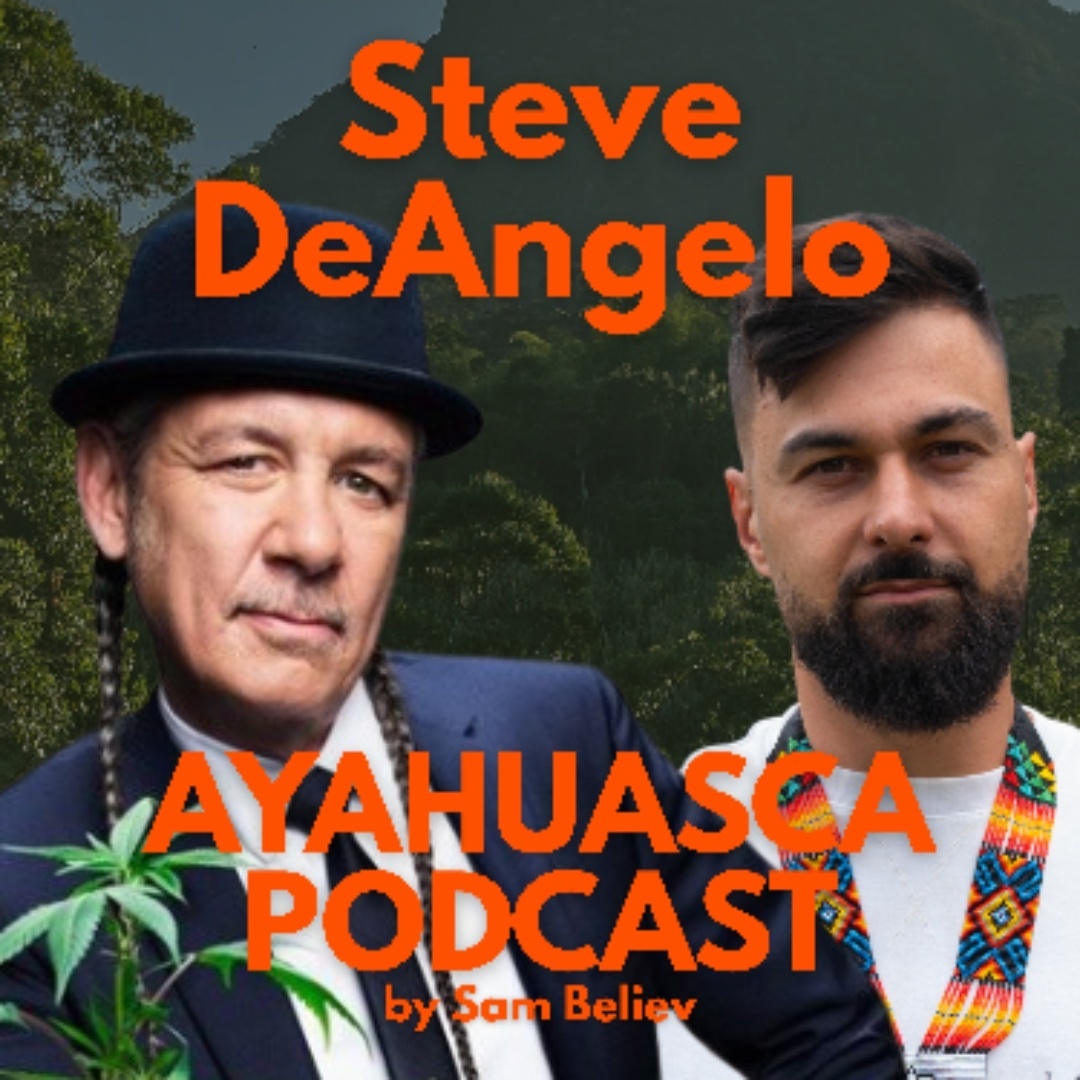
In this episode of Ayahuasca Podcast, host Sam Believ (founder of http://www.lawayra.com) has a conversation with Steve DeAngelo. Steve DeAngelo is a world-renowned activist, author, and entrepreneur often recognized as the “Father of the Legal Cannabis Industry.” He co-founded Harborside Health Center and the Last Prisoner Project, a non-profit dedicated to freeing those incarcerated for cannabis. With over four decades of activism, Steve has been a central figure in transforming cannabis from a prohibited substance into a respected plant medicine and a global industry.
We touch upon topics of:
- 04:10 – Steve’s first spiritual experience with cannabis at age 13 in a neighborhood park.
- 06:30 – The racist origins of cannabis criminalization and its use as a tool of oppression.
- 09:15 – The devastating toll of the “War on Drugs” and mass incarceration on families.
- 11:50 – How targeting cannabis ships in the 1980s inadvertently sparked the cocaine surge.
- 16:40 – The counterproductive nature of drug prohibition and the rise of fentanyl.
- 20:25 – The mission of the Last Prisoner Project: Seeking justice for those still serving time.
- 24:10 – Cannabis as Mother Nature’s “kindest and most gentle plant teacher.”
- 26:50 – Archeological evidence of shamanic cannabis use dating back 12,500 years.
- 29:30 – The historical spread of cannabis from Central Asia through India, Africa, and Europe.
- 32:15 – Cannabis in ancient religion: Its presence in Egyptian mythology and the holy anointing oil of Jesus.
- 36:45 – The industrial versatility of hemp: From Levi’s jeans to construction materials like “Hempcrete.”
- 41:20 – The “Decriminalize Nature” movement and the rise of mushroom churches in Oakland.
- 45:00 – Resisting corporate colonization: The importance of community-centric psychedelic access.
- 48:30 – The fusion of traditions: Rastafari communities integrating Ayahuasca and Iboga into their practice.
- 52:15 – Exploring the feminine spirit of cannabis and its role in a world needing more cooperation.
If you would like to attend one of our Ayahuasca retreats go to http://www.lawayra.com
Find more about Steve DeAngelo at http://www.stevedeangelo.com and http://www.lastprisonerproject.org
Transcript
Steve DeAngelo: Cannabis is one of the major ingredients in the holy anointing oil that Jesus used to cure people, to restore sight to the blind. We called it divine madness. We were so in love with this plant that we decided that we would rather die than live in a society where it was not legal, where it didn’t have an honored and respected place.
I think of cannabis as Mother Nature’s kindest and most gentle plant teacher. She has many plant teachers. Psilocybin mushrooms are plant teachers. Peyote buttons are plant teachers. Ayahuasca, plant teacher. We don’t want the only legal route for psilocybin to be going to a therapist who’s using a substance produced by a pharmaceutical company and is charging 1,500, 2,000, 3,000, $10,000 for that psychedelic assisted therapy.
We wanna make sure that the people who love psychedelics are free to gather, are free to share them.
Sam Believ: You’re listening to ayahuasca podcast.com.
Hi, guys, and welcome to Ayahuasca Podcast. As always, with you, the host, Sam Beliaf, and today I’m having a conversation with Steve DeAngelo. Often called father of legal cannabis industry, Steve DeAngelo is the world-renowned activist, author, and entrepreneur who spent over four decades on the front lines of the reform movement.
In 2006, he co-founded Harborside Health Center in Oakland, one of the first six licensed dispensaries in the US. Harborside set the gold standard for the modern industry, pioneering mandatory lab testing and the use of CBD for pediatric care. This episode is sponsored by LaWayra Ayahuasca Retreat. At LaWayra, we combine affordability, accessibility, and authenticity.
LaWayra, connect, heal, grow. Guys, I’m looking forward to hosting you. Steve, welcome to the show.
Steve DeAngelo: Thanks for having me, Sam.
Sam Believ: Steve, you have a very fascinating story, and there’s, It’s a story of endurance and it’s, You could easily have a movie made about you. But let’s start with your early life and what put you on this path, what brought you to, to work with plant medicines and cannabis specifically?
Steve DeAngelo: When I was 13 years old, a friend of mine invited me over to his house, the parents were not there, for a Mexican tea party. And turned out to be cannabis, which I knew. And I had this really very formative experience with the plant. And I I didn’t feel anything when we smoked the joint, and I started heading home feeling disappointed.
But my pathway home took me through a park. And this was a, a park that was, for me, a 13-year-old boy, it was just a thoroughfare. It was a shortcut to get from one place to another. I’d never really noticed anything about this park. But on this day, as I was walking home I started noticing things I’d never noticed like the way that the light was filtering through the trees and and showing the, the, the light through the leaves on the trees.
The way that underneath my feet there were dried leaves, and I could hear them crunching. I could smell their smell. And and down on the back of my neck, I could feel the same sun that had dried out those leaves raising beads of sweat on my neck. And I heard in the background the gurgling of a creek.
And there came this moment where all of these elements fused into one, and I felt like I was just there and I was present and I was in that web of life, that web of nature. And looking backwards, I recognize it as my first genuine spiritual experience. Then I only knew that something very profound had happened to me, and that I wanted this plant to be in my life forever, and that I also didn’t wanna be a criminal forever.
Sam Believ: Speaking of being a criminal tell us a story on why was cannabis criminalized?
Steve DeAngelo: Why was canna- cannabis was criminalized mainly not because of anything to do with the plant itself, but to do with the people who were using it. And and that was Black people and Brown people. Cannabis entered North America rather late by two vectors.
One was Afro-Caribbean sailors sailing into places like New Orleans, and the other was Mexican refugees who were fleeing the violence of the Mexican Revolution. This was all around 1910, in that period of time. And that’s when you started seeing the very first bans against hemp and and the first or very first bans against cannabis and laws being passed against it.
So it was really about who was using it and finding a legal tool of oppression to use in those communities.
Sam Believ: Yeah. You were alive, in that period when the war on drugs have started. For me when when I was growing up, it was already there and we just kind of– I assumed that all the drugs are same and they’re all bad.
It took me till my late 20s when I finally learned that not everything that’s Schedule I drug is actually a drug. A lot of those things are medicine. So I’m here in Colombia now, and which is one of the front lines of the the wars on drug, the war on drugs. Talk to us about the, the war on drugs and, the harms that it caused
Steve DeAngelo: Oh the the war on drugs and the mars- mass incarceration that went along with it was was really devastating.
And again, it was, centered in those Black and brown communities in the United States that that the powers that be wanted to bring under control. And so it was just a, a terrible campaign of oppression that was brought down on people. And I have friends who were growing up in that time who are people of color in New York, and they just describe, every day on their walk home from school seeing carloads of undercover folks who would jump out and throw them up against the wall.
And and, that daily terror was a factor of life for many years in the United States. It ultimately ended up in just to take the example of cannabis 40,000 people locked up nationwide for cannabis convictions. And so just a huge amount of harm visited on the people who were on the streets, visited on the people who were arrested, who were put on prison and on all of their families.
So it’s really taken a devastating qu- toll here in the United States. And then, of course, you’re in Colombia where we can see the, the harms that were created there. And we could go into them. There’s a whole long list.
Sam Believ: Let’s let’s talk a little about this a little bit, yes
Steve DeAngelo: Yeah.
Just to take one example. I first got introduced to Colombia, or at least Colombian contraband in the early 1970s when I was a young weed dealer in the suburbs of Washington, D.C., and I was selling this really beautiful Colombian gold cannabis that came from Santa Marta and those environs and were smuggled out through LaWayra.
And it was beautiful weed. It was some of the best weed that I’ve ever seen, and it was cheap. I was selling ounces of it for $35. The United States started putting pressure on the big freighters. There were freighters that were bringing up tons and tons of this Colombian cannabis at the time.
And so in 1980, I believe it was the US military was brought to bear to intercept these freighters that were bringing cannabis up from Colombia. And because they were large, slow-moving targets, that was quite effective. So then what happened in response was that there was this massive upsurge in cocaine smuggling into the United States which resulted partly, not entirely, that’s another story, but resulted partly from these attacks on the cannabis ships.
And so all the people or a lot of the people who were running those ships instead started running very fast cigarette boats that were much smaller targets that could outrun the Coast Guard ships that were chasing them. And that was when we saw the start of, really this kind of deluge of cocaine that came into the United States in the 1980s.
And then, of course, the militarization of that entire industry and trade down in Colombia
Sam Believ: Yeah, I believe if coca plant and even cocaine are just basically most of those drug w- drugs were legal and just kinda sold in pharmacies, the, the narcos wouldn’t have money to fund their armies and basically…
Like Colombia is like there’s the center of the country around the Cordilleras, which is controlled by government, and it’s safe, and it’s kinda where I am. But in the jungle or on the farther outlooks, like basically or all the b- closer to the borders, it’s it’s all controlled by those organized armed groups.
But a- as you said, they stop the weed, cocaine came. Now they, let’s say, they stop cocaine, fentanyl comes, whatever. People, I think, will always find a way to get high on something. So l- let’s talk about what do you think that the war on drugs is basically futile?
Steve DeAngelo: I’m sorry.
It was what?
Sam Believ: The, what do you think about war on drugs being futile?
Steve DeAngelo: Oh look, it’s it’s worse than futile, right? It, we saw the example of the weed market being disrupted by or coca- the weed market being disrupted and cocaine coming up in, in the ashes of that.
You saw the same thing with fentanyl, right? There was a huge amount of pressure that was put on the Mexican cartels who at that time were growing opium and processing it into heroin which resulted in a few overdoses, but not anywhere near as much as is being done with with fentanyl these days.
And again, we traded out one harm for an even greater harm. So it wasn’t just futile, it was it was e- extremely counterproductive. And if just imagine if coca leaves, at least coca leaves and cannabis had been made legal at the beginning of the 1970s, as we are advocating for there would’ve been a completely different story in the history of the armed groups in Colombia.
It would’ve been a story of gradual disarmine- armament and reintegration instead of this ongoing bleeding war, which has claimed, what? Tens of thousands, maybe hundreds of thousands of lives in Colombia.
Sam Believ: Yeah. I don’t know the exact number, but it’s a lot. And I just even a few days ago, met a person who lost three family members to that violence.
So it’s terrible. And especially with both cannabis and coca, it’s, those are all both amazing plants, and they should 100% be legal. I recently interviewed Wade Davis, and he’s really working hard on trying to get the coca plant legalized because it’s it’s an amazing healthy stimulant and it’s even better than than coffee.
So if, if those things, they’re obviously not rooted in science, and as you said they’re more sort of persecution of certain groups of people like DEA, and you talk about that it’s almost like a, like an ideology for them. They kind of hunt people, and they hate them, but it’s talk to us about that. What is wrong with those people?
Steve DeAngelo: Look, the DEA since its inception has been steeped in drug war ideology. And and we are now entering, the third or fourth generation of DEA agents who have been steeped in this ideology, and they are actually true believers in what they’re doing.
And and they’ve been convinced that they’re actually doing something that’s good. And it’s a culture that’s, continually been growing and been reinforced over the years
Sam Believ: Yeah, and obviously they put a lot of people in prison, and I loved the project that you have, which is the Last Prisoner Project, where you’re trying to free all of the people that were convicted by having cannabis or working with cannabis.
You wanna get them all out of the prison. Obviously makes no sense that they… those people that even in states where it’s legal now, they’re still in prison. T- tell us about this project.
Steve DeAngelo: I launched the Last Prisoner Project in 2019 following the 2018 implementation of legal cannabis in California.
And, I have been locked up in, in cells o- on cannabis charges, and it was very easy for me to imagine just imagine how you would feel if you were sitting in a cell, maybe serving a life sentence for selling cannabis and you turned on your television and you saw news stories about people who were creating intergenerational wealth millions and millions of dollars doing exactly the same thing that you are still serving time in prison for.
And it was easy to imagine myself in that place, and so I thought that the first order of business after we legalized cannabis would be to make sure that people who are still serving time were released. And and so we launched the Last Prisoner Project with the objective of making sure that every single prisoner down to the last prisoner on earth was released.
Sam Believ: I think it’s a very noble cause, and I really hope one day we’ll get there and that the, the sanity will prevail. Cannabis used to be known as a gateway drug. Now we kinda almost see it more as a gateway plant because a lot of people, for them it’s the first plant medicine they engage with.
Talk to us about that, seeing cannabis not as, not only as a recreational thing, but also as a plant medicine.
Steve DeAngelo: Yeah, I think of cannabis as Mother Nature’s kindest and most gentle plant teacher. She has many plant teachers. Psilocybin mushrooms are plant teachers. Peyote buttons are plant teachers.
Ayahuasca, plant teacher. But- Cannabis is, I think, the, the most gentle and generous way for people to enter the plant medicine world. But, back when we started this movement, we didn’t see, any, We didn’t– We regarded all these plants as a spectrum. We figured that we would get cannabis legal in five years, and then we would start working on mushrooms.
It’s, taken us a little bit longer. But, Mother Nature created so many different plant medicines, and she created them to thrive in just about every single ecosystem on this planet. She wanted to make sure that we had access to these most valuable teachers and healers.
Sam Believ: Yeah. And I can only imagine how many more plants there are that we don’t know of. And yeah, I think there is definitely plants, visionary plants and they used to be used in all the cultures, and we lost ours, and now we can use cannabis that’s… I believe it’s originally from China, right?
Or from India.
Steve DeAngelo: S- Central Asia, more a little bit west of India is is where we believe that the, the plant first started growing. And of course, that was where it first started being consumed. The first evidence we have of human cannabis consumption is twelve thousand five hundred years ago.
The cave grave of a shaman who was discovered with a, essentially a large bag of hashish, along with other shamanic tools.
Sam Believ: So let’s let’s talk about shamanic use of cannabis and a lot… Not so many people see it this way, but seeing cannabis as a psychedelic and what is…
Which way is it consumed to be, like, in that s- sort of psychedelic level?
Steve DeAngelo: It, cannabis if you trace the history of cannabis from its central origin poi- when its origin point in Central Asia to the east and to the west, wherever that plant went as it entered various different human societies, it sparked spiritual revolutions.
And so to the east, immediately to the east, of course, we have India, and and cannabis has been played a central role in the development of the Hindu religion. If you go down the coast of India you reach the enclave of the Jains. And the Jains also adopted cannabis as a sacrament.
The and then as there was a lot of trade between the western coast of India and the eastern coast of Africa cannabis then went a- across those trading routes and started making its way across Africa, where it also sparked spiritual revolutions. And then if you look going to the west cannabis moved largely to the west through a tribe of people called the Scythians.
The Scythians were the first human tribe to domesticate horses, so they covered a lot of ground. And they brought cannabis all the way to the shores of the of the Black Sea. And for the Scythians, cannabis was a very important sacrament. All of their funerals, their funerary rites were centered around the consumption of cannabis.
Then they went all the way down to Egypt. If you take a look at the Egyptian goddess Seshat, she is the goddess of knowledge and is depicted with a cannabis leaf above, above her head. And we even see cannabis being adopted into Christian religions. We now have the recipe for the holy anointing oil that Jesus used to cure people, to restore sight to the blind.
And it– that is essentially a, it’s cannabis is one of the major ingredients in that holy anointing oil. And so wherever cannabis went it sparked these spiritual revolutions and, for the majority of the human engagement with cannabis has been in a sacramental context.
Sam Believ: This episode is sponsored by LaWayra Ayahuasca Retreat.
Most of LaWayra if you’ve been listening to this podcast for a while. Some of you might have already been to LaWayra before. For those who don’t know us yet, we started LaWayra four years ago. At LaWayra, we combine authenticity- Accessibility and affordability. LaWayra is currently highest rated Ayahuasca retreat in South America with more than 700 five-star reviews and an average rating of five stars.
If you come to LaWayra, you’ll experience powerful, authentic ceremonies led by our indigenous shaman, Fernando, in a very beautiful venue just one hour south of Medellín, Colombia. We’re surrounded by nature and have comforts like hot water, Wi-Fi. At LaWayra, our team has guided more than 2,500 people through this life-changing transformation of Ayahuasca experience.
At the same time, we keep it very affordable. So whether you’re coming for healing, clarity, or a deeper connection to yourself, LaWayra is the best choice. If it is your first time drinking Ayahuasca, you will love our three and a half hour preparation course and integration support. All of that is included in price as well as pickup from Medellín, accommodation, and Ayahuasca.
Visit lawayra.com to book your retreat or learn more. LaWayra, connect, heal, grow. L-A-W-A-Y-R-A.com. Yeah. I believe you also say that it was in the medical recipes, like in ancient medicines of different cultures. You mentioned Sc- Scythians, and it’s actually have an interesting story, which is less about psychedelics, but I’ve never told this before.
So I’m originally from Latvia, but one of my grandmothers, she’s she’s from south of Russia. She’s half Ukrainian and half Moldavian, and she… We had, She lived there 30 kilometers from Black Sea, as you mentioned, and we had land. And she once found a Scythian coin, which was not even round. It was like oval.
I think my dad still has it somewhere. It was very interesting archaeological find. And behind, we had this outdoors bathroom. Behind it, there was a cannabis plant, and there were always guys, like young guys trying to get inside to steal some of the buds. But it was it was more like commer- not commercial, but industrial cannabis plants, the big ones that they use to grow for ropes and stuff like that.
And I know you’re very passionate about this as well different uses of cannabis plant, not just visionary, but also as like a construction material and other things.
Steve DeAngelo: Yeah, cannabis is such an incredible plant. In addition to being used by almost all schools of medicine throughout human history cannabis ca- has also been one of the major textile sources.
And the, the stalk of the cannabis plant is made up of fibers, and those fibers can be taken and made into rope. They can also be made into textiles. They if for, something like 80% of the clothing in Europe in the Middle Ages was derived from hemp. The very first Levi’s blue jeans were made out of recycled Conestoga wagon covers that were also made out of hemp.
So there’s this long history of human beings using hemp as, one of their major sources of clothing, of construction materials. You may have heard of the daub and wattle houses that are that were used all throughout Europe. They were all made out of hemp stalks and and probably used a early form of hempcrete for the daubing.
Sam Believ: Yeah. It’s it’s an amazing material and I was distracted myself a little bit because I was trying to look up the story about Levi’s blue jeans. Another irrelevant fact, but as I told you, I’m from Latvia originally. And the co-inventor of blue- the the Levi’s jeans was a Latvian immigrant whose name was Jacob Davis.
Not a lot of people know it, but he was the one that was actually sewing them, and the Levi’s was the, was a commercialist guy. So lots of cool interesting, irrelevant facts today. Yeah, there’s so many amazing plants and for some reason, there’s so many things that are illegal and very bad for you.
SSRIs are so dangerous and they’re passed left and right. We have so many people wanting to come to the retreat. They just can’t stop using those because they’re, like, super addictive and super dangerous and so many side effects. And at the same time, we have those amazing plants and they’re always demonized and illegalized.
What do you think about just this movement to just legalize everything that grows in nature?
Steve DeAngelo: The decriminalized nature movement?
Sam Believ: Yeah.
Steve DeAngelo: Yeah. I’m, a, a avid and enthusiastic supporter of that movement. I live in Oakland, which was the first jurisdiction to decriminalize the, all of the visionary plants.
And it’s just really been a, a beautiful thing to see here in my hometown. We now have several mushroom churches that have have emerged. There is a free commerce in psilocybin mushrooms in the city of Oakland. I go down to my local farmers market, and there are mushroom farmers there who have, great big huge mason jars of of mushrooms available for sale.
And so more and more people are using them and are finding, all the amazing uses that there are for them. And now, of course, Decrim Nature has spread really all around the world. And I think that it’s crucial, right? Because, what’s happened what we’ve seen with cannabis is that a lot of the power of commercialization in cannabis has has, moved into…
there’s been a corporate colonization of the earliest pioneers of cannabis. And the result is that, cannabis is sold now in legal places, mostly by people who are more interested in money than they are in cannabis. And we neglected to do something in cannabis, which I think decriminalizing nature is doing, right?
It’s just like we couldn’t stop corporate colonization of cannabis we’re not gonna be able to stop corporate psychedelics either. They’re already here. But what’s crucial is that we create a legal space for community-centric forms of psychedelic consumption and and access are encouraged.
We don’t want the only legal route for psilocybin to be going to a therapist who’s using a substance produced by a pharmaceutical company and is charging, fifteen hundred, two thousand, three thousand, ten thousand dollars for that psychedelic assisted therapy. We wanna make sure that the people who love psychedelics are free to gather, are free to share them, and are free to have access points that are not tied into a corporate structure
Sam Believ: Yeah, I recently interve- interviewed Roman Levi, who…
Ro- Roman Levi is someone who was in the forefront of this corporate side of psychedelics. They, their ketamine clinic business, they raised like 90 million. And he said that one of the most exciting things for him right now is that psychedelics did not fit into this stru- into this model. They just could not be commercialized enough.
So in a way, they successfully resisted that first wave of, as you say, corporate colonization. So I guess I guess it’s going in a good direction. And yeah I totally agree that it has to be preferably done traditionally and in the community. That’s kinda the way we work with with Ayahuasca specifically.
And yeah, trying to keep it affordable as well because it’s, it can be prohibitive because otherwise, it’s just not gonna have, give enough people access to it. Speaking of communal work with psychedelics, I know you you work with Rastafaris that have been embracing Ayahuasca as well.
Can you tell us about this?
Steve DeAngelo: Sure. In, in 2019, I went on a global tour to countries that had legalized cannabis, or at least decriminalized it. And that tour took me to Jamaica, where I had the opportunity to be introduced to Rastafari indigenous village. Rastafari indigenous village has always had, like all Rastafari seen cannabis as a sacrament.
But about 15 years ago the village became the first and so far only Rastafari community to integrate the other visionary plants, psilocybin, iboga, ayahuasca, into their spiritual practice
Sam Believ: Yeah. How does it look like? I’ve never seen a, a Rastafari person drinking ayahuasca. Do they blend their tradition with the ayahuasca tradition?
Steve DeAngelo: Yes. And it’s really quite beautiful to see. So I think, one of the challenges for a lot of folks in in indigenous ayahuasca ceremonies is while the music is central to the experience most people can’t understand the words of the songs.
While at Rastafari Indigenous Village that music is is Nyabinghi music, which is the root of reggae, and the lyrics are sung in English.
And I had the experience of being in ceremony at Rastafari Indigenous Village and really being able to understand the lyrics of the song, and they were deeply moving to me. That’s, one of the new variations that’s happened with this collision of psychedelic cultures.
Sam Believ: Yeah. That’s really cool. I like that style of music myself, but I’ll be honest, it probably would be easier for me to understand songs in Spanish than the Jamaican accent. It’s very challenging. But I would love to be in a ceremony with reggae style music. I think they have this certain aloofness to it that would be interesting to see that combination.
So you know a lot about ayahuasca and obviously s- super much about cannabis. In some traditions they kinda try to keep those plants away. In other traditions, they mix them together. What is your opinion better separately or together or interactions? What do you say?
Steve DeAngelo: Oh no, absolutely together.
I I know that there are traditions that keep those plants apart, but for me, I I c- I could not imagine going into a psychedelic experience and not having several joints rolled to go into that experience with. For me, cannabis is always a, a balancing factor. It helps me get over some of those challenging peaks and valleys that you encounter in the psychedelic experience.
So the culture that I grew up in it was, it was cannabis, it was mushrooms, it was LSD. And and we really didn’t see any contradictions or friction between any of those different medicines
Sam Believ: Yeah, it’s a different approach. I say wherever people go, they should just follow the l- the local tradition.
Here in Colombia they tend not to mix them or in general, and they kinda… Shamans describe it as both of them are feminine spirits, and they’re kinda jealous of each other. In a way, they kinda could conflict with each other. I don’t know. What do you think about spirit of cannabis?
Have you ever seen it? How is it similar or different to the spirit of Ayahuasca?
Steve DeAngelo: I’ve had experiences with almost every psychedelic that you can imagine other than Ayahuasca, so I’m not speaking from direct experience here. But I’ve always considered cannabis to be a feminine spirit.
I refer to her in the, the feminine pronoun. The cannabis that we consume comes from the female plants. And and so yes, I’ve always seen her as a feminizing force. But I think that if you take a look at the state of the world today we need a feminizing force. We need a force that that emphasizes cooperation over destruction and nature over industry.
Sam Believ: Yeah. Definitely we need more love in this world. You’ve h- you fought so hard your entire life to see cannabis legalized, and now it kinda is happening and together with other visionary plans. How does how does that feel? Like, how does it feel to you personally seeing your work create those results?
Steve DeAngelo: It’s wonderful. One of the sacrifices I made over the course of of this career was not starting a family. So I have no children of my own. But when people ask me about that, I answer by saying that I have more children than I can possibly count. And today relative to when we started, I started on this journey 50 years ago, hundreds of millions of people around the world have gained access to these plants.
And and it’s really sparking a, this incredible revolution because, most of the borders the boundaries that separate people can be broken down and turned into bridges with these plants. Because no matter what religion we grew up in, no matter what language we speak, no matter what our nationality is these plants all speak to us in the same language.
And from those conversations, we all derive the same or similar lessons. And out of those lessons, there is a common value system. And so wherever the plant tribe is found, we value individual freedom. We value mother nature. We seek to resolve conflicts peacefully. We are radically inclusive.
There’s always room for one more person at the table. And that’s our culture, that’s our value system wherever we go, anywhere in, in the world. And so that’s such a powerful thing today, especially when we see so much of the world descending into this into these seemingly endless conflicts.
Now we have this medicine revolution that has turned borders into bridges.
Sam Believ: And obviously, you went through lots of challenges, and you describe being in those in your… one of the first dispensaries that you helped create and any moment police could come in and capture you. And obviously, 40 years ago, it was hard to imagine that it will take that, that route.
Ki-kind of what, what gave you that perseverance and the, the strength to carry on?
Steve DeAngelo: We called it divine madness. We were so in love with this plant that we decided that we would rather die than live in a society where it was not legal, where it didn’t have an honored and respected place.
So it was really just out of that, that passionate love for cannabis. And, my belief is that Mother Nature is calling all of us to a mission through these plants. And and that mission is very clear and it’s very simple, right? It’s peace, love, and nature. And and so that’s really what gave me the determination was that, we we thought that it was essential to the preservation of the planet that these values spread.
We– when we started this movement, we didn’t we didn’t know about medical cannabis ’cause all that information had been scrubbed fr-from us. We didn’t know about industrial hemp. We didn’t know about any of these things. But we did know one thing, and that was that the cannabis plant helped us more be the people that we really wanted to be, to bring our daily actions in line with the yearnings of our heart.
And we figured that if it did it for us, it would do it for other people. And that if we got more people consuming more cannabis, that eventually we would live in that peace and love world that we always wanted to get to. And I still believe that today. If you want to preserve this planet, if you want to end genocide and warfare, then spreading these plants to as many people as quickly as we can is the best route to really to salvation
Sam Believ: I salute you for keep going and doing the work because I think it opened many people’s mind to other visionary plans and pushed us in the right direction.
You mentioned that few things that happened in this revolution went wrong, like a corporate takeover of the industry. What else have gone wrong? And what else would you prefer in that industry to be different?
Steve DeAngelo: We always saw adult use, full legalization as the holy grail of our movement.
But when we moved from medical cannabis to adult use cannabis, we also gave up a very high moral ground, right? When we were talking about medical cannabis, we were talking about saving lives. We were talking about healing people from really dreadful conditions. When we went to adult use, we were talking about getting people high.
And that’s a very different kinds of conversation. That puts you more on par with alcohol or tobacco and or cocaine or fentanyl. And so I think that we really lost a lot in that transition. So that’s, another one of the things that I think we got wrong. We also really failed to make any kind of place for sacramental cannabis.
And if I had these years of activism to rewrite some initiatives to rewrite, and I could write them any way that I wanted to, I would make sure that we had legal space under legalization for the sacramental uses of cannabis. What I saw in in, in– I embedded in, at Rastafari indigenous village for six months, and what I saw there was, was a society, was a village that was already living by the lessons that this plant medicine teaches us.
Sam Believ: Maybe it’s not too late. Maybe as people go, they kinda will learn about different ways to use it and get inspired by other traditions. And Yeah, because my, my, my concern with the recreational use is just maybe one, which is… So I personally don’t work with cannabis too much. I’ve maybe smoked it- 20 times in my life, maybe a bit more, and 10 of them with my coach Sebastian, because he always smokes it and he always invites me too, and it’s generally tends to be very positive.
But I’m concerned about the, that now cannabis is evolving into this super monstruously strong breed of it. What do you think about this? Should they just keep it more natural, or what do you think?
Steve DeAngelo: I am of two minds. I think that there’s been a lot of misinformation about the super strong cannabis.
In my experience, when people are consuming cannabis, unlike alcohol where they drink way beyond any point that they should, when you’re passing a joint around people in a circle with people, at some point somebody’s gonna stop passing the joint and stop hitting the joint. They’re just gonna be holding it.
So there’s this kind of natural point of saturation that you reach with cannabis where you don’t really wanna do any more, at least in that moment. And you can get there by smoking a joint or two or three joints of relatively weak cannabis, or you can get there by taking one or two hits of relatively strong cannabis.
But I think either way, you get there and you just level out. And and so I think that’s the experience. My, my personal experience with that. But, cannabis is this very, very complex plant, and what we learned, what I learned in my work with Harborside, is that it’s not just the THC that has therapeutic effect.
Cannabis is packed with therapeutically active molecules and compounds. And they include terpenes. They include flavonoids. They include minor cannabinoids. And so there’s not one type of cannabis. There are, cannabis is almost infinitely variable. And it’s not, a lot of this, the, the attention has been placed on the idea of THC and super high quantities of THC, and that’s the direction a lot of breeding has gone in. But people are now, sophisticated consumers are beginning to buy much more by terpene content rather than THC percentage.
Sam Believ: So outside of THC, what is what is your most favorite cannabinoid?
Steve DeAngelo: I haven’t had a lot of experience with a lot of the minor cannabinoids. The minor cannabinoids are often produced by the hemp industry which has been made illegal in California by our governor. So I haven’t had legal access to many of those pro- products. The ones that I’ve have experienced, I would say the THCV is quite interesting and and potentially Delta-8 and certainly CBN.
I think CBN is a incredibly useful cannabinoid and it’s it’s the cannabinoid that is responsible for for quelling insomnia, and insomnia is just such a widespread ailment today. CBN, especially in combination with CBD or THC is one of the most powerful natural remedies that you will ever find for insomnia.
Sam Believ: That’s interesting. I’ve never heard about this one. You talk about importance of use of cannabis for, to kinda quiet down our default mode network, and what is… Why do we all kinda need need that?
Steve DeAngelo: There, i- in the human body, there exists a neurotransmitter system.
It happens to be the largest neurotransmitter system in the human body, known as the endocannabinoid system. Our body endogenously produces many of the same compounds that you find in the cannabis plant. It is that system, the ECS you can find it in every organ in the human body. It’s in our connective tissues.
It’s even i- in our skin. And wherever the endocannabinoid system is present, its purpose is the same, which is to preserve, maintain, or restore our body’s place of natural balance. This is the reason that cannabis is so effective for so many seemingly unrelated medical conditions.
Sam Believ: Yeah, I interviewed Ryan Sprague long time ago, a few years ago, and he said that about the endocannabinoids, he almost said that we have ca- cannabinoid deficiency in our bodies, that we all need more of it, which is a very interesting way to look at it.
I think our time starts to run out, so it was a great interview. We don’t talk about cannabis too much, but I think it was very interesting. Any last parting words for the audience, and where can they find you and your work?
Steve DeAngelo: Yeah. So you can follow me at on Instagram, steve.dangelo.
You can visit me at my website stevedangelo.com. You can find out more about the One Plant Alliance at oneplantalliance.org.
Sam Believ: Thank you, Steve. It was a pleasure. Guys, you were listening to Ayahuasca Podcast. As always, with you, the host, Sam Belyev, and I’ll see you in the next episode. I hope you enjoyed this episode.
If you’d like to support us and psychedelic renaissance at large, please follow us and leave us a wherever it is you’re listening. Share this episode with someone who will benefit from this information. Nothing in this podcast is intended as medical advice, and it is for educational and entertainment purposes only.
This episode is sponsored by LaWayra Ayahuasca Retreat. At LaWayra, we combine affordability, accessibility, and authenticity. LaWayra, connect, heal, grow. Guys, I’m looking forward to hosting you