
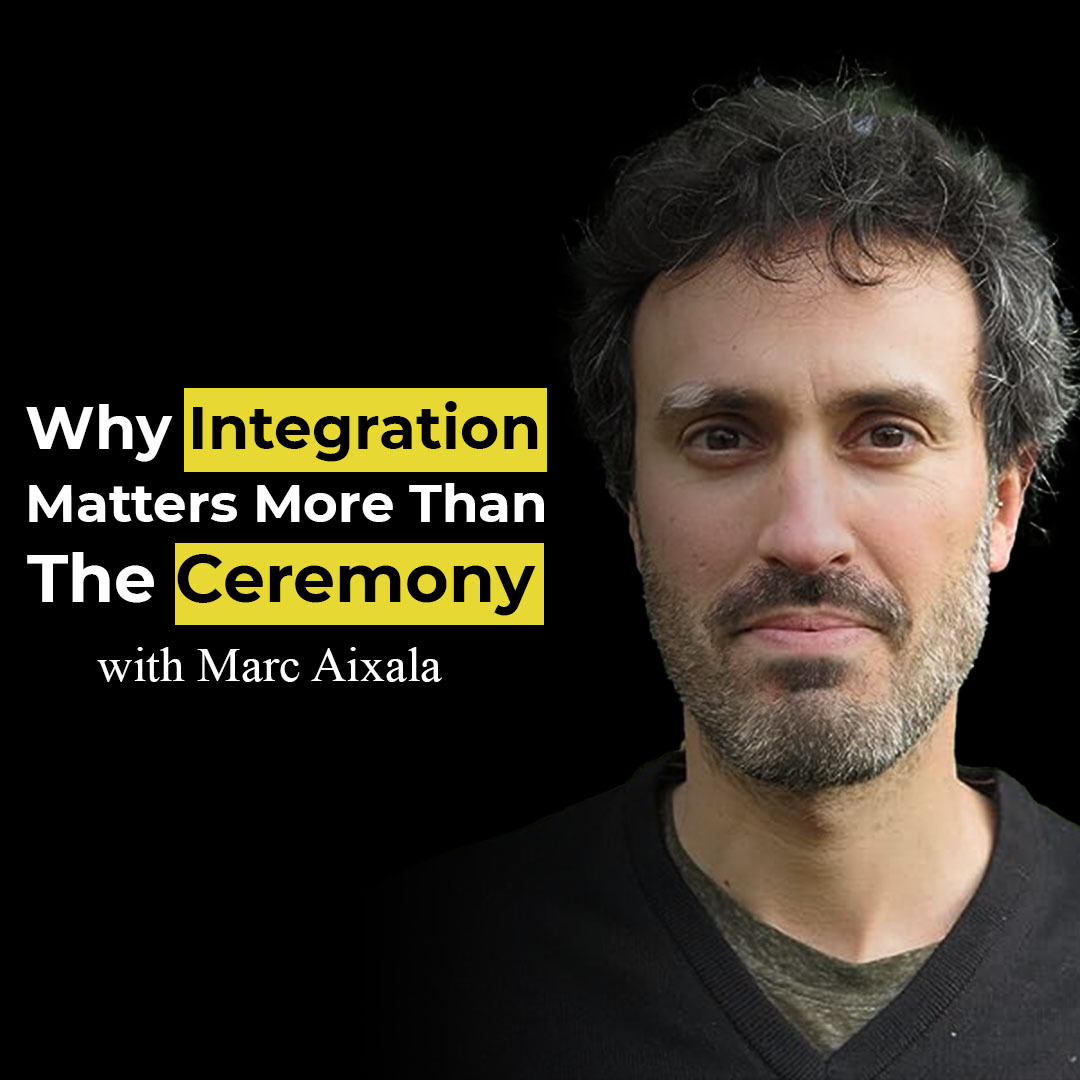
In this episode of Ayahuasca Podcast, host Sam Believ (founder of http://www.lawayra.com) has a conversation with Marc Aixalà, a Barcelona-based psychologist, psychotherapist, and former engineer who has become a leading figure in psychedelic integration. Marc is trained in integrative and strategic therapy, is a certified holotropic breathwork facilitator, has worked on MDMA and psilocybin clinical trials, collaborates with ICEERS, and authored Psychedelic Integration (Synergetic Press).
We touch upon topics of:
- Marc’s path from engineer to psychologist (01:01–02:57)
- How he defines integration & why definitions fall short (03:25–05:40)
- Marc’s metaphors for integration (puzzle pieces, astronaut, developing photos) (05:40–08:40)
- Sam’s grocery-shopping metaphor & Marc’s response (08:45–10:49)
- Two types of integration: crisis vs. growth (10:49–13:55)
- Seven categories of difficult experiences (13:55–17:10)
- Preventing harm through preparation & facilitation quality (17:10–18:46)
- Dose management and psycholytic vs. high-dose models (21:26–26:23)
- Self-inflicted overdosing & patient expectations (26:23–27:51)
- Positive/growth integration & the importance of immediate rest (27:51–30:33)
- Long-term integration: outer behavior vs. inner insight (30:33–32:13)
- Seven dimensions of integration (spiritual, cognitive, emotional, physical, behavioral, social, time) (32:13–35:33)
- Avoiding extremes: materialism vs. magical thinking (35:33–36:52)
- Why people resist integration & who should be concerned (36:52–39:53)
- Overuse of psychedelics and the risks of “more is better” (45:01–48:33)
- Spiritual bypassing & misunderstanding ‘light only’ approaches (48:33–52:10)
- Indigenous approaches vs. Western integration culture (53:08–56:25)
If you would like to attend one of our Ayahuasca retreats go to http://www.lawayra.com
Find more about Marc Aixalà at:
Instagram: @marcaixala
ICEERS Training & Integration Programs: https://www.iceers.org
Book: Psychedelic Integration (Synergetic Press)
Transcript
Sam Believ: You’re listening to ayahuasca podcast.com.
Marc Aixalà: Yeah. Spiritual bypassing is usually understood as using spiritual content or spiritual experiences to divert our attention from painful more ordinary aspects. Yeah. So somebody that has, I know a lot of issues with social or interpersonal relationships.
But somehow marriage is to avoid the pain of these because they’re having spiritual experiences. Yeah. So that the light of these spiritual experiences somehow makes it easier to forget the suffering that we have, as if we could only, or we should heal or we should improve by focusing only in the light and not focusing on the pain that our ordinary lives bring.
Which is sometimes a line that certain schools have approached certain, even Buddhist meditation schools, they say no keep meditating. This is part of the veil. You need to transcend that you’re suffering is do not get attached to your suffering. Your joy do get not attached to the church.
Just keep pushing through the oneness. Yeah. Through this. That most of the times, for most of us life is not that easy to take. Only in that dimension. We have families, we have jobs, we have parents, we have friends. We need to also live in this, in dual reality. Yeah. Then when we are trying to use.
Psychedelic experiences to avoid those conflicts, to avoid those feelings, to avoid those difficulties. I think that’s when we are doing a harmful spiritual bypass, because in the end, we’re not having a real spiritual experience because we are just putting something aside. We’re not having a. Whole experience.
We’re choosing just to focus on one side of the spectrum, but why should be sadness less spiritual than ecstasy? There’s a whole universe that I can think of how spiritual can be to contact with your own sadness and to see the reality of sadness in your life and doing something about it.
Sam Believ: Hi guys, and welcome to Ayahuasca podcast, as always with you, the host, Samie. Today I’m having a conversation with Mark Alala. Mark is a Barcelona based psychologist and psychotherapist with a background in telecommunication engineering who has become a leading figure in the field of psychedelic integration and non-ordinary states of consciousness.
He holds advanced training and integrative and strategic therapy and is a certified facilitator of. Teleo Tropic breath work. He has worked with clinical trials using MDMA for PTSD and psilocybin for treatment resistant depression. He collaborates with the International Center for Athena Botanical Education Research and Service.
I seers his book, psychedelic Integration Psychotherapy for Non-Ordinary States of Consciousness, consolidates his years of experience helping people integrate expanded states of awareness. This episode is sponsored by Lara Ayahuasca Retreat at Lara, we combine affordability, accessibility, and authenticity.
Lara Connect, heal, grow. Guys, I’m looking forward to hosting you. Mark, welcome to the show.
Marc Aixalà: Thank you, Sam. A pleasure to be here.
Sam Believ: As I was telling you earlier, I learned about your work because one of our volunteers was reading your book and it was, it’s a big book, on topic of integration.
Interest me a lot. And then I’ve heard about the courses that you provide in. I ended up talking with one of your team members as well here in the podcast. Mark, let’s start by talking about your past and like how your life brought you to this line of work. ’cause I used to be an engineer as well.
I was a marine mechanical engineer and now around this ayahuasca healing center. So how was that story for you?
Marc Aixalà: So I guess that, not that different from yours, but yeah, I was an engineer. I studied engineering at university and I have to say that even during those years of study at the university, I had some experiences with states, expanded states, northern United States.
And that showed me a world that I had not known before and that became some sort of an interest slash obsession. So even as I was becoming an engineer something entitled me. I knew that was not really my path. And eventually, after a couple of years of working as an engineer, I clearly saw that I would never be a very good engineer and that my heart and my passion was elsewhere.
And that brought me to go back to university study psychology, become a certified tropic brother practitioner, and start trying to find a career around non the United States of consciousness supporting people during, before and after experiences in expanded states. Yeah, that was a long journey from an engineer to psychologist.
It took whole transformation about, I don’t know, probably six years or so. So it was a slow process, but it ended up being a really powerful one, and that’s why we’re talking today.
Sam Believ: Yeah. I think engineering is a good foundation for many things because healing is body is an body is like a mechanism as well.
So if you’re, if you kinda understand those concepts, you can be very step by step. And I think it’s it might be a good influence on, as opposed to just psychology by itself. So I’m happy that I have this engineering mindset and it’s useful even in this line of work. You you obviously are an expert in in integration and you you dedicated lots of time to it.
So integration is one of those topics that’s kinda has many different definitions. So I’d like to hear yours. What is integration for you?
Marc Aixalà: Yeah. So the way that I usually approach that question is by not answering this question. I think that defining integration can run into some reductionist bias, and as we give one, just one definition, we are skipping, we’re keeping some things out of the picture, which could be important as well.
I think that maybe the only thing that we can agree on about integration is that integration is what we do after the experience. Yeah. Or integration starts. As the experience finishes, then the practices that are involved in integration can vary from practitioner to practitioner, person to person, or experience to experience.
So the way that I’ve tried to define and explain integration is through a way that could be somehow expanding and providing different angles of what integration entails. That’s why most of the times I start defining integration through different metaphors. And a big chunk of my, my book in which I summarized my understanding on integration is talking about different metaphors like growing trees, developing a picture seeing things from different angles, planting seeds, so integration cannot be captured by a single definition. Different experiences will be integrated in different ways. For some experiences, we will need a conscious effort. Sometimes even with support from somebody else, sometimes integration can happen in a very natural, spontaneous, and effortless way.
I think it’s more helpful to understand how broad can be integration in order to facilitate integration. If we get stuck with very rich definitions of what it should be. I think that we’re missing the point that we’re not doing a favor to those in need of integration.
Sam Believ: So you mentioned that you have 11 metaphors for describing integration.
I’m not sure if you know all of them by roads, but maybe you can tell us the ones or your favorite ones.
Marc Aixalà: Yeah, I think that this has changed since I published the book. I have added some more, and depending on the class or lecture or talk that I’m giving, I focus more on some or others.
But definitely there’s some classic metaphors that are like highlights. One would be the pieces of the puzzle, how, psychedelic experiences. Experiences in non United States can be like new pieces of the puzzle. They provide new information and then integration could be like trying to put that piece into the existing framework and try to see where this piece fits.
Sometimes it’ll fit right away. Sometimes we’ll spend a lot of time trying to make it fit. Sometimes we need to work with the piece. We need to, I don’t know, turn it around, look at it, maybe polish it or whatever. In order for it to fit into existing framework. And sometimes we will need to work with a framework what is already been assembled.
We need to maybe readjust that so new pieces will fit. Yeah, so that would be a classic metaphor for integration. Another one that I use very often and that captures a different aspect of integration would be an astronaut coming back from these space travels back into the mothership. I’m sure that you’ve seen these movies that they go with all these space suits and then they go back to the ship.
They close the doors and it becomes pressurized again, like all the air coming in and the sounds coming in again, and the effort of taking the suit and all that, like this transitioning space from expanded realities into ordinary reality. That time, that space can also be considered a space of integration.
And that’s extremely important to make a safe and good landing. Yeah. So that could be another metaphor and then one that I’m playing a lot with lately is developing pictures like old school analog photography in which you went holidays with only a 24 picture role. And you would take some pictures and then the process of developing those pictures were was when the pictures actually came alive.
And there’s a lot of art in the developing. Process. One had to do it in specific conditions with red light, with specific chemicals. You have to choose the frame that you want to develop, how much you zoom into this. So there was an art team choosing what I’m going to be developing from that negative, from that picture that I took.
Yeah. So this could be three metaphors, then planting seeds, growing trees, for example, or organizing information in a coherent way, ordering the information. Usually I like to talk about it more visually. So when I teach about these in my trainings, I present images because I think that they capture much more of the power of these metaphors and just talking about the metaphors.
That’s the beauty about metaphors, that one doesn’t have to speak much about them, for people to really see the depths of them.
Sam Believ: Thank you for sharing those. I’m I’m a man of metaphors and analogies myself. I would like to share with you the ones that, that I came up with. One is.
What for integration specifically is when you go to have a psychedelic experience, let’s say you go to an Ayahuasca retreat, you have one week retreat and you it’s like going grocery shopping. It’s like you, you bring all of this information out, it’s on your countertop of your kitchen, all the vegetables and meat and dairy products.
Everything is it’s right there. So integration is taking it and putting it in the fridge or cooking some and processing it and putting it where it belongs. And the way I like to describe is if you don’t do anything, you basically, it will just get wasted and then rott.
But in reality it’s just just gonna disappear. So that, that fresh information and all this knowledge it’s right there, right now and it can be worked with and can be processed into something beautiful. But if you don’t do anything, it just. Fades away. That’s an analogy. What do you think about that one?
Marc Aixalà: Yeah, I think it’s a really a point that many times we don’t do anything with all the information that we’ve been given, all the experiences we have been given, they have a natural tendency to fade away. That’s part of the psychedelic experience. That’s just the way it is, so it’s not just by having had the experience that we embody those learnings Many times we need to act on that.
We need to do something, we need to pay attention to these afterwards moments. Sometimes it could be a matter of days, sometimes we’ll be weeks, months, sometimes years. Yeah. But I think that the more we concentrate and we focus on providing that time and space for integration, the more fruitful our experiences can become.
Yeah. Like food. If you don’t store it then you waste the food and all the fantastic recipes that could come up with those grocery shopping that you did, it’ll never exist,
Sam Believ: very wasteful. That’s just how it feels sometimes. But when I, as I was getting ready for this interview I’ll, I thought about the concept of, obviously integrating difficult experiences and I know you focus a lot on that and also integrating beautiful and light and easy experiences.
And it’s I almost think that we should come up with two different names because it’s a two different, two very different processes. I don’t know, may, maybe there already is a, is some kind of distinction and are different names. So before I continue can you, is there any abbreviations or anything that, that distinguishes the two?
Marc Aixalà: I dunno if there’s any specific names, but that’s definitely something that I have been noticing for a long time as well. And when I started doing integration work, it became very clear that these. Two very distinct aspects of integration working for maximizing the benefits as I call this, or dealing with adverse reactions or dealing with challenging experiences.
I think that these are two different courses of integration. Many times the interventions, the things that we can do in one scenario will not work for the other scenario. Yeah. When we have had a beautiful, easy experience, it’s usually easier to integrate with our own tools like journaling, painting, whatever.
Yeah. So this natural and classic integration tools that we use, these are something that will be useful and we will help us to integrate experience. But when we have had a difficult experience and we’re struggling with symptoms, ruminations strong emotions or whatever, those things might do something, but they will not solve the situation.
So for me, these are two different integrations. We could still put them under the same label of integration. But I think that even the professional or the person that can do or can support that process many times are different professionals. Yeah. Because when we’re dealing with difficult reactions, many times we need interventions that are more similar to therapy or therapeutic interventions.
And I don’t think that you need to be a therapist to facilitate integration when things have gone in a positive direction, so I do make that distinction as well. And that’s I would say like the second de second definition of integration. No, we have the metaphor, but then we have these scenarios and needs.
What are we working for to maximize some positive experiences or to deal with some difficult reactions that people have experienced.
Sam Believ: Yeah. Like one is like crisis integration and the other one is like growth integration and, with the kitchen analogies. Like one is you coming back to a kitchen full of groceries and the other, you’re coming back and your kitchen is on fire and you need to do something urgently.
But I always feel like there should be a different word, but I’m not nothing’s coming up for me right now, but let’s talk about those difficult integrations You have you have seven, seven different types of difficult experiences. Can you talk to us about that?
Marc Aixalà: Yeah. This is some attempt that I did back in the day to understand what people were needing.
So the place which this came from was not just my intellectual sort of thinking about integration. It came through observing the cases that I was working with in the ICR integration and support service. This is a free service that we’ve been providing for. 12 years or so, or 13 in which people could contact us and we would do integration support for those in need.
Usually when somebody contacts you to do integration work, it’s ’cause they perceive that there is a problem that they’re dealing with. Usually people don’t contact you so much to say how beautiful their ask experiences were. They contact you when things have gone wrong. Yeah. So after some years of working with people, I started trying to document to get some sort of data to understand what kind of requests people had, what sort of problems they were experiencing more often.
And that is how I came to this classification of the different problematic in integration. This is not meant to be a diagnosis criteria, but it’s meant to help integration practitioners understand what can have been the cause or the problem that has originated the challenges in integration.
Also how it manifests, and then how to support these different nuanced situations. So they go from. More general situation of lack of preparation when somebody has gone into the experience with not enough preparation and then things go south, not because there was anything problematic, but because the person was not ready enough in whatever sense to deal with what could come up.
Then we have experiences, what I call unresolved experiences. When something opens up in your experience in your journey and you’re not able to process that due to lack of trust due to the intensity of experience. And that is like a door that remains open reminding you of the content of experience in your daily life.
Yeah. Then we have interactions with shaman or facilitators or therapists and harm can come also from that interaction or when people have memories that emerge, that they seem to be traumatic memories, that they had repressed what to do with that. That they real, are they not real? Yeah. That are very common sort of problems.
Integration as well, or. When we have people that overdo, so to speak, the healing practices. They drink medicine too often or they do too many techniques, too many experiences, and then they up end up more yeah, they lose ground. Yeah. They end up in more theory sort of spaces and their life is not improving rather the opposite.
Yeah. So they seem to be less and less in touch with their daily reality. So these are some of the more common integration scenarios that I was observing as I was supporting people. So I tried to somehow formalize and summarize them so we could talk about that in more depth and with more detail and hopefully find ways to support these particular needs.
Sam Believ: Yeah, I’m familiar with many of these cases and a lot of them, as you described them, they almost feel more than half of them can be, almost completely. Removed by just good organization of the retreat or good facilitation. It’s like when I tell people when I first want to drink ayahuasca, like right now, people that come to our retreat, they go through a three hour course, and then they, they fill out the questionnaires and it’s a process.
But and then there’s still workshops when they arrive. When I first went to drink ayahuasca here in Columbia, it’s like you just, you come in and here’s your cup and good luck. It’s if you don’t know anything or if you’re taking any medicines or nobody knows, nobody cares. It’s just so a lot can be avoided.
And I think that there’s there’s some difficult experiences that you described there. I think you could separate them into. Forms, which is like productive ones and unproductive ones for example, an unresolved difficult experience. Or they can be terrifying, like a very common one.
People remembering that they’ve been sexually abused. I still think is much better to find it than to just let it be there and poison your life. So I, I don’t know if you wanna talk about this which if, some difficult experiences can be necessary w whilst others are, basically a side effect.
Marc Aixalà: Yeah, that’s a good point. And in, in my way of working, I have not taken these stance that much in the sense of consider what would be useful or good or not. I’ve been more pragmatic in the sense like, somebody’s coming. With a problem after use of bio, ask for psychedelics and they need some sort of relief.
They need to feel that they can go back to where they were before, so to speak. Like something bad has happened to me, helped me be as I was before this experience. But I do agree with you that there are experiences that, although challenging, they come with potential growth. Yeah. So as you were saying, an unresolved, difficult experience, something that has opened up and I have not been able to deal with probably if I am able to deal with, I’m not only as I was before this, but I am stronger or I am more complete or I am closer to my truth after having been able to confront that, to go into that experience and go through that experience.
And some experiences, as you say, this could be like a side effect or traumatic event that has happened that could have been prevented. I dunno, an abuse that had hap happened in a therapeutic setting or an abuse by a child or facilitator or a therapist. Even if you can grow and end up somehow stronger, I will never say no that this was for the good.
Yeah. So these things should be avoided. They should not happen. And same thing as when people have really intense experiences, what I call in my definition of these profiles, the very traumatic experience with dissociation with can look like a psychotic break. I think that many times, although this can be not permanently harmful, I don’t think that a lot of good comes from this.
No. So people can recover, people can go back to who they were before and yeah, have suffered no consequences from them. But most of the time I wouldn’t say that there’s been a learning or a growth or something of value after having overcome this experience. So definitely when we. Open ourselves to work in United of Consciousness.
We need to know that things can be hard, that we can be confronted with difficulties with hard experiences, and that is part of the process, that a normal part of the process. But as you say, there’s many of these difficulties that can be prevented because they are not because of our own inner psychic journals.
They are related to facilitation or the context or safety or interactions. And these things should be minimized and optimized. Yeah.
Sam Believ: Yeah. First of all, thank you for doing the work you’re doing because I’m sure people I’m happy that you exist. When they go through those difficult experiences and they’re left confused, they really need integration.
Like in our case we work with integration coaches and one of our coaches, Simon, who also interviewed a few episodes ago. He takes those difficult cases, when someone specifically sexual abuse it’s unfortunately more common than we would like to believe and helps people integrate those experiences.
But what I notice in reality, and I’m, you’re on the receiving end of all of the difficult situations on all the retreats or traditional ceremonies all over the place. Anyone who can find you, they end up going to you. But I’ve, what I find from from the other side where we work with people in the medicine, as long as you do it in a very gradual and very reasonable way, and especially managing the dose of the medicine specifically, I ask it’s not really that common that people get so destabilized.
But and I would like your opinion on, on, on the dosage because I think what, from my point of view, what I observe is a lot of places is where people come and all they have is one ayahuasca ceremony. And ayahuasca does tend to, for you to break through and go to this productive part of the experience where the information starts coming up in a conscious way.
It takes few ceremonies to build up. And you have a group, for example, let’s say we, we have a group of 25 people. If we were to give exactly same amount to everyone so that everyone in the group would have this profound experience on the first ceremony, I believe, then we’d have to take three or four of them to a psychiatric hospital next day.
And like the way we work with our shaman is we start slow and we find who needs more and who needs less. And we take people to that level where. They are having productive process, but they’re not overwhelmed. I don’t know. And it’s like integration is one thing where it’s like you’re dealing with the consequences.
How much can be done on the level of people that it serve the medicine to even prevent people from going to this difficult place.
Marc Aixalà: I think that’s the key question. And that’s where we should be putting all the attention, or maybe not all the attention, but a lot of the attention integration should not have to be focused on dealing with difficult directions.
We should focus more on preventing those difficult reactions from happening. And as you say, I think that a lot can be done in order to bring. Experiences to people that they can somehow manage. And what you were saying sounds very similar to what the European current of psychedelic therapy back in the fifties and the sixties were doing, which it was called the psychic therapy.
They were using incremental amounts of psychedelics starting low, not just to stay low, but to find an experience in which happens exact exactly what you’re saying, that you’re immersed in the experience, that you’re navigating the experience, but you’re not overwhelmed by the experience. Yeah. Which that goes in sharp contrast with the psychedelic approach which they did mostly in the United State, which is one high dose, 500 micrograms of LSD trying to reach Eagle D solution and in one session do all the work.
Yeah, that can turn out very well, but it has lots of risks as well. These more incremental approach. I think it makes much more sense for the times that we’re living in now in which we see that the importance is not so much in the experience itself, but in the process in which the experience is immersed.
So using incremental dosages in which there is internal agency to navigate the experience. So it’s me surfing the psychedelic waves rather than me being drowned by the psychedelic waves. I think that’s what we should aim for. Like people have this kind of experience that it’s an intense enough experience to be in experience, but that is not too intense, so you cannot relate to the experience.
That’s when we start losing track of what’s going on, that’s when we forget what’s going on. That’s when we can go into more psychotic like manifestations, and the Psycholytic authors, they said it back then. Han Handcar lawyer said that the key element in achieving this is the dose.
So one should be really careful in finding the proper dose for each person, so they will be inexperience, but by not, but not overwhelmed by the experience.
Sam Believ: This episode is sponsored by Lara Ioas Retreat. Most of Lara, if you’ve been listening to this podcast for a while, some of you might have already been to Lara before.
For those who don’t know us yet, we started Lara with my wife four years ago. At Lara, we combine authenticity, accessibility, and affordability. Lara is currently highest rated Iowas retreat in South America with more than 635 star reviews and an average rating of five stars. If you come to Lara, you’ll experience powerful, authentic ceremonies led by our indigenous shaman, Fernando, NA.
Very beautiful venue. Just one hour south of Meine Columbia. We’re surrounded by nature and have comforts like hot water wifi at La Wire. Our team has guided more than 2000 people through this life-changing transformation of Ayahuasca experience. At the same time, we keep it very affordable. At the moment, we have retreats starting at as lowest $645.
So whether you’re coming for healing, clarity, or a deeper connection to yourself, the wire is the best choice. If it is your first time drinking Ayahuasca, you’ll love our three and a half hour preparation course and integration support. All of that is included in price as well as pick up from Metagene accommodation in Ayahuasca.
There are no hidden fees. Visit lara.com to book your retreat or learn more. Lara Connect, heal Grow. L-A-W-A-Y-R a.com. Yes. So a lot of those negative experiences, they can basically. The unproductive ones, they can basically be described as an overdose. Basically. You’ve been overdosed on psychedelics.
And but the problem there is that it’s a lot of times it’s self inflicted. Like no matter how mu how careful we are, no matter how gradual we are people because of the videos they watched and people they spoke to. People want to have, they self-inflict this. They’re like, give me more or give me more.
And it’s so hard for us to be like, just trust the process. You will get there. It’s like a little bit more and a little bit more, not not to overwhelm them, but unfortunately a lot of times it’s this difficult situation where as someone who facilitates ceremony, we won’t everyone to have the experience.
We want them to have a productive outcome, but they want everything and all at once. Give me like five cup, let me just because ’cause people have this mindset and it’s it’s challenging, but like to put things back to positive perspective, like we, we hosted more than 2000 people here at LA Wire and those cases were in somebody’s this completely disbalanced after the retreat and needs completely needs integrations.
I can think of maybe three cases. And even then when they do the integration and the process, the experience, they come out better on the other side. But like 99% of cases is very manageable and just rainbows and butterflies and good things. So let’s let’s talk about this positive side, which is this other kind of integration like growth integration, the integration of a beautiful experience.
You’ve already gotten so much, how can we get more out of it?
Marc Aixalà: Yeah. So I think that there’s not a lot of sophisticated stuff that needs to go into this sort of integration. One thing that I really believe to be really important is to distinguish between what I call immediate integration.
Which is integration the following hours or days after the experience, and then long term integration. Yeah. There’s certain things that I believe need to happen in this short or this immediate integration that have to do mostly with rest, recovery, nutrition, hydration, like a soft and proper landing.
Yeah. So taking care of the body, having time to having time. Yeah. Just to be with yourself, be with experience. I’ve worked with people that have had problems in the integration phase, not because the experience itself, but because few hours after the ayahuasca retreat ended, they had to take an airplane to go back to Europe, for example.
And all of a sudden this shift of dimension even, like you’re in this very cared environment and all of a sudden you’re thrown into an airport and people go crazy. Taking care of this immediate phase of the integration as usually happens in good retreats, that they allow some time for integration that is essential in order to be able to then continue working in a soft, in a relaxed way.
Usually most of the practices that are done in retreats I dunno, journaling, Mandela drawing, group sharing interviews walks in nature, meditation, all these sort of activities, they can continue being useful after we go home, and also understanding that integration. Is itself a process, it is not a, a task or a deadline to be done.
No. I need to integrate my experience in the next three days and then I’m done and I can go and do something else. Integration is again, this metaphor of planting seeds. We’re planting a seed and the results will come with time. Yeah and time needs to go by as well. We cannot rush integration many times for an experience to be fully embodied.
We need to go through other life experiences as well. We need to reflect on things, we need to experience things, we need to act on things. And only then our psychedelic experiences will really find its way into being embodied and being fully integrated. Yeah. So I think that patience and working in this soft and trusting way that the process will unfold at little on pace.
It is also essential, but that’s not to say that we should not devote certain amount of time to think about experience, to listen music that connects us with experience, to journal, to write the trip reports, to continue painting, reading, inspiring books, being in touch with the peers that we had experience, so all this will be very important.
And there needs to be a a coherence between the steps that we are taking in our inner process and the steps that we are taking in our life. So we learn things. We open up, we discover things, but then that maybe needs to be reflected on our behavior, in our relationships, in the way that we do our job, or what job do we do.
So all these things that need also to change as a result of this inner change. And if we’re not doing the outer change, that is a sign that the inner change is not that complete. That’s when I talk about the different dimensions of integration from spirituality to the behavior cognition, emotions, physical body, social component of integration, and the time dimension of integration.
Integration needs to happen as a whole, not just as a cognitive exercise.
Sam Believ: Can you tell us a little bit more about the dimensions of integration that, that you just mentioned?
Marc Aixalà: Yeah, that’s another attempt to keep expanding the definition of what is integration. Yeah. So we have the metaphors, we have the different scenarios, difficult experiences versus positive experiences.
And I talk about these different dimensions, the spiritual dimension, cognitive dimension, emotional dimension, physical dimension and behavior. And then the social dimension of integration and time. Yeah. So these are the seven dimensions of integration and certain tools, certain interventions will focus more in one domain than another.
Yeah. So for example, when we are journaling or we are writing, or when we are sharing our experience and putting words into experience, maybe we’re working more on the cognitive domain of the experience. And for a lot of westerners, that’s a very important domain and I need to understand what this means.
Yeah. Other situations might involve lingering strong emotions and we need to deal with this emotional domain as well. And attending to the emotions, even if they don’t have any cognitive or any thoughts attached to them. It’s very important. Same thing with the body. The body is both a tool and that we use to go into the experiences, but also it’s a place where we get a lot of information about what’s happening in our inner process.
So we might be focused very much on doing some cognitive work with our experience, but actually what we’re getting most of the information is through the body. So paying attention to what’s happens in our body sensations, in our body processes, that can be an extremely important intervention or approach.
Same thing with social interactions. In order to fully be able to sustain work in the United States of consciousness, I believe that it’s much easier to do it if you have. A circle around you that can hold those experiences as well. If you are isolated, having psychedelic journeys that you cannot share with anybody, that you cannot find people that you relate to and understand you on that level, that’s gonna be very difficult to sustain a journey in this non-ordinary realities.
So taking this as a whole, I think that it helps us see where we could focus more in our integration process. Am I being too cognitive in my approach to integration? Am I basing integration just in, I don’t know, certain practices, or I’m being too spiritual or I am not being spiritual at all in my approach to integration?
That was a bias that we find in the Western Scientific approach to psychedelics that they try to, not to speak so much about spirituality or spiritual experiences because it sounds not serious, not scientific, but in other contexts we have an over-emphasis on spirituality and all integration seems to be spiritual.
All experiences are because of. Spirit or because of the higher dimensions or whatever, and they are missing, for example, that there’s difficulties in relationship with your family or your friends, or that you have some behaviors that really need to be addressed and modified. So like expanding our understanding and focusing on the things that we might not be focusing before.
I think that can help to have a more complete integration process.
Sam Believ: Yeah. It’s important to not go from one extreme where, you, you just fully material to another extreme where it’s like everything is magical thinking. We, you know what as we speak about integration, I feel really good about what we do here at Lure as we do everything from giving people journals, and even with Mandela, they can call and the integration circles.
And we even, we also do conversations with the title with the Shama, where people can sit down and talk to ’em and a lot of times they come and they say oh my God. Like I, this bad energy, whatever. And because our title, his wife is a psychologist, he’s no. It’s you’re just depressed.
Something like that. Grounding them. But regarding all the topic of integration what we find is that a lot of times people they come and they wanna do the ayahuasca experience, right? Because it’s it’s this big flashy, interesting experience and it has a lot of hype around it, but they don’t really want to do the integration part.
It’s it’s that kind of boring, a little lame, it’s oh, what do you mean? I just need to like, sit down and journal and of course like when you get people that are in a bad situation, people that have, their kitchen is on fire, they will look for help. But what about those people that like, have countertop full of good groceries, but they just don’t really want to process it?
Of course if they’re busy and they just don’t have time and life happens it’s understandable. What if they do have time, but they just choose for some reason culturally or something’s missing? How can we motivate more people to do integration? And specifically why do people that needed the most wanted the least?
Marc Aixalà: Yeah, that’s good point. And as a therapist that I’ve worked with people that came with some sort of problem or request, I have not encountered this situation that often in the sense that when somebody comes to a therapist asking for help, it’s because they do perceive that they need help and they are even willing to pay for the services.
No. So there’s clearly a need, an interest in doing that. If somebody comes to your retreat and they don’t want to do any integration work, I can think of different scenarios that would lead to different interventions and who is this person? It’s just somebody that came, wanted to experience this and goes away and they have no intention of doing anything within.
Okay. So in that case, I would say, I don’t know if that’s, you’re an adult, you are adult enough to decide to do ayahuasca, to do psychedelics, and you’re adult enough to decide what you want to do with that. If you want to waste your time, I don’t have to push you to do anything. I, as a practitioner, would definitely provide.
As you are saying that you do the context in my retreats in which that can happen. If you don’t want to use it, you know I can do my best. I can try to create the best environment for you to really see the point in that. Spending some time doing integration can be actually really beneficial for you.
But if you don’t want to, I will not force you. It would be different if this is somebody, for example, that wants to become a practitioner, let’s say. Yeah. Or somebody that wants to become a psychiatric therapist and they’re doing psychedelic experiences, but they’re not doing any work afterwards. So then that would be a concern because this person wants to eventually lead other people in these experiences.
No, if you are a shaman apprentice and you’re not doing what you’re supposed to be doing outside the ceremonies, that would be a concern for the teacher. So I think that depending on who is doing that, we would have a different approaches. But if somebody decides just to take psychedelics or ayahuasca for the sake of doing that and having a blast and taking a picture and then sharing that on social media and telling their friends how crazy was their time in Columbia or Peru?
I dunno if it’s my role to, to judge that, but if you want to come and learn, then there is a path.
Sam Believ: Yeah once maybe every six months, we do integration retreats, which is after we’ve done three, we do three retreats a month. And after the those three retreats, we have sometimes four or five days integration retreat, which like, there’s no medicine, it’s just yoga, meditation, lots of workshops.
And we’re actually doing one right now. And this month we had maybe 70 people attending different all the three retreats and only two people stayed for the integration retreat. So that’s the ratio because it’s even though people, we’ve done it before, once we had, I think eight people or 10, and they had an amazing result, they were so happy they stayed.
But it’s just so hard to explain the value because it’s not, it doesn’t have this. This sexy, explosive side that Ayahuasca does have. And it does feel like work, even though it can be fun. Let’s let’s change topics a little bit ’cause I think we, we’ve gotten good understanding of integration.
Let’s talk about yourself, your own your own experiences with plant medicines or psychedelics. ’cause obviously if you’re in this space, you might, you must be pa passionate about those things. Can you talk to us about your own journey and maybe your own integration as well and challenges in it?
Marc Aixalà: Yeah I’m not a person that likes to share a lot my personal journeys. I think that psychedelic experiences are part of the intimate world of each of us. And I don’t know if my journeys are relevant at all really or that spectacular or that memorable that I could not, probably not write a book about the amazing experiences that I’ve had.
My, my experience with non of consciousness has been more of a process. So I could highlight some experiences, like my first experience with having, for example, my first experience with MDMA, but or with ayahuasca. So there’s been some moments that they have had definitely an importance, but the.
The value of it has been more of an ongoing journey, and that has also been very much the case with holotropic breathwork. That’s been a technique, maybe the technique that I’ve used the most holotropic breathwork is a non-pharmacological tool that induces an non set of consciousness that can be similar to the what we achieved with psychedelics, but also different.
Yeah. And breathwork is interesting because experiences are not, I would say they are not spectacular compared to psychedelics. At least in my case. I don’t get these fancy visions. I don’t go so much into these archetypal experiences. I don’t go to transpersonal experiences that would be really impressive.
So a lot of my breath work experiences have been more. I don’t know, ordinary dealing with anger, dealing with fear, with sense of loneliness, like difficult emotions that I guess that we all carry inside. Definitely. I carry inside and somehow relating to those emotions and those contents in a different way.
As a teacher of mine would say I could not say that my breathwork experiences were really impressive, but what I saw is that following this path, my life was becoming better. I was becoming a better person. I was becoming a person that was more confident, more calm. I found more purpose in life.
I found a path for me, I, I am maybe the example of somebody that is not a very fast changer that I had one experience and then the day after was a different person. My story is more a story of a continuous. Evolution, so to speak, or a transformation that has happened sometimes in a non perceptible way.
But then you look back and it’s yeah, I have transformed this is because of the path and these experiences that I’ve had, but I could not really pinpoint one specific moment. Yeah. Dunno if that makes sense at all. But that’s a little bit how my journey has been so far regarding experiences in the United States of consciousness.
Sam Believ: Yeah. No, I can identify with that. My mind has also been slow slow and gradual and, but yeah, you can see the change after years and there are some experiences that are more profound than others, but it is a process. I think more people understand that it’s in case of ayahuasca or breath work, it’s like a, you’re creating a lifelong relationship with with this modality and once again, you get some groceries, you cook them, you eat them. Then you go and get some, again, you don’t want to like, overwhelm your system. Let’s talk about that. What do you see with people that are overdoing it? They’re like doing a different retreat every, I’m doing three retreats every month and not integrating what is the what is the risk there?
Marc Aixalà: I think that there’s definitely several risks. One is wasting time and money to begin with. As you said, you buy too many groceries and you cannot process them, so you have to end up throwing them because they rot or whatever. No, they expire. So there is no need to do that much all the time.
But I think that there’s also and this is we humans, we all carry a longing inside that sometimes becomes even a craving for wholeness, for connection. And that makes us go looking for more intensity, for more quantity. So that’s definitely there, and that will not be solved by going into having more and more.
That’s actually the symptom, not the solution. But I also think that there’s a part of this that has to do with the ecosystem that we’re living in with is team. The market economy, so there’s been this hype in, in retreat and psychedelics, and there’s a lot of people offering a lot of things.
And many times to differentiate yourself from the other people competing doing retreats, one needs to offer something more, or at least I’ve seen this happening in Spain for example, now has maybe quiet and down, but for some years you had this crazy retreat in which in four days they would take AO three times.
They would have all experience with, they would take rap, they would take changa, and then we, they would have, I don’t know what else, five, six experiences in four days without proper screening, without really measuring doses. Like providing a really intense experience as if more would be better.
Yeah. And of course that’s, that has certain appeal. No, I’m gonna go for this transformative weekend and next week I’m gonna be a different person. I’m gonna heal my traumas, I’m gonna heal my depression. And because it’s so intense, it’s gonna be a reset. That narrative makes a lot of sense, but usually it’s not true.
That is not how change happens, or if it happens, it’ll probably be somehow stormy. Yeah. Because there’s this saying a rabbi that said that the problem is that people want to change overnight and they want to sleep well that night. And still things have not happened on the same time.
Yeah. I don’t think that going for more and more is the answer. Actually, that’s one of the profiles that I describe in my book of people running into the difficulties know that you end up so much into the collective, into the trans person, that you start losing yourself. That you start losing who you really are as a unique individual, and then you somehow lose track of your own work and you’re just that mercy of the energies, the experience, the forces, the archetypes, and then it’s not your journey through life anymore.
It’s you just drifting through those psychic waters. Yeah.
Sam Believ: Yeah. It’s all about balance, I think. Any extreme is bad. Having someone that’s completely doesn’t believe in anything and just thinks, you were meat bags that are just here to live, work and then die is not good.
And then having someone that just spiritually bypass is everything. That’s also not good. Can you talk a little more about the concept of spiritual bypassing? Do you have any topics on that?
Marc Aixalà: Yeah. Spiritual bypassing is usually understood as using spiritual content or spiritual experiences to divert our attention from painful more ordinary aspects.
Yeah. So somebody that has, I don’t know a lot of issues with social or interpersonal relationships, but somehow manages to avoid the pain of these because they’re having spiritual experiences. Yeah. So that the, of these spiritual experiences somehow makes it easier to forget the suffering that we have, as if.
We could only, or we should heal or we should improve by focusing only in the light and not focusing on the pain that our ordinary lives bring, which is sometimes aligned that certain schools have approached certain, even Buddhist meditation schools. They say no keep meditating. Everything is Maya.
Yeah. That’s all. This is part of the veil. You need to transcend that. Your suffering is do not get attached to your suffering, your joy to get not attached to a joy. Just keep pushing through the wellness. Yeah. But through this, that most of the times, for most of us life is not that easy to take only in that dimension.
We have families, we have jobs, we have parents, we have friends. We need to also live in this dual reality. Yeah. Then when we are trying to use psychedelic experiences to avoid. Those conflicts to avoid those feelings. To avoid those difficulties. I think that’s when we’re doing a harmful spiritual bypass.
Because in the end, we’re not having a real spiritual experience because we’re just putting something aside. We’re not having a whole experience. We’re choosing just to focus on one side of the spectrum. But why should be sadness less spiritual than ecstasy? This a whole universe that I can think of how spiritual can be to contact with your own sadness and to see the reality of sadness in your life and doing something about it, but again we live in the, in this western world in which usually these techniques are marketed or sold as you are gonna be having positive results only I had a friend long time ago that she told me when I started this spiritual path or this healing path with breath work with psychedelics, I thought that I would, that my life would be focused only on the positive emotions that I would start experiencing only positive emotions.
But what I realized is that it actually was like my field of experience was broadening. I was able to experience more in depth, joy and happiness, but I was also opening myself to sadness and grief and the challenges that life brings, so I think that’s much more spiritual than only being happy.
Imagine a friend that it’s always happy, somehow it’s a little bit shallow. No, there’s certain shallowness in only being happy or only being in the positive.
Sam Believ: Yeah. It’s like you can only. Let’s, this song you only miss the you only miss the sun when it starts to snow. And, it’s kinda like you to understand, to feel happiness.
You can only feel it from the difference between how sad you were and how happy you are. It’s this emotional range. And if you just feel happy all the time, you, I guess you, I guess it’s not possible because you just can’t if it was possible. My, my approach to this sort of spiritual bypassing, kinda seeing, focusing on just one thing.
It’s if God made us this way and put us on this world with this experiences, then it’s for a reason. It’s kinda if somebody says no to be, to serve God, I need to be celibate, for example. Then why did God made us with sexual desires? It’s I would say I see more sense in living full life and then trying to get wisdom through it and not just be like, oh, of course it’s easy to be enlightened if you’re in a cave and don’t have three kids running around, like in my case, which is very challenging.
But I guess that’s what makes you really stronger. You talk about the topic of that indigenous people don’t really have concept of integration. Why so and in general, like what is that dialogue between Western approach and the Amazonian approach?
Marc Aixalà: I think that indigenous traditions, they do have integration practices, but they don’t frame them as integration.
Yeah. Again, we westerners, I believe that when we talk about integration, first thing that comes to mind is the cognitive aspect of it. I need to understand my experience. I need to interpret, to analyze, to reach. Rational coherence about experience integration in Amazonian traditions. I think it’s different.
You go to diet with the s and what they will tell you to do after the diet are some behavioral prescriptions. You cannot eat this, and that for certain amount of days. You cannot have sexual relationships. You should not drink cold or drinks or whatever, so they tell you, do this after the experience, because that’s the way in which your data is gonna be really embodied.
You need to do that for the data to really work. That in a way is an integration practice, but they don’t frame it in the same way that we frame it. It’s part of the process. And somehow we understand that this is the way that it is. You have your experience with the plant and then you need to do something else and you do that.
Yeah. And the thing is that, that is already integrated in their worldview. That’s why they don’t have to integrate anything, because everybody knows that after a data, that’s the way that you do it. They even know it in the restaurants, in the cities around, for example, in Alpa or in SCO or in ketos, you can go to restaurants and in the menu there’s Ayahuasca diet, which is food that you can eat after ayahuasca, and they sell it on the restaurant.
It eats integrated in the society already. It’s part of what, what happens. It is not so much integrated in our society now. It’s starting to be maybe a little bit more in this last 10 day 10 years. Things have probably improved a little bit, but we haven’t had a social container in which we can bring these experiences and somehow process these experiences.
We have to do it in a very individual way, at your own pace, in your own home in solitude, so we, that’s why we have to integrate because these experiences are something that feels alien. To us, it’s almost like it’s something external and needs to be integrated in our lives. For many indigenous traditions that these experiences are not alien.
There’s no need to integrate because it’s already integrated. It’s part of what we do. It’s not that we need to do something different to bring this here because it’s part of our reality. That’s why I say that indigenous ations do not talk about integration in the same way that we do.
Sam Believ: Thank you, mark. We’re gonna start wrapping up.
Tell the guests more about you, where they can find you, social media about your book, your courses and things like that.
Marc Aixalà: Yeah. Thank you. If people are interested in knowing more about this integration approach and going more in depth about these different metaphors and approaches to working integration, I’ve put a lot of information in my book, psychedelic Integration, which is published in Synergetic Press, and I offer a training at IC.
In which we go more in depth on how to apply the contents that you read in the book and somehow practice them to make them real. That’s a course that is mostly designed for therapists or for people that work with people. But also we have a few openings for lay people that are just interested in the field.
So this is gonna be starting in January 26th and we’re gonna be opening registrations soon. That’s the work that I do regarding integration. Then I offer workshops of phototropic breathwork trainings in holotropic, breathwork in Europe. Yeah, and usually I publish this information in my social media, which is a mixture of my personal life and my kids and my adventures in the psychedelic field.
So feel free to meet me there and communicate there. There are smart, so pretty straightforward to find me. And I think that’s that’s it. Yeah.
Sam Believ: Thank you, mark. Thank you for your time and thank you for your work you’re doing. I think it’s very important in this space.
Marc Aixalà: Thank you, Sam, for the invitation and for sharing also the way that you work at your retreat center.
It’s good to see that you bring so much heart and attention to working in a way that is compassionate and professional and useful for people. So yeah, thank you for the invitation.
Sam Believ: Thank you, mark. Guys, you’ll be listening to our podcast as always with you, the host, and believe, and I’ll see you in the next episode.
I hope you enjoyed this episode. If you’d like to support us and psychedelic renaissance at large, please follow us and leave us a like wherever it is you’re listening, share this episode with someone who will benefit from this information. Nothing in this podcast is intended as medical advice, and it is for educational and entertainment purposes only.
This episode is sponsored by Laira Ayahuasca Retreat. At Laira, we combine affordability, accessibility, and authenticity. Laira connect, heal, grow. Guys, I’m looking forward to hosting you.