
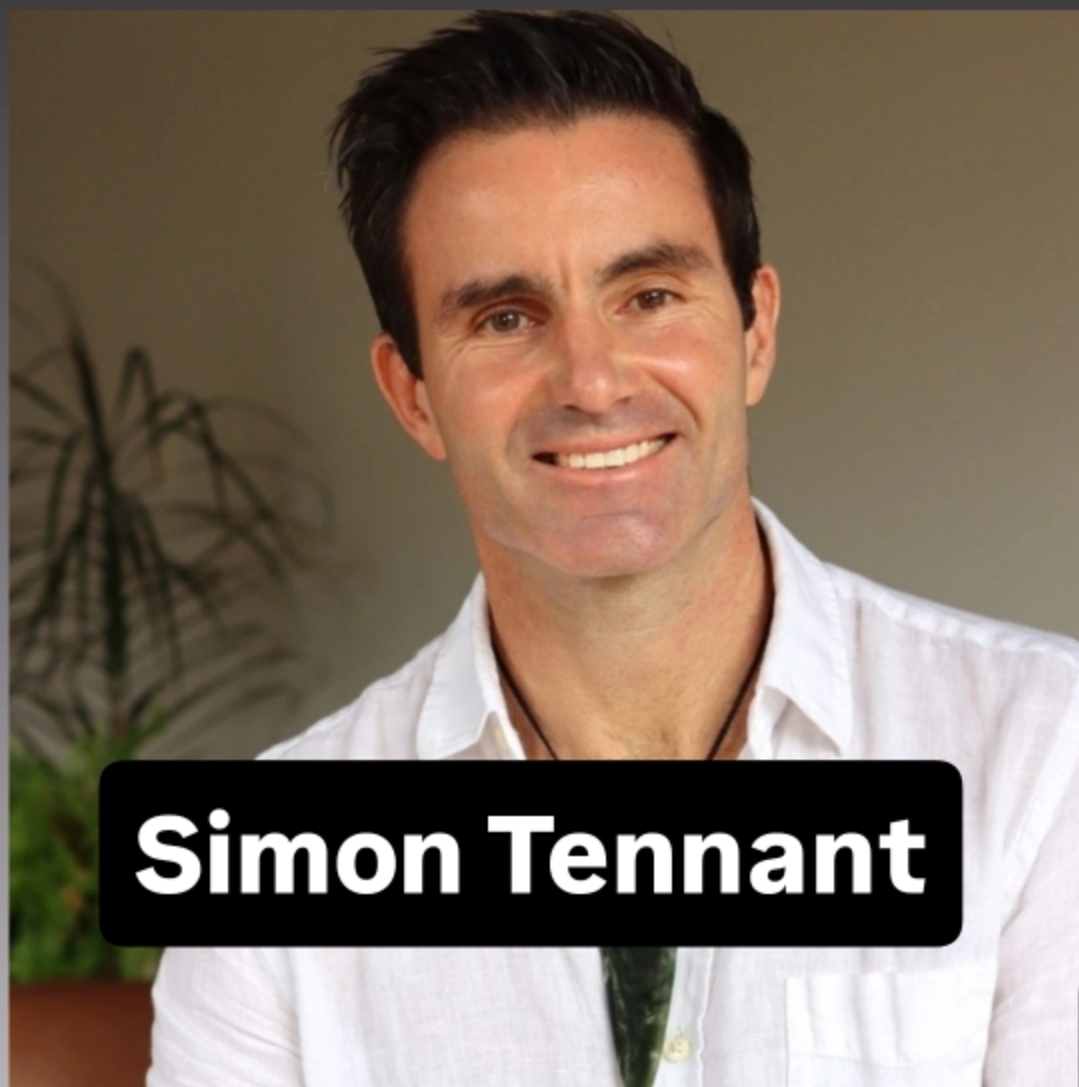
In this episode of Ayahuasca Podcast host Sam Believ (founder of http://www.lawayra.com) has a conversation with Simon Tennant—a New Zealand psychotherapist, integration coach, and longtime friend of LaWayra. Simon supports guests through complex processes (including repressed trauma), drawing on meditation, IFS lenses, somatic work, and a growing interest in philosophy and Christian mysticism alongside Buddhism. He’s served on LaWayra’s facilitation team and consults post-retreat, emphasizing patience, embodiment, and community as pillars of lasting change.
• 00:00–00:03 — Reunion, Simon’s role with LaWayra and integration work
• 00:03–00:06 — Recent ceremonies: body-based learning, “great mystery,” non-ordinary states
• 00:06–00:09 — How ayahuasca deepened meditation; greater capacity with difficult client work
• 00:09–00:12 — Shamanic flavor across traditions; curiosity over fixed identities
• 00:12–00:17 — From Buddhist lens to Christian mysticism; using “God” without recoil
• 00:17–00:20 — Multiple lenses metaphor; flexibility vs. rigidity in belief systems
• 00:20–00:23 — Losing self/other to return more whole; holding paradox and conflict
• 00:22–00:24 — Containers, boundaries, and why safe ceremony space matters
• 00:24–00:29 — What volunteering at LaWayra teaches therapists vs. online courses
• 00:29–00:32 — Building a practical facilitator training: “cookbook” + kitchen analogy
• 00:32–00:35 — Post-retreat integration: practices, community, and resisting distractions
• 00:36–00:39 — Working with childhood/sexual-abuse material: patience and not-knowing
• 00:39–00:43 — Somatic integration: TRE, SE, body as a safe place
• 00:40–00:41 — Ayahuasca as a shadow medicine; opening and purgation
• 00:44–00:48 — Shadow, DMN, neuroplasticity, and the ego/DMN connection
• 00:48–00:50 — Three-hour maloca meditation: embodied attention and capacity
If you would like to attend one of our Ayahuasca retreats go to http://www.lawayra.com
Find more about Simon Tennant at csimon.nz (C-Simon, spelled c-s-i-m-o-n.nz).
Transcript
Sam Believ: Hi guys, and welcome to Ayahuasca podcast. As always, we do the host, Sam. Today I’m having a conversation with Simon Tes Simon. It’s his second time with this podcast. The previous time was about a year and a half ago, or about 80 episodes ago. 80, yeah very long time ago. You definitely should check the last episode.
So go back 80 episodes. It’s it’s worth it. Simon is very good with his words. Simon is a friend. Yeah, he is a therapist. He’s an ayahuasca enthusiast. He’s an integration coach, tango dancer, horse rider, man of many talents. He’s one of those the most interesting men you’ve ever known, kind of people.
But most importantly. Simon has been a part of LA Wire ever since he came here last time. He’s been helping us. He was one of our integration coaches, still is. And Simon generally takes over when we have a difficult case like someone discovering big trauma and he always guides those people and really helps them to get better.
So Simon, welcome to The Wire and welcome back to Iowa Podcast. Thanks, Sam. It’s lovely to be here. Anything I missed in that intro? Anything else you want people to know about you?
Simon Tennant: Oh, just that I’m a guy deeply drawn to being of service and helping and exploring the big mysteries of life, the big questions and again, relationships.
Sam Believ: And Simon is also from New Zealand, so he is literally if you would look down. He’s right from like right from the other side. Funny enough that New Zealand is exactly on the opposite side of the globe. For those of you who believe that artistic globe, because don’t wanna offend anyone, I don’t wanna offend anyone who’s not educated.
Sorry about that. Speaking of flat Earth, I used to work on ships, so we would circumnavigate the globe. So I have no doubt, and if you have any doubt, so reach out to me. I can prove it to you that. That is indeed a globe anyways salmon. Yeah. Tell us about, so you just did one week of retreats with us.
First of all, let’s talk about your experience. How was Ayahuasca for you?
Simon Tennant: Yeah ayahuasca is very dear to my heart. It continually teaches, and bewilders and shines new lights onto unexplored territories. I think probably context from last year when I was here and I was here for, 21 days or whatever it was and then coming back this time from my last retreat, it really opened up a new landscape for me to explore.
In the last year I’ve really gotten interested in philosophy and theology. Christian mysticism when I came here last time was very much into Buddhism and so I’ve just become really curious to the different mystical traditions. And so I feel like ayahuasca when I take it, it allows me to have more experience of some of the things I speak about in those.
Had ancient wisdoms and intimations about experiences of something larger than yourself. Yeah.
Sam Believ: Any recent experiences in those ceremonies where you were like, I, what the hell was that?
Simon Tennant: I guess not. What the hell was it? I think I framed it simply as feeling like a mis, the mis, the great mystery was unveiling and, unveiling itself to continue to be a mystery.
So I, I love that that it, for me, I was a really ’cause it’s so volley based, so body-based, so semantically experienced. I don’t tend to have lots and lots of visuals, but the felt experience in the body is just, yeah, really beyond words. It’s so rich. It’s, texturally deep and it’s like you could look at one aspect of of experience and just fall into it, into eternity, literally.
So I guess that’s, I get to experience just going, beyond the kind of egoic experience of every day and into different experiences of something much larger, much as you could say, grander.
Sam Believ: Yeah. You did a retreat with us last January, so it’s about a year and a half ago. Yeah. You did it 18 days.
It was very profound. Yeah. It was incredibly changed my life. How did it change your life? What happened since then?
Simon Tennant: It was my first time doing any psychedelics here last time, and I came from having a strong meditation practice and having a lot of, personal therapy, which I still had.
I feel like the last 18 months have just opened up this beautifully rich landscape to explore. Little intimations I’d had through meditation and ayahuasca really deepened my meditation experience. It’s helped me to have a lot deeper, richer more expansive experiences just with meditation.
So it, what it did is it opened me up to, non-ordinary states and how how they visit people in a myriad of different ways. I feel like it helped, it’s helped me to become more compassionate person. And it’s helped increase my capacity to be with really challenging situations, especially with clients.
And since then, I’ve my, my private practice has become, there’s more, more suffering, more difficult challenges that have come my way that I felt like in the past would’ve been a real stretch and they still stretch. I guess there’s a kind of a grounding. Like a trust that there’s a way to get through it even if we don’t know what the way is.
And so I think it really helped ground like not just trust in myself, but trust in life. And so that’s a gift I’ll be eternally grateful and know to my last breath.
Sam Believ: How did it change the way you work with your
Simon Tennant: clients? It changed the way, just in context, if you haven’t seen the last episode in New Zealand, if you’ve had sexual abuse, you can come to a psychotherapist like myself or a counselor and get free therapy for many years if that’s required.
You can also have mindfulness retreats, yoga trauma informed yoga’s, a lot of support New Zealand. And this is all all done by the government. So people that really need the support and help can come and get it. So I think it’s a beautiful. A beautiful thing that New Zealand does in that space.
And I feel this is just laro my experience here, helped me hold those clients in a kind of more, a deeper way. Hold. What’s happening for them? Have more trust in like the innate wisdom of the body or the psyches. Lured towards healing if we’re just patient and spacious enough.
And I guess it helped me tolerate things like sometimes we have to tolerate that, which. Someone’s not been able to tolerate themselves or no one else has been able to tolerate. And sometimes that’s really confusing and somatically really big in the body. But I feel like my experience with Ayahuasca helped me trust and being patient with that, and that there’s a way through and.
So I had these experiences where the client lands on and they come in through and I might feel, battered around or in a disequilibrium with it and confused about what to do. But if I stay with it for long enough, that might be over multiple sessions. Usually something comes through and arises and participates in some type of co-creative experience that feels larger than just.
Me and then something comes, interjects back in that helps shine a light on where we might head a, where we might go like a glimmer of where to go. And so I feel that’s one of the really big things that’s happened for me. Just a trusting in that process.
Sam Believ: It sounds
Simon Tennant: almost shamanic that, that kind of thing.
Yeah. It wouldn’t be too dissimilar and. Mean, when you look at Shaman traditions and Buddhist traditions, Sufi, Christian mystics there’s a flavor of that’s quite similar. And I’m not saying that I’m one of those, I just, someone’s really curious and exploring those spaces.
So there may be a little bit more difficult to explore with, a conventional know, empirical scientific paradigm yet. Yeah, that’s changing as well.
Sam Believ: Yeah, don’t be shy. I think you can definitely call yourself a mystic. A curious
Simon Tennant: mystic, that’s for sure. Yeah,
Sam Believ: for sure. And that larger thing that you feel you’re connecting to or where you pass on this trauma and pain of other people what is it?
Is it God universe? Is it collective unconscious? Any theories about that?
Simon Tennant: We could, I could name it in many ways is. The creative advance of the cosmos, like Alfred North Whitehead’s process, philosophy, and theology is something that has and informed me like keratitis hagel, like this kind of unification of opposites or something around the intimacy of holding something that would seem to not be able.
Enter the same space seems really important that if we can hold the tension of that there’s something new that can emerge or ate something new that, that comes from there. And so that’s where I’ve been really interested. Not just in my personal life and private practice, but also with clients holding, a way of holding conflict conflictedness and, from an IFS perspective different parts wanting different things.
So it’s informing me in, in, a myriad of different ways. I notice I have to do continually check myself, and I feel like I’ve landed somewhere of some kind of knowing, having to give wave of that knowing to a new space of unknowing. Which is what DiUS says about the sculpture that just chips away at the stone, although there’s no stone left, but a sculpture.
So I a lot of these metaphors I really love from these mystical traditions. ’cause they, they have, they, they get me confused and. And this kind of poise space of having to stop and pause a while and sink into that confusion about what on earth are they speaking to here? And to be tumbled around in it until something kind of indwells and gets enlivened.
That again gives a little intimation, a little flavor or glimmer of what they might be speaking to. Yeah, I feel that’s an eternal process that’s ongoing. Yeah. So that’s, I feel like that’s the space in the last year that’s been the big, say revelation, but continued unfolding, shaping of,
Sam Believ: yeah.
So you said it, it almost changed your worldview and like you went from more of a Buddhist lens to mystic Christian mysticism lens. Yeah. And. How do you feel about that? Like the, there’s like many different schools of thoughts. Religions, et cetera. They’re in a way contradict each other, but in a way, when you work with, you realize that it’s just different people looking at the same thing from different angles.
It’s like how do you balance out this conflict. Where, which one do you prefer? Why just yeah. Let’s just go in that direction for the,
Simon Tennant: yeah. The first thing you ask me is how I felt. And so I’m noticing myself sitting a little bit of a smile on the corners of my cheeks. Some little butterflies pulling it up and my chest feels full and I feel buoyant.
So also dense and my body with it too. And I guess that’s speaking to quite a few words that I can put to that, which is like feeling excited, feeling blown and away by it, feeling the profundity of it the bigot two, another word. I guess for me, using the word God because of all the things that had been done in the name of God and really enjoying science.
When I was younger, it was a, it was literally a word that I felt really, it was really difficult for me to say and now it’s not so difficult and I can use it without feeling like I need to retract away from it. And, I could use it interchangeably with, a creative advance or a, a cosmology or a collective unfolding.
Yet going from, I wouldn’t say going from Buddhism to, to Christian mysticism that’s that that both of them inform me in different ways. And so it’s coming back to what you speak to different lenses and to. Modes of inquiry at speaking to the unknowable. Like why is there life, my says that, if life was asked a question of why there is life, I would simply say that I live so that I may live that life, gives birth from its own ground and springs forth from itself without ever asking South why is alive and.
So I feel like these different traditions, these rich traditions, whether you’ve got indigenous cultures in South America or the rich, traditions in India from and the different schools over there in Buddhism to Christianism, to Sufism, to the Middle East all have these modes of inquiry that have incredible wisdom.
And so I guess I don’t land. On one, one place With that all yet at the moment, I would say Christian mysticism possibly. ’cause I’m from a European background and often I think those of us that have been in science or been really interested in kind of the western mind, that really prizes the intellect and rational knowing that, using that word.
God’s really difficult. So Buddhism’s in some ways a safer entry, which is not to which is not to kinda make a judgment on Buddhism. ‘Cause it’s, incredibly rich in its own tradition. And by the way, I’m not a scholar on either on any of those. Just a lay curious explorer in them.
Sam Believ: I kinda like that approach to. Some people, they would choose a religion and then they would change the way they dress and maybe even modify their body parts, if and it’s like very strict and you just follow those rules. Some people have no religion at all.
I kind that approach of viewing it as like a lens, or specifically in that case you have glasses, right? So you can probably wear other pair of glasses with slightly different tinge of. Color, maybe a bit more, paint a bit more blue, whatever. Or just sunglasses. And just be able to, as you go through life and as you learn more things to be able to like, switch and adjust.
It’s like for anyone who ever had glasses made, when you come to the glass the opt, optologists optometrist, they like put in different lenses. Until they find like a proper one. And I think that’s a process we should all do as we grow and live in this world.
Instead of just oh, my, my grandfather had glasses. He’s gonna wear them. Just gonna wear them. Yeah. It almost feels, from that analogy, it almost feels stupid. What do you mean you gotta ruin your eyes? But we, at the same time, we accept so many things our ancestors did. And sometimes it has merit to do what has been done because it’s the best for you.
But I like that flexibility. It’s like I, or even have one lens in one color and one lens in the other car. As a bit of Buddhist, a bit of, yeah. A Christian or a bit of Sufi, mystic and a bit of indigenous Earth-based understanding of the world. Just finding your own way. I, I. I’m all for that flexibility in life and the way we live our life.
It’s obviously I have a very unusual life and if I would be like, oh, but I, what do you mean I have to do nine to five? What do you mean start an NIUs retreat? Just go in the middle of nowhere and start building something. Yeah. So obviously I’m a I’m all for it, so I don’t know. Any thoughts come to mind?
Simon Tennant: Yeah, it did. It’s like we don’t have to let difference, see a threat to each other. If we’re all these, wellsprings where life pours out from and is creative advance that, lays down a value laden story in the creative advance of life, then more stories are necessary.
And to have it one way of looking at something I feel is really limiting. I often ponder you, I guess I shared in, in one of my experience af after I’ve been here recently helping be part of facilitation team, but also doing some myself and realizing this experience of losing myself and other.
In order that I can return to myself with including them. So I’m really wanting to be rich to like, how does, how do when I come into contact with someone, even if it’s someone that you know, maybe doesn’t land on me in the most, in a way that is feels lovely or enlivening, but maybe I’m wanting to retreat.
What is it that they’re showing me? What is it that I can learn from them? What is it that I can include that can help me give away what I know so that I’m ripe for something more to come in? And I guess that’s one of the traditions like that tic having to become the barren desert to let go of yourself in order for newness.
It’s for new understanding to, to come in to then let it go again. And I think young psychedelics there’s this lovely thing that can happen and it can be terrifying as well. When someone has an ego dissolution or an ego death which is the way in which they’re in the world, gets ablated in what they know.
Gets changed and the energy they have for life, what drove them. Maybe it was to prove themselves or the seeking of material wealth. The energy for that kind of dissipates. And there’s this kind of difficult space where something new emerging, ’cause something maybe deeper saying to form a connection to purpose, something larger than themselves that they wanna give back to.
Having to be patient with that process, but having to literally give away what you know in order to know deeply to give it away again, I think this is what a lot of these traditions say, the a atic tradition, the Christian sticks around. You can’t say anything about the divine or know it. You have to give away of knowing into unknowing so that it can visit you in, a different type of way.
Sam Believ: It is the crab that in order to grow has to remove its shell and
Simon Tennant: then get a new shell. And limitations are really important when we have to have boundaries. Like we have cholesterol and we have a phospholipid membrane. ’cause if we didn’t, we’d be like a pool of fluid on the water. We need containers and holding in order for.
Attention to build. So that’s something new can emerge from it. Like you have a malca here where a wonderful shaman, Tyler Fernando, and your musicians and your ceremony staff hold space, literally hold a space in which this process can emerge. ’cause if you didn’t have that space, it just, it goes out.
And that, that can leave people feeling incredibly exposed And like the foundations are a water bid.
Sam Believ: It’s interesting that you mentioned that, we have our, every cell has its membrane and otherwise it would be a liquid. It reminds me, we had one, one time, one guy, he described an experience where he dissolved and became a puddle on the floor.
Not literally, from his ego point of view. So you mentioned the team. Obviously you got to be a team member for yourself. What do you notice the first question is, what can being a team at Naas Retreat teach you?
Simon Tennant: Oh gosh. I noticed myself having to take a big breath there.
’cause I guess this experience here has just, has touched me very deeply. The people that come and give their time here, the support that yourself and the other long-term people. Here like Nico and Clara that have been here, your long term stuff. Just the welcomeness and the love that they put into this.
And I don’t use that word lightly. There is a real profound sense of wanting to help people here and wanting to do well by others and accept others and. Find a way to help them. And as a therapist being here and being able to experience people in some real non-ordinary states, some would say some quite extreme states is such a, wonderful experience.
And will continue to inform the way I work in my practice. So there, there’s it’s complex. I wouldn’t say it’s complicated. It’s complex. There’s a lot of. Parts moving here, you’ve got these, process of people’s autobiographical stories coming up, their traumas, and you’ve got transpersonal, psychospiritual stuff coming up.
You’ve got perinatal birth processes, you’ve got relational processes. So it’s just such a rich crucible for people to explore themselves. And there’s a reason why I came back to Laira, and that’s because, the way things were done here was in a really safe manner, and I can put my hand on my heart with that.
Having experienced it from both sides that if you are wanting to do ayahuasca or any psychedelics, that sense, for something like ayahuasca that’s got the rich tradition here, that you’ve got shamans that, that train for their whole lives to be able to do that, come to somewhere. Like here to do it, respect and honor the tradition.
So for me I don’t do ayahuasca outside of Columbia, outside of Lara. Thank you for sharing
Sam Believ: that. That’s that’s all very nice and thank you for recommending yeah, recommending us. What can being a part of a team teach someone from a point of view of, let’s say how would. Three months of volunteering at LA Wire compared to, let’s say, a three months online course.
Simon Tennant: Yeah. Gosh. I, and look, I, recently completed a certification with my Medicine Australia. Really rich learning as a psychedelic assistant therapist, fantastic faculty, really well held online in a nice experiential space at the end. And a really great way to learn. And, but then also to bring that knowledge and that learning to a place like Laira and be on the ground with it.
Is that’s it’s invaluable. Like you can’t put a price on that. There’s only so much you can do online without being boots on the ground and feeling like, I guess you could say the beauty that comes, if beauty is the unification of diversity and. Being able to hold more intensity of experience.
And that’s what you get at an Ayahuasca retreat. You get diversity, you get people of all ages and cultures, all different processes and this right process, and you get to be pulled and swayed by it. You get to be like, oh gosh, what do I do now? And trust in the process and trust in your team that it’s not just you having to hold it, but you’re a part of this team that’s holding it, who’s also, part of, the wire as a whole holding it and a shaman holding it and a musicians holding it.
There’s just these different layers and so there’s a real communal community. Thing here that happens, which I think is really important for therapists. ’cause office, obviously most of the time we’re in the four rooms of our practice on our own. We have supervision and we have collegial support. But something like this is is just so rich and spending three months here.
I think would be invaluable to any therapist, even if they don’t wanna work in the laundry states, but to build capacities to be with someone that maybe has DID or extreme borderline personality disorder or bipolar or psychosis or, antisocial type personality, deeper pathologies.
Yeah.
Sam Believ: Yeah. Analogy I like to use, and it doesn’t go to a therapist, but specifically with people that are training to be facilitators at the psychedelic spaces the courses, it’s it’s like reading a cookbook. It doesn’t matter how much you read it, it’s not gonna make you a good chef.
This is like real, but here we have a kitchen. And we have a little cookbook, but I’m really looking forward to keep expanding our cookbook. And the videos of how we cook, if it’s a good analogy, if it’s still stands, but like we’re working now, the different ingredients, workshops and training manuals.
And eventually, hopefully you’ll get good enough to become a mini facilitation training program with a lot of practical part of it. And it’s something that. Yeah, I told you that, that idea that I have. What do you think about it? Should we,
Simon Tennant: If we take the shit out of it, I would just say yes.
Absolutely. I think it’d be invaluable. And like I said, like this last year, I’ve, been a part of supporting the wire from a distance and helping often patients that have, repressed memories of sexual abuse since it’s a specialty area. And, there’s something that happens in these states where you have to help people that have these experiences, whether they don’t know if they were a hundred percent real.
Part of them feels it is. And part of them feels, it’s not like how do you help someone hold the anxiety of not knowing? And I feel like that my experience at Laira and working with your patients in that space has been incredibly valuable. And even it’s not just for people wanting to train non-ordinary states, whether that’s through breath work, meditation, tantric practices, or psychedelics.
Even if you are just wanting to deepen the way in which you work with your clients, coming to somewhere this where you have to be with people in their most vulnerable and their most exposed is such a rewarding and. Rich, I use that word rich because it is like textually rich experience of being required to grow.
Like you. You have to, you’ve gotta, now, like they say the samurai, you must learn all the techniques, but you have to throw them out the window or forget them when you go into battle. Otherwise you’ll die. You’ve gotta be in this other space where you can be somewhat by the seat of your pants and.
As one of my first lecturers in Psychosynthesis said to me, intuition favors a well stocked mind, so you’ve gotta do the learning, but then you’ve actually gotta be here. So I if LA Wire is to create something like that it’d be invaluable. Valuable.
Sam Believ: Yeah. So you mentioned supporting LA Wire from the distance, and I highly appreciate you because occasionally people do discover really big trauma and it’s they need.
Integration and you’re really good at it. And you’ve helped us guide several people, and then one of them Clara as well. She had her process. And for those who want to learn more about this, Clara was our head of facilitation for almost a year, and she recently left and her episode should be, should have come out right before this one, so go check it out.
But she has, she had her own journey. The integration post retreat integration. And where, when you work with people, what are the, tell us about it. Yeah. What is your method? What is useful? What is that?
Simon Tennant: Every now and then you get a client, I don’t even, that’s I’ll say with client such as someone like Clara, who’s Will’s really engaged in their healing.
And does the practices, doesn’t just use the one hour a week with me, but that uses what we practice in session, looks outside of session, into meditation, into yoga, into somatic experiences, journals reflects deeply. And it’s those types of people that are really engaged that really see the benefit, like you’ve said, 10 years times, Sam that.
Ayahuasca, psychedelics, they open a door, so it’s for the individual to walk through that door and step and walk on that path and, there’s some really important things. Integration. The integration is literally a more of a western concept. These medicines usually were held, whether there were va, Buddhist taking an amrith medicine, or whether it was taking ayahuasca.
They all had a SA community that held their process held helped them on their way. And so the integration was an innate we don’t have that in the west. We come to this beau like the wire is beautiful, it’s spacious, it’s quiet. You can hear yourself think again. And then we take that and we go back to the jarring ness of the concrete jungles to Fernando would say.
And we have the, those winds that blow. Of needing to, needing more and more, and distractions, never before have we been able to, obliterate ourselves by doom scrolling, literally annihilate, annihilate ourselves with distraction. So the integration process is important, like nature, if you need to work with someone or find a group that you can be with, that helps hold you on your way.
Noticing, being able to put the medicine music on and reflect deeply on, on your time that you’re imagining your time at these spaces. And so that unfolding, what will be revealed to you is got enough content for a lifetime. If you choose to work with it, it’ll continually unfold.
So yeah. That’s what I got to say about that. Yeah.
Sam Believ: So you work specifically a lot with people that drink ICAN and childhood trauma comes up or Yes. Or more commonly sexual abuse from childhood, what do you have to share there? For example the cases he worked with, what are the common patterns?
Should people be afraid to drink because the trauma will come up, or should they pursue it? And how do you know what is the process like? What are the challenges in this kind of process? Yeah. I think Freud
Simon Tennant: says something important here, as does Jung ASAs, Oli. Like we’re responsible for our own conscious and unconscious process, and we’re dominated by that, which we’re identified with.
And a lot of the times. All this trauma is there, even if it’s been repressed and it’s, and in some ways been forgotten the body knows somewhere, the psyche knows somewhere, and it will be seeping out in ways in your life that you maybe not conscious to. You might think you’re making a decision from a place, but it might be from an unmet need or from a place of fear or terror.
Like the psyche always we would say is you’re seeking for integration, for individuation to to become whole. Working in that space the important thing is to, I’ve found, is to help them hold the space of not knowing. And a word they get sick of me saying is patience, is that.
If we’re patient enough, we’ll at some stage get a knowing and an in depth knowing I could trust that what was given to us was either symbolic or it was real. And so we have to hold that tension. And that’s when helping manage anxiety and daily practices are really important.
‘Cause they help keep you well engaged in that process. So I think that’s the major thing. Is that we have to be patient with that process. And often it’s difficult to do on your on your own. And this isn’t a plug by the way ’cause I’m literally pretty full. But to find someone that can help you, whether it’s a wise guide, I have a wonderful guide that I’ve worked with for 12 years.
I have a be a beautiful supervisor. That helps me. I need help as well. We all need it. And, so that’s an important thing to know, that we need to help and to be patient, to trust, but trust can be really difficult. One of the things I guess is really important is that talking about it’s not enough either has been my experience that we have to get into our bodies, especially with trauma.
We have to make the body a safe place to go to. So that’s things like, CH yoga, trauma informed yoga can be helpful. A modality that I like is TRE. That’s a really. Great process, somatic experiencing lots of different ways that we can include the relational experience with, making the body a safe place to go to again.
And leading it to express. Yeah.
Sam Believ: So having your own extensive experience with Ayahuasca now and helping integrate lots of people and other knowledge of psychedelics. How would you explain the mechanism of how Ayahuasca works for healing? Gosh, I’m not sure
Simon Tennant: I would we often say that ayahuasca’s a shadow medicine, and so I think we have to hold that, that it helps open like even the purgative aspect of Ayahuasca, that it opens in some ways.
To allow something to be let go of. And we could say it through a purge, but I feel it opens the opening can be really difficult for people at times, or it can be beautiful on my personal experiences is that it is something I wish everyone could experience. And I’m grateful for that. But that’s not always the way either.
But I feel like it, it opens a a space in which. Other types of wisdom or understanding can end well come in or come forth from within. It helps us look deeper, helps shine a light into the unknown, un illuminated spaces of the psyche, those rich sutures. It’s like the journey in a way, like it, it helps helps feel like a Virgil to Dante in those spaces.
But because it’s so somatically based I think that’s one of the beautiful things about ayahuasca and the challenging things is that you feel in your body, you get to feel your body and the body gets to release, it gets to cry, it gets to sweat, it gets to laugh, it gets to dance, it gets to, to sweat.
Yeah.
Sam Believ: So speaking of the body, and you mentioned, importance for people with trauma to, in integrating to make the body a safe space. And we did this workshop recently on TRE. Yeah. Talk to us about this process. Let’s say somebody who is not in Columbia, they have no access to Alaska.
What can they do to make their, to reconnect with their body, make it feel safe again?
Simon Tennant: Like I’d often used to say mutation and body-based mutation is good, but if you are suffering from a lot of trauma. Then closing your eyes and sitting in a room on your own could be an, leaf and really exposed and really vulnerable.
So I would encourage, if that’s how you are to find a therapist that does somatic based things like I said, TRE, which is trauma intention releasing exercises, which is something that I’m studying at the moment. As a wonderful way of allowing the body to unwind naturally, it’s like it’s inducing a tremor response so that all of the tension and the torque up energy that’s in our nervous systems that we don’t allow to.
To release can release. And also what’s really gentle about it is that you have control over the tremors by starting and stopping and not going over certain level of activation and noticing somatic markers. And so I’d encourage you to reach out to TRE providers that can help you with that or somatic experiencing providers.
That’s difficult to do on your own because. You want someone to help you understand how to regulate that process to start with. Otherwise it can be really overwhelming. So there’s a caution there of just doing it on your own. But David, the silly is the is the founder of TRE and there’s plenty of information on YouTube and the web to, to look into that.
Sam Believ: You mentioned shadow and that was being a shadow medicine. Talk to us a little bit about that, integrating your shadow. What is it? What do you mean by that?
Simon Tennant: Yeah shadow shadow can mean a lot of things. It can mean that we’re not alive to, and that we’re not aware of.
It can be the pain, shame, guilt. Those things trap that the ego extent of ourselves doesn’t want to get close to ’cause they’re really uncomfortable or they don’t fit a worldview or they leave us feeling exposed and vulnerable. ’cause often these things happen in childhood when we are really vulnerable like a human organism.
When it’s birthed, when it goes from an aquatic creature to an air breathing creature, through a really difficult experience called childbirth is like one of the most vulnerable creatures. And when it’s been taken advantage of in early years, then we cra these different types of defenses that help lock innocence that was taken advantage of away.
That doesn’t happen again. And shadow work or a shadow medicine. Can really help shine a light into those spaces. And Jung speaks about this, very eloquently around when this process, this content comes up and its need to metabolize how difficult that transitional space of metabolizing it is as it seeks integration.
But that integration part is really difficult and know Ayahuasca is another one of those lights that’s helped shine and open that up, psychiatric research suggest that it decrease, psychiatrics help decrease the default mode network. Those long patterns we have on our life in which the lenses, which we view.
View our world, the patterns that are maybe dysfunctional with. They’re safe because they’re familiar and the psychedelic, like ayahuasca helps open those helps, create new kind of neuroplasticity from a kind of more biological sense. So that what we’re usually used to experience and in the way we’re used to experience in I wouldn’t wanna say shuts down, but becomes a lot softer and we’ve become a lot more porous or open to shining a light into those darker spaces. And those are the spaces that can be really scary. Those are the spaces that, that, visit us in our dreams with nightmares or monsters or demons, or being chased by those that wanna assault us.
Yeah.
Sam Believ: You mentioned default mode network and sort of default mode network being. Switched off or diminished during the secondary experiences. Yeah. Do you equal default mode network to ego? Is there any connection with,
Simon Tennant: Yeah. Conceptually these are all conceptions. You can’t touch an eco, an ego or like a default mode network.
They’re abstractions, but helpful. Helpful. We sometimes in psychotherapy talk about them as structures. To be helpful. But yeah, the they can in, in ways be interchanged. Being a way, an ego conceptualizing it as a way of knowing what we know and being identified and what we know.
And that being a way that helps us navigate the world. ’cause we’re always wanting to protect against uncertainty and the unknown. Like you look at our world today, literally. It, like whether it’s insurance or funeral insurance, life insurance, motor vehicle insurance, university jobs, all these things.
And they’re all necessary in a way as well, but they’re often about protecting against uncertainty. And the unknown, which I think I said in my first podcast a few, is I feel one of our biggest capacities is to build thing with the unknown and the uncertain. And so I think, a way of. This is only a very brief way of looking at the ego.
’cause depending on whether you are a Freudian, a Jungian, or a psycho, dynamically based what object relations theorists you subscribe to, the ego is described in different ways. But, as general a wave, which we know the world and identify with it, and it helps us navigate the world, would be, general, which would be enable us to the default mode network too.
In some ways,
Sam Believ: Freudian Union or Iowa Skin. Whatever is your school of thought. Yep. You said this morning to me that you just meditated for three hours in the Moloca. Yep. Talk to us about meditation. It’s important. And you mentioned body-based meditation, like what is it?
Simon Tennant: Yeah. Firstly to be able to meditate in the Malka, you probably can’t see it behind, but it’s at the foot of the mountain.
The mountain holds it and it holds the mountain. That’s a conditioned space there where people come to heal. There’s a wonderful shaman that works there. There’s beautiful musicians, there’s a lovely team. There’s been so much care. One of the things that, that I think I shared with Clara the other day, is that when I’m here in LA Wire, it makes me wanna be a better person, makes me wanna be kinder, makes me wanna participate in life with more depth and more richness.
And so meditating in that space is literally like having a mini ayahuasca ceremony for me that’s so full in my body. I have to go through some pain with sitting for a long period of time and lean into it and try and find a spaciousness in amongst, my, so as tremoring as I’ve sat cross-legged for a while.
And be with that, be with the bugs that, you know, like a fly that lands on my face. All those things. And so that’s all really rich and embodied and. Those types of body-based meditations help connect with our body, but they need to be leaned in gently to start with. They need to be helped into so that you’ve got sufficient capacity to be with that.
And generally most people can just do that. But as Blaze Pascal says, the root of all man’s Missouri is his inability to sit quietly alone. Because when you’re alone. Your ego gets involved, your urges and desires of wanting to always be busy and productive, especially in the west, come up.
So you get to learn so much about yourself by just being with yourself to realize that yourself is not just yourself.
Sam Believ: On that note, let’s start wrapping up. Yeah. ’cause I think we both heard the. The bell, the kitchen bell. Yeah. That means that the food is coming. Yeah. Tell people where they can find more about you. I know you have a blog.
Simon Tennant: I just a, I just have a website that’s out of date. But c the letter C Simon nz.
If you wanna get in touch with me, reach out. Always happy to be available when I can and help where I can. Or point you in a direction where you might be able to get some resources and help. Yeah. So Simon with the C so C Simon, so C-S-I-M-O n.nz. So it’s a play on words. C Simon nz.
Okay. I’ll ask you later and I’ll put it in the description. Yeah. Can you spell it? C-S-I-M-O-N, NZ C Simon? Yeah. Okay.
Sam Believ: Thank you Simon. It’s always pleasure having you here. I hope you come back and never leave. I will be back for sure. Guys, you’ll be listening to our Oscar podcast. As always, we do the whole assembly leave and I’ll see you in the next episode.
Thanks, Sam. Good stuff.