
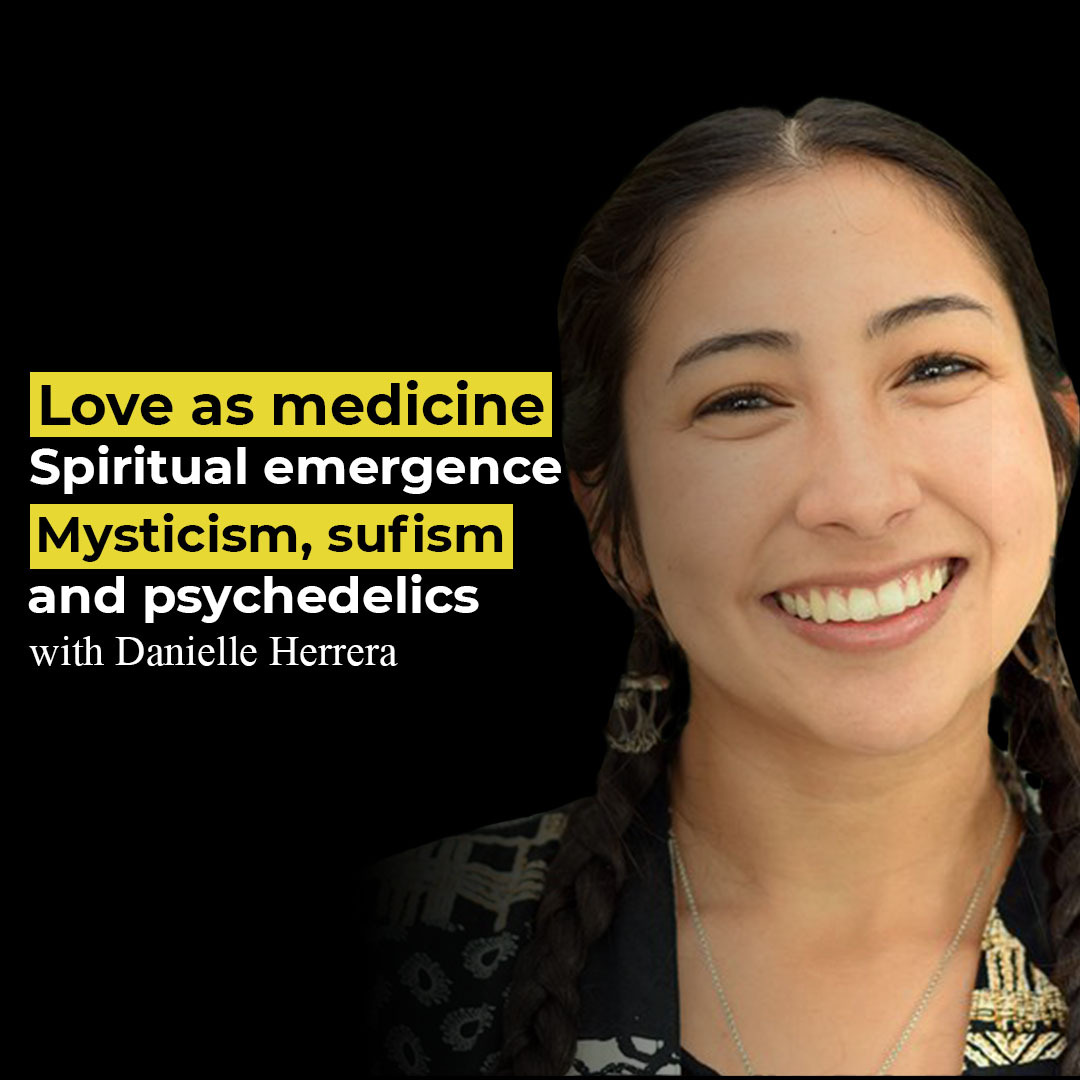
In this episode of Ayahuasca Podcast host Sam Believ (founder of http://www.lawayra.com) has a conversation with Danielle Herrera, a California-based licensed psychotherapist and psychedelic-assisted therapy specialist. Danielle blends somatic and Jungian work with harm reduction, draws on Indigenous lineage and Sufi mysticism, and trains new facilitators with Beckley Academy. We explore how love, right-relationship, and spiritual technologies help people heal trauma and integrate psychedelic experiences into daily life.
00:01–01:22 — Intro and Danielle’s background
01:22–08:14 — Origin story: chaotic childhood, harm reduction path, ketamine/MDMA training, founding Tender Heart Healing Arts
08:41–12:48 — “Loving people for a living”: centering love in psychotherapy; Indigenous and Sufi lineages
13:14–17:11 — Trauma as absence of holding; parenting parallels; harm-reduction lens
17:12–22:03 — Why some grow from pain: “jet fuel,” ayahuasca discomfort, meaning-making
22:32–25:10 — Transmutation of pain; rites of passage and village containers
26:01–29:46 — Shamanism vs “psychosis”: the role of container (Crazywise reference)
29:46–36:30 — Sufism 101: Rumi, polishing the heart, spiritual technologies; resonance with ayahuasca/Icaros
37:32–42:43 — Mystical experiences in therapy; clinician competence and frameworks
42:43–47:02 — Spiritual emergence: signs, tenderness, intuition, “magic is real”
47:02–51:40 — Addiction: “don’t ask why the addiction—ask why the pain”; right-relationship with medicines
51:40–54:19 — Real integration: becoming better to those you’re responsible to love
If you would like to attend one of our Ayahuasca retreats go to http://www.lawayra.com
Find more about Danielle Herrera at tenderheart.us (yourtherapistlovesyou.com) and Instagram: @yourtherapistlovesyou
Transcript
Sam Believ: You’re listening to ayahuasca podcast.com.
Danielle Herrera: There is not a single indigenous culture that is secular. Also, indigenous cultures fail to have words for religion and spirituality or mysticism. There just aren’t words for it. And the reason is because you wouldn’t even begin to conceive of living a life without those at the center.
Okay, so spirit at the center of the work religion, of the center of your work, mysticism, is it is the container in which they exist. So I’m very excited about the mystical experience as it occurs. People have it, I would say, through lots of different directions. It reminds me of something in Ramdas’s book Be here Now where he describes.
He says something like, it can happen through having your heart broken or giving birth to your child, or falling in love. It can also happen through the psychedelic experience. It’s these moments he says, it’s like the rug gets pulled out from underneath you, and when that happens, you’re like, I don’t know how the world works.
I thought I did and now I don’t. Okay once the rug gets pulled off from underneath you, what you need is somebody to help you make sense of that experience. If you get a psychologist or a psychotherapist or a psychiatrist who’s oh no it, you just you’re going a little crazy ’cause you took some drugs and they make it that simple.
Your capacity to meaning make and actually integrate something as powerful as one of its experiences just completely collapses if that’s who you have. But if you’re instead meeting with a shaman or a Sufi merchant or a Shik or some other mystical initiated being, whatever it is who can help you make sense of you’ve done the thing, you’ve touched the divine, and now you’re coming back to earth and you’re trying to make sense of that relationship that you just had.
You had a moment of merging, and now we want to know how do I take this merging and make it so that I am a better person to the people whom I’m responsible to love.
Sam Believ: Hi guys, and welcome to Ayahuasca podcast. As always, you the host, Sam. Today I’m having a conversation with Danielle Herrera. Danielle is a licensed psychotherapist and psychedelic assisted therapy specialist based in California. She blends somatic Jungian and harm reduction approaches with a deep respect for indigenous wisdom and spiritual emergence.
Danielle supports marginalized communities, trained new facilitators through Beckley Academy, and is a leading voice in decolonizing psychedelic therapy. This episode is sponsored by Lara Ayahuasca Retreat. At Lara, we combine affordability, accessibility, and authenticity. Lara Connect, heal, grow. Guys, I’m looking forward to hosting you.
Danielle, welcome to the show.
Danielle Herrera: Thank you so much for having me. Sam.
Sam Believ: Was that a good description?
Danielle Herrera: I think that’s great. I was like, wow. How’d you come up with that one? Yeah, this, it can be hard to capture the work that we do, but
Sam Believ: I don’t share my sources. But actually was Chad ZPT. Awesome. Yes I remember once I was getting ready to be interviewed myself, and somebody asked me for my bio, and I have a couple of them written, and then I asked JGBT and it actually gave me a better bio of myself than I could write.
It was just very good. So since then I’ve been always asking JGBT. The issue is that sometimes it’s outdated. That’s why I ask was it good? But the rest of my questions that I prepare them by myself that’s as much as I use AI for Dania. So you have a pretty interesting story. So tell us your story from, how you grew up, your trauma and how, what brought you to eventually work with psychedelics?
Danielle Herrera: Yeah, great. Thanks. I’m happy to start with that question. For reference, when I was just at the Psychedelic Science conference, I was on a panel. Mostly on the use of psychedelics for substance use treatment, substance use disorder treatment. And when we were trying to figure out what question to ask me, one of the conversations that came up was that the best and most real way for me to enter, talking about what I care about is actually through my personal experience.
And I’m a psychotherapist, so it is a pretty radical thing to be able to have that out in the world. And my clients, know that it’s something that’s accessible. I work with people with complex traumas and what I’ve found is that it can be really helpful for them to know that I have shared experience.
So I appreciate starting at this point. Just gives a lot of context as to why I got to this work. So let’s see. I. Met my first psychotherapist actually was a social worker when I was about five years old. And grew up in a family that in ton Ville land in Los Angeles and grew up in a family that was pretty chaotic.
Both of my parents were chaotic drug users. My father is a chaotic heroin user. He didn’t raise me. And then my mother in time, she was an alcoholic, but then in time she also started bega, began to use methamphetamine, chaotically. And the, I think the most striking part of my experience with this was that I, my love for her never changed.
We experienced a lot of housing instability homelessness, et cetera throughout my childhood, mostly in my young adolescence. And it was intense and a lot of social workers in my life. My mother’s stuff was all her trauma, all. CSA childhood sexual, like assaults, various degrees that she did not have access to treatment for, that were just projected onto the family system.
And she, she was suffering. And so when I was younger, I, before I understood that it was some, it was a drug related experiences that she was having a lot of symptoms that sort of looked a lot like paranoid schizophrenia. So before I knew that it could possibly be from something like drugs, I taught myself or explored psychology very young in order to under understand her.
And so by the time I was in middle school, I was reading psychology textbooks, like college psychology textbooks, and became really interested in that whole realm assuming that she just had a mental illness that was untreated. Then by high school when we were also homeless, I discovered that she was indeed struggling with mental illness, but ultimately was having a really intense relationship with drug use.
And by that point I already knew I was a straight A student, I already knew I wanted to become a therapist. But I always figured I wasn’t going to go into working with drugs, I was like, why would I turn my trauma into my career? Then you go to grad school and you realize what you’re good at.
I thought I was, I did originally start training and working in child development and working with, directly with children who were experiencing traumatic scenarios. But then I was still working with their parents when I was doing that work. And. I found my way to harm reduction therapy center in San Francisco, where I naturally just understood the language.
And I remember sitting there with pat Denning and Jeannie Little, who are the founders of West Coast Harm Reduction Therapy. And they were interviewing me and they were like, what how do you know about harm reduction? Like, how do you know that the basic thing about working with drug users is to treat them with compassion and respect?
And I was like, I don’t know. I didn’t learn this from anywhere. And they’re like, oh, we get it. You knew of harm reduction because you knew of it before it was the, you even had a word for it because it was simple. It was loving your mother, everybody told me, kick her to the curb, let her bottom out.
Just abandon her. Like she’s, she’s useless. And I just couldn’t believe that was the case, so I stayed in relationship and over time she, went to rehab and struggled with it. But she, as of today, is 14 years sober. So as I was working with drug users directly in, in San Francisco, and this was mostly with folks who were also experiencing homelessness, it was a very comfortable environment for me because it was what I was from.
And then at some point you get to your own point of kind of burning out in those environments. The good news was that I was training while I was doing that work, I was also training in ketamine assisted psychotherapy. And so I got to do harm reduction work, which was addiction. Air quotes, work alongside doing psychedelic assisted therapy work.
I was also training in MDMA assisted therapy and psychedelic integration. So I found myself in doing what I say is drugs, full spectrum work. I still do that. I now run a private practice. It’s a group prac practice. It’s called Tender Heart Healing Arts. It’s, if you go to your therapist loves you.com, it’ll redirect to our website.
And I really love the work that I do and I a lot of the work that I do now is just actually distilling everything from my experience into. Something very simple, which is to bring love back into the psychotherapeutic relationship. To honor that love is the thing that is healing us. And what that looks like in practice is not turning people away who seem like they exist on the fringes a little bit too hard or trusting that people are intelligent and are orienting towards what they need to heal and supporting them in those processes.
That’s the story in a nutshell, and I’m happy to answer any questions in any direction, but I really appreciate starting here with the story. Sam. Yeah.
Sam Believ: Thank you for sharing your story. First of all, congratulations on, turning things around and, starting from the bottom. Now we’re here sort of situation.
And also congratulations on your mom being, you said 14 years sober.
Danielle Herrera: 14 years. Yeah. She’s my hero. She’s done more work than anybody I’ve ever seen do in one lifetime. Yeah.
Sam Believ: You touched many interesting topics and we’ll go through them, but let’s start with the topic of love and importance of love in the therapy because you say you, that you love people for living.
Yes. Tell us how, tell us why, and tell us why the world needs more of it. And why is it not widely accepted?
Danielle Herrera: It’s beautiful. It’s beautiful. I’m so glad that resonates for you. I do like to say that I love people for a living. So here’s what I’ll say. Is my, my perspectives on love and my experience of being like a Capital L lover and putting love at the center of my work, I think are informed by two different lineages that I come from and they’re worth naming in order to honor them.
The first lineage is my indigenous lineage, both on my mother and my father’s side. So my father is Paki and my mother is Cher Kawa Apache, and she’s also Filipino. And there is something about being raised with this core of right relationship, reciprocity and reverence that has informed everything that I’ve done since I was a child.
So much gratitude to my lineage for that. The other lineage is one that is not blood, but is something that I have been beautifully initiated into, which is my mystical practices. I’ve initiated into a lineage of, in Ati, Sufism, and Sufism. Has now really come to inform so much of my being and so much of the way that I work in a way, and sufism, one way that we describe it is the religion.
That is also not a religion, but is a religion in the sense of all paths lead to the same or all rivers lead to the same ocean, the religion of love. And so when I do my work, which is my absolute dream job, I can’t believe I get paid to do it when I’m sitting sacredly across from another person as they is getting to hold their process.
What comes up is love and reverence to them. Why do I think it’s not, why do I think it’s edgy? Why is it non-traditional? For somebody to center it in this way is that I think we exist in a culture that, maybe doesn’t trust, love or know love to be safe. And I think that’s we have to be careful with something like love within the psychotherapeutic transference.
We have seen, especially for example, in the psychedelic field, the way in which having erotic transfer, for example, or love in the therapeutic container can be misused or power dynamics lead to harm and abuse. But even in that case, I’m wanting to bring back the reality of what is happening between clinician and client and just in the clinician and the client’s experience, and then the clinician’s experience of love.
So what does that actually look like in practice is, it depends on the capacity of each client, but with my clients, I will. When I will be open to the point where we get to where they tell me like, I love you and I’m open to expressing to them that I love them back and that we just simply honor.
It doesn’t have to be or mean anything other than that core reality of existence is present between us. And that core reality of existence that is right there is actually what’s doing the work. So that way I actually get to step away from being the person who heals, right? And instead we get to honor that this like quality, this truth.
Capital T is what is healing this person. And that their ability to access that and open to that and receive that is just absolutely divine. Yeah.
Sam Believ: You described the harm reduction as just. Most, the most important thing there is loving people. So instead of judging them or telling them to bottom out or just cry it out.
And as you were sharing that, I thought about that, in our society also child rearing is also considered, there’s like similar patterns. Like just let them cry it out. Just let them go through it themselves. So I have three kids myself, so we don’t do it this way. So I’m just wondering if you ever thought about it this way as well.
Like why? Most of the trauma starts from the childhood, right? And we have this entire generation that grew up being like locked in the room where they’re the most vulnerable and they need the help. That’s why they’re crying. So the sleep training sort of thing, any thoughts that come to you from the direction?
Danielle Herrera: Oh, I love that you’re bringing in your experience with fatherhood here, and congratulations, you’ve hit the jackpot with the three babies. Yeah, that’s a great comparison. Okay. So I think one of the things that you’re hitting on is this truth about trauma, which is that trauma isn’t the thing that has happened to you.
It’s the thing that happened without there being a person to hold you within it, right? Or the absence, the isolation in it, the the lack of somebody to guide you or give you context or help you make meaning of it. It’s the, I am alone in this experience. That’s what creates the trauma. We can have an event occur, but if it is held contextually, we’re in a different, if it is held relationally, we’re in a different experience.
So take the child who is having, being a brand new human right, who is having a really intense experience, understanding this emotional capacity, what is going on, this human body, human experience and the power of the parent being able to help them understand that this is the human experience, so this is what, for example, Sufism does.
Is it provides a, it’s like a blueprint. It’s a science, it’s a true like spiritual technology that gives you a lot of language, a lot of story, a lot of structure, a lot of container for what might be happening in the intensity of the human experience. So for example, when you connect us back to like harm reduction, what we do in harm reduction is we trust that human beings are intelligent and we’re, we are simply trying to manage our human experience.
And in the same way that if I am feeling. Dysregulated and then I assess, oh, I actually haven’t eaten in a few hours. Maybe I should go eat this cheeseburger. That same mechanism is occurring for a human who is having a really intense, maybe out of alignment relationship with a drug who is, potentially just having an experience where they’re like, I need, I’m feeling like I need to shift my internal experience.
Okay. What we have is a human who’s trying to understand and shift their human experience. And so the power of their being somebody outside of their body to help them understand that process and then help them come back into right relationship with themselves and with this drug and maybe the right relationship with that drug is to not have that drug in their life.
But there’s still that. There is a relational tether that is occurring. We are always searching for something to help us regulate. And maybe it’s psychedelics or maybe it’s philosophy or maybe it’s spirituality or whatever it is. But we’re honoring that humans tend to know what they’re doing, but maybe they just need a little bit more help.
Sam Believ: Yeah. On the topic of childhood, like you obviously went through a really difficult, really traumatic childhood, and there’s this phrase, you know what doesn’t kill you makes you stronger. And I really like this joke. What doesn’t kill you make, makes you cripple. So it’s like, what is the difference that some people crumble and other people use it as strength to grow?
Do you, have you ever, have you been able to identify, why did you go. The more positive route.
Danielle Herrera: Yeah, that’s a great question. Yeah. Yeah I definitely am grateful for whatever ancestors and protectors and guides and angels have allowed me to be somebody who has taken everything that has experienced, I’ve experienced and found a way to use it as like jet propulsion, rocket fuel, to get me to where I am now.
I’m a meaning maker, so I, and an optimist, I’m an Enneagram seven. So there’s something even just about the personality of oh, I can, I’m, I can use this. I’m gonna find a way to make this beautiful. And that could just be personality. But I think it goes back to the previous question around like I, I noticed this with my clients, for example.
Sometimes they don’t know that there is another way. One thing that I get reminded of a lot as a psychotherapist is some of these things that I say that I have gotten to this point can judge them as being almost basic, are actually things that people really need to hear and I need to keep saying, no matter how many times I think it’s becoming trite.
And one of those is that is that there is a function to our agony. There is a function to an annihilating experience. It is the necessary like catalyst that propels one to having any desire to make something different, right? So a common question people have I think on spiritual paths, psychedelic paths, therapy is why do bad things happen, right?
So like you’re naming Sam, like a lot of bad things happened in my child, that’s for sure. But one of the answers that I have at this point is why don’t ba more bad things happen? And I think there’s, so what happens when bad things don’t happen is that we can fall into living a life of lacking purpose lacking direction having a stunted emotional sort of range.
I, my pain has been very intense and it has pushed me into having a really, I’ve had moments of crumbling, right? Lots and lots. I have complex PTSD and have been in a lot of therapy, 20 years of therapy and, but that pain in cons in holding it in context of an understanding that it is this jet fuel.
That it is like as so much as I can go as so much as I can catapult myself into the underworld as so much as I can agonize is as so much as I can feel ecstasy, right? So the depth of my pain, the well that I access, that is the that’s the invitation to add so much beauty that I’ve gained access to.
So we wanna make meaning to our pain. Ayahuasca podcast Ayahuasca is not fun. It’s I don’t know if, does anybody do it and think, oh yeah, this is gonna be like, so nice. No. I very recently just did a ceremony with some beautiful friends. And all of us were laughing about how much we before the ceremony, we were like, why are we doing this?
None of us wanted to do. Why can’t we just hang out like normal people? Why can’t we just get dinner like friends? But no, we had to plan a ceremony and have our, and know that we’re about to freaking purge and be extremely uncomfortable and nobody’s had coffee. We were suffering and we’re gonna have an intense, painful experience.
But ayahuasca being this metaphor too of that’s how it works. That’s the chemistry of it, is that the intensity of the discomfort opens up or expands your heart, pushes your capacity to receive love, beauty, harmony, et cetera. Does that make sense?
Sam Believ: Yeah. I ask is a great analogy for this.
The good, another good analogy I’ve heard about this specific topic is. It’s like pulling a string on the ball and the more pain you go through, then if you do it right when the arrow is released and you can fly far away, one of the guests on the podcast Doon taught me that it’s makes a lot of sense.
So you said function to the agony. It’s like you’re drowning in the river and this, it’s like the rock bottom, but then if you push from it, you can go straight back to the top. Is that in any shape or form connected to the topic of the transmutation of pain?
Danielle Herrera: Oh yeah. Oh yeah. Great.
Yeah. One of the things, I love this image too. One of the things that came up when you were saying that was and this is on also the transmutation of pain. There’s something different about our culture and one of the things that’s different about it is we could talk about various indigenous cultures, for example where.
This where pain happens or where a trauma occur occurs. For example, in our culture, when a trauma occur occurs, something terrible happens the person who experiences it can often struggle with one. Now it’s a thing I don’t know, who do I go to? How do I try, who do I talk to in so many families, it’s it’s American families really struggle with even talking about feelings, right?
Even having that level of intimacy of something. So there was a violation that occurred, for example. I think of different cultures who have this shaping where the child who experiences a really intense trauma, rather than being ostracized, not being believed, being isolated and then being put into a lot of different like therapies and psychiatry and put on medications, et cetera, et cetera, et cetera.
Sometimes there are shapings where a child who experiences such an event will be approached by the rest of the village as if they have been initiated. And that’s a totally different shaping. So the child gets approached by the village. Embraced by the village, okay. Acknowledged something happened.
And then there is ritual surrounding that child, oh my gosh, this thing happened. And there’s grief and there’s also a container of meaning making. And then the initiation is held as something is happening to this child where this child is now being given, a pass, some sort of torch. It’s a rite of passage.
Pass some sort of torch surrounding wisdom that they now have access to because they’ve experienced it. And then that’s very different. It’s very different. You know what a shaman is somebody who has transmuted their pain. And I, one of the grips that I have with the sort of modern psychedelic culture is that we don’t have these rites of passages.
We aren’t like being passed torches in the same way. We are self-initiating. We don’t have elders, right? But rather what would it look like, to continue to hold this model of the people who have really known their defeat and known their suffering and conquered those depths might potentially have some access to information that is valuable.
For those of us who are newly initiated into such terrible acts. Does that make sense as well?
Sam Believ: This episode is sponsored by Lara ias retreat. Most of Lara, if you’ve been listening to this podcast for a while, some of you might have already been to Lara before. For those who don’t know us yet, we started Lara with my wife four years ago.
At Lara, we combine authenticity, accessibility, and affordability. Lara is currently highest rated Iowas retreat in South America with more than 635 star reviews and an average rating of five stars. If you come to Lara, you’ll experience powerful, authentic ceremonies led by our indigenous shaman.
Fernando. Very beautiful venue. Just one hour south of Meine Columbia. We’re surrounded by nature and have comforts like hot water wifi at La Wire. Our team has guided more than 2000 people through this life-changing transformation of Ayahuasca experience. At the same time, we keep it very affordable.
At the moment, we have retreats starting at as lowest as $645. So whether you’re coming for healing, clarity, or a deeper connection to yourself, the wire is the best choice. If it is your first time drinking Ayahuasca, you will love our three and a half hour preparation course and integration support. All of that is included in price as well as pick up from Metagene accommodation in Ayahuasca.
There are no hidden fees. Visit lara.com to book your retreat or learn more. Lara Connect, heal Grow, L-A-W-A-Y-R a.com. It’s basically no pain, no gain. If you wanna. If you wanna be really advanced, you have to go through, through the pain. Another thing on that topic of like shamanism, I talk, I ad maps, I actually interviewed professional in that field on like schizophrenia.
And it’s like the, there is this very thin line between being crazy and being a shaman, and the difference is the container. So if if you’re this slightly different child than in a tribe, for example, and you have access to those states, you’re probably gonna be trained by the shaman and you’re gonna become the next shaman because it can be a superpower.
But because you, we don’t have a tool for that in our society you’re just a crazy person. I don’t know if you have any opinion on that.
Danielle Herrera: Oh yeah, totally. There’s a documentary called Crazy Wise that kind of speaks to this and. The, yeah, the what, who was it? Ramdas who said something about those that your greatest Holy Men and mystics, you have them walked away into these mental facilities.
And I’ve worked with a lot of folks who struggle with psychosis, so I, can definitely see where it’s like they, that the gem is true, right? There’s this real access point that is occurring and then everything else around it, the lack of container is what can cause somebody to become harmful to themselves or potentially others, or really struggle within society.
Yeah I was also thinking about how this looks with something like Mania. There’s another film that actually comes up, it’s called touched by Fire, and it speaks to, this a similar thing that occurs for folks who are accessing ecstatic states manic states. And, there’s a lot of this film and it’s a book as well, shows you how often there have been brilliant pieces of art that have been made when the artist was in that state.
But a thing about our society is that we don’t know what to do with that state. A thing about Sufism is that it knows what to do with that state. The ex, the ecstatic the mystic, that quality of it can feel really edgy, un untethered. There are technologies that exist within spiritual containers and, traditions that can really support somebody in, in, in tethering that, and expressing this and containing it in a way that is safe for the person who’s experiencing it and does pull from that person whatever it is that they’re receiving without exploiting them versus what we experience here, which is just to become really panicked about it and to just try to take, turn it off as soon as possible.
So yeah, you’re right about the context thing for sure.
Sam Believ: Yeah. So shamanism, my, my sort of guess now is that shamanism is controlled psychosis, like when you can access psychosis on demand or in case of ayahuasca shamanism, it’s the, it’s that state access through the medicine. That’s what. Shaman knows how, how to navigate it.
You mentioned Sufism several times and for those, watching this on the video, your background looks like you’re coming to us from ancient per or something like that. But recently I discovered roomies poetry on YouTube and I was kind like listening to it. I’m not much of a poetry kind of guy, but I can, maybe not after while ask I drank, I kinda opened myself up to many more layers of emotions and things like that.
So I’m slowly trying to get into it. Talk to us about Sufism. What is it? Should people learn about it? What’s the benefit?
Danielle Herrera: Great. Oh, awesome. I’m so glad to hear that you’re opening up to poetry. I was actually just teaching I did an hour of work with Beckley just before this.
And one of the questions that a psychiatrist who was training in psychedelic assisted therapies was asking was about how to work with ineffable states acknowledging that folks are going to come integrating their medicine experiences, struggling to put it into words. And we talked about the need to be open to the ways in which people process information.
And sometimes that’s verbal and they can capture it. And other times it’s pure archetypes, pure symbolism, pure metaphor and imagery that you have to be able to understand as a clinician. And sometimes it’s poetry. And I love when clients can come to me and they’re making use of something like poetry to describe this ineffable quality.
So we could use that as the inward point to Sufism. Because Sufism really does make use of poetry to describe this ineffable quality of our union with the divine and our separation with the divine. Let’s see. Where do I wanna go? Actually, I’ll go, I’ll connect this back to what we just were saying.
You’re saying the container for psychosis, et cetera. A quote came up, which was the mystic swims in the same waters that the psychotic drowns in. Okay. So Sufism is is a mystic tradition. It is it has, its origins is the mystical sect of Islam. The order that I’m initiated into is universalist.
And it is the per pure ier of my lineages. H Knight Han he’s an incredible person. I would say. If you’re interested in anything I’m talking about, you probably resonate with his teachings, but he was a oh my gosh the most incredible musician from India who you know was a suf, like a classical musician who then dropped his music to bring Sufism to the West.
And so I’m in this in Iati order. And what these closed traditions, Sufism is a closed tradition. What these closed traditions do is that they preserve the transmission of mystical truths. And so there are things that I literally can’t say on a podcast. And there are other things that I can say on a podcast because they have informed me to a cellular level.
I have been changed directly by the science of these traditions. I say science in the same way. Okay. Ayahuasca. When we for example, I worked with the Shabo tradition and I was, when I first started, when I first went to Peru, I was most moved by the spiritual technology of the IROs the feeling of the song and the prescription that is within.
Something that we, otherwise, we think of a song and we’re like, oh yeah, there’s lyrics, there’s a bridge. There’s it’s, we hear them when we go into the grocery store and the difference of what was happening when I was in ceremony receiving these e to cleanse me and clear me and bless me, and feeling how much they work.
Okay. So Sufism has something similar. It’s a spiritual technology. So many things I could say about it. But it, most people do know of Sufism from this place of hearing Rumi poetry. Who Coleman Barks made most popular through his translations, who is also a Sufi. And what you’ll see in Rumi poetry, which I’m so glad you’re reading, I would say continue to, because they’re speaking to this core essence of of our longing and our yearning for our connection with the divine.
It focuses on the lover and beloved dynamic, the human and the divine. And this sort of primary attachment wound, honestly, to use therapy terms of what has happened in the act of creation with a divine has turned us into human and separated us so that the divine could experience themselves.
And now we feel this overwhelming sense of something missing of a lack of connection to something, to someone. And what it turns into, going back to harm reduction is. Drug use is relationships, is literally everything. We’re just, we are looking for connection. And so we’re working directly with that.
I’m absolutely in love with the tradition, so I’d love to talk about it more in whatever way you’re orienting towards. Wish I could hear the audience right now and see what they’re interested in, but it has really informed the work that I do. And I’ll say the one last thing about it is that it hold, it melds very well with ayahuasca.
So in the same way that I’ve done Shabo, tradition, ayahuasca, ceremony, so I’ve seen their structures, their technology and their imagery and their stories. Knowing Sufism has allowed the Quran to open up to me in a way that I never thought I could have access to, has allowed the names of God to open up to me in ways that I never thought possible.
One of the primary points of Sufism is to polish the mirror of the heart. So we’re cleansing and open our capacity to love and receive love and be loved and the action of love. And so when I take Ayahuasca, now that tradition is is very accessible in that state. So yeah.
Sam Believ: Okay. You convinced me.
Sign me up. Where do I
Danielle Herrera: keep reading the poetry?
Sam Believ: Yeah. I’m gonna read a couple of quotes from Rumi. I don’t get me wrong, I’m not that deep into it. I may be, I haven’t even read it. I listened to it on YouTube for an hour, so that’s as much exposure as I get, but it found me. As algorithms tend to do in a moment that I needed it.
So I was like, okay, let me like transmute my pain and go out that direction. So the wound is a place where the light enters you. That’s pretty great. Then another one is what you seek is seeking you. Another one is don’t grieve. Anything you lose comes round in another form. Another one is, you were born with wings.
Why preferred to crawl through life? So it’s like very small phrases, but it’s contains a lot of wisdom. So like each of them you can sit and basically make a one hour podcast about yes, truly. And so you talk about Sufism and connection to ayahuasca. Let’s talk about. Mystical experiences.
’cause Sufism is a mystical school of thought. Let’s talk about mystical experiences induced by psychedelics, ayahuasca, mushrooms.
Danielle Herrera: That’s probably, if I, if you were to ask what are you most interested in your work right now? I’ve been doing this for a long time, and so I, I could do the addictions and harm reduction work in my sleep at this point.
The point that I’m most interested in now is integrating mysticism within psychedelic psychotherapy, and even just within traditional psychotherapy. Which is to bring that dimension of reality back to the human experience. Actually, I was just saying this earlier today, and it feels applicable.
I. To this group that I was teaching at Buckley, they were all psychiatrists. And one of the psychiatrists had said that they don’t think they’ve had a single conversation with a client about spirituality. And that’s a very common thing. What I brought in was that just a year ago I went to the a PA conference.
It had a presentation there, but I was most struck by a workshop that I went to where the psychotherapists and psychologists, it was a really str, like a really intense percentage. I think it was like 89% or something like that of psychologists and psychotherapists who said that they felt incompetent when it comes to the spiritual capacities within their clinical work.
Their number was also just as high when they named that they’re atheist or agnostic or secular, which is fine. You can be that way when you do your work. But I just get curious about what it means when, for example, somebody comes to their clinician who they’re paying $300 an hour with, hi, I had a psychedelic experience, I had a mystical experience, and I need some framework for that.
And their clinicians are saying, I actually, I can’t, I don’t know what you’re talking about. I don’t know what to do with this. So when we were talking about that, that in this specky little was just one hour course today I named how, again, in traditions that I pull from, I named how there is not a single indigenous culture that is secular.
There is not a single indigenous culture that is secular. Also indigenous cultures fail to have words for religion and spirituality or mysticism. There just aren’t words for it. And the reason is because you wouldn’t even begin to conceive of living a life without those at the center. Okay? So spirit at the center of the work religion, of the center of your work, mysticism.
It’s just that it is the container in which they exist. So I’m very excited about the mystical experience as it occurs. And people have it, I would say, through lots of different directions. It reminds me of something in Ramdas’s book Be here now, where he describes, he says something like it can happen through having your heart broken or having, giving birth to your child, or falling in love, right?
It can also happen through the psychedelic experience. It’s these moments, he says, it’s like the rug gets pulled out from underneath you. When that happens, you’re like, I don’t know how the world works. I thought I did and now I don’t. Okay once the rug gets pulled off from underneath you, what you need is some, somebody to help you make sense of that experience.
If you get a psychologist or a psychotherapist or a psychiatrist who’s oh no, if you just you’re going a little crazy ’cause you took some drugs and they make it that simple, your capacity to, to meaning make and actually integrate something as powerful as one it experiences just completely collapses.
If that’s who you have. But if you’re instead meeting with a shaman or a Sufi merchant or a Sheikh or some other mystical initiated being, whatever it is who can help you make sense of, oh, you have, you’ve done the thing you’ve touched the divine and now you’re coming back to earth and you’re trying to make sense of that relationship that you just had.
You had a moment of merging. Now we want to know how do I take this merging and make it so that I am a better person to the people whom I’m responsible to love? That’s it. So lots of different ways it can happen. But I love when it does.
Sam Believ: So I think it’s very close to the topic of spiritual emergence, whether through psychedelics or naturally.
I know you talk about that. So how do you help people go through, through the spiritual emergence and what is it?
Danielle Herrera: Oh, it’s so great. Yeah. I have a client right now who is having an active spiritual emergence, and it’s, this is why I say I get to love people for a living. ’cause I’m sitting across from her and I’m just like in complete awe of what is unfolding for her.
Okay. How does that happen? What does it look like? Wow. It’s for, so let’s just use it as an example. It came from pain. She’s been in therapy for a very long time and experienced a horrible thing in her childhood and she’s done plenty of therapy about it. And of course you could do a ton of therapy about it, and you can still feel the big question of why, and so she did ketamine assisted therapy with me, and from that, a lot just started opening up, and so this has happened before with many clients where, what can happen is that you access this deeper understanding of the metaphysics of the universe or this deeper.
Capacity to have forgiveness for everything that occurs, and then therefore a deeper ability to be in relationship with that which is, and that which will be. And so what does it look like? Is that she’s people will get one, they gain access to a lot more intuitive states. That’s a common feature in spiritual emergence is suddenly dreams open up.
Visions open up poetry becomes readable. That’s a big one, right? You’re like, whoa sacred text becomes readable. People are tender. That’s what happens. They get, they become softened. That’s why I named my practice tender. Heart Healing Arts people become tender. They become moved easily by the suffering and the beauty of the world, and we want that.
We want people to be moved. And of course, we need people who still just do the dishes. Not everybody needs to be this person, but I imagine if you’re listening to this podcast, then you’re somebody who is, open to being moved. And so you become more sensitive, you become more attuned.
Yeah. Yeah, exactly. Both hand, totally. Wash a dish. Wash a dish. But we want that quality. We want people to, it’s break open into their full capacity to be a human and to be, I think there’s a thing about you, you start to feel like you’re going to become annihilated by those experiences, but you don’t.
Like every time you get your heart broken, you’re just like, this will end me, and then it doesn’t. And then the gift of that is that your capacity increases like tenfold, so that’s what we’re talking about. And sometimes people are really special. I’ve gotten to work with channelers and Seers who, it’s really cool work.
It’s, I’m, it’s the place where I’m telling you very directly that magic is real and there are people with incredible capacities that science will dispel. But that they, it happens and it can happen from a place of, their devotion to healing their, those wounds, the where the light enters you, right?
Like their devotion to working, to doing their work and their devotion to their spiritual practice and their devotion to being better to the people who they’re responsible to loving like that can gift them with these superpowers that you speak of absolute superpowers. Yeah it’s incredible.
Sam Believ: Let’s do last topic before we wrap up your favorite topic, which is addiction.
I interviewed Gabriel Mate two months ago, and he says, don’t ask why the addiction, ask why the pain, your thoughts on this, and also on potential for psychedelics in working with people dealing with addiction.
Danielle Herrera: Ooh, great. Yeah, I could wrap this all up at the end here with this one. Okay.
Yeah. I go, Marta’s great with that. That’s like his hard hitter that don’t ask why the addiction, but why the pain. Okay. Okay. So one of the things I think I talked about this earlier in terms of we have this primary attachment wound, the like. Why am I separate from where are you, God, where are, where, what am I?
Who am I? Why do I die? Why does it hurt? And what we do with that pain, and it intensifies the more we get hurt by people, we get hurt by life experience. And then it’s more, oh my God, why? Why did this happen to me? And so then we seek, what you seek is seeking. We seek some balm to that wound.
And we are relational beings. So we seek it through relationship, we will go to other humans and try to get some support. We will, but we will also go to that which is reliable. Gabriel mate, it’s like he’d be able to tell you this too, of something like alcohol. What a perfect, reliable source.
Regulation much, much, much more reliable than a human. Always the same. Always the same can do. It does exactly what it’s supposed to do. Okay. Okay. But there’s always the thing across from you in relationship. But then there’s the tether between the two. So we have this relational tether, it’s like a, I imagine it’s like this glowing golden rope between you and other whatever other is.
And in an animistic sense, other is always alive, whether it’s the bottle of alcohol or human okay, or nature, you’re, it’s always alive. So what do we do with this? Where can psychedelics come in? Is that we want to heal that relationship to the other. I have gotten to work with folks who have had various chaotic relationships with drugs and found that there, that glowing golden tether has become really wonky and like really scattered or really sharp and distorted, and they can see like an abusive relationship, for example.
They’re like, oh, this isn’t, this is out of alignment. Our relationship isn’t good. Okay? So one thing that we can do is we can have them have a new relationship with a psychedelic and feel the difference of relationship that, a difference of right relationship, the reciprocity that say they were doing say they were, they had an opiate, addiction, air quotes.
And instead we’re introducing them to ibogaine. Then we’re gonna have a different relationship here or whatever. Choose one. I work a lot with ketamine, so maybe that’s a good example. And then we can feel the quality of a relationship that is in balance where the harmony is restored. Okay? And then we can take that relationship and apply it everywhere.
You just need one, you need one al in alignment relationship to start replicating that over and over again in your life. That’s why therapy works, because you have a relationship that exists between you and your clinician where this person who you’re paying is reliable and good to you and ethical and safe and attuned, and then you go home and you are reliable and safe and attuned to your partner.
At least that’s the hope. And once you do enough of that relational work, then the dynamic between you and the divine can be reliable and safe and attuned, et cetera, et cetera, et cetera. So that’s probably my best answer for what we can do there.
Sam Believ: We still have a few minutes left. Let’s talk about psychedelic integration.
Danielle Herrera: Cool. Yeah, just in general. Okay. Yeah, I was just talking about this. That was what I taught on with Beckley. Okay. Actually, here, I’ll underline the thing I was saying ’cause I think it’s a big deal. This is something that my teacher says p natal miles, Yez.
He says that your spiritual work is worth nothing if it doesn’t make you a better person to, to the people around you. And I think that’s huge and I think a lot of people who do psychedelic work. I would say this is one of my gripes with the community, is that we can go towards psychedelic experiences for the experience of it, for the, like shiny, almost it’s a bit selfish. The I did this thing, I experienced it. But the integration is when you go home after your three months in ceremony, are you more gentle to your wife? Are you more attuned to your child? Did when your best friend reached out to you, were you patient?
Or did it just, or does it just make you look more sexy? You know what I mean? So integration being so much more than you took a walk and a bubble bath and you journaled and you did your art, and those things are so important. But I’m really interested in are you loving better?
Yeah. Because there’s always more. There’s, you can always be loving better. Love is an act, and I think that these medicines are, they’re like initiating. They’re, they can be perceived or received as new internal like structures, almost like internal guides that can inform our relationships as they’re happening in real time.
So if I’m my, I’m being impatient with my partner. I can attune to Ayahuasca, usually with partnership. I’m attuning to MDMA. How I have taken MDMA enough times to ask her in real time how would she respond, and that’s integration.
Sam Believ: Cool. Cool. Thank you for that explanation. And thank you for the episode. I think we started, we touched very. A very interesting topic, so a very different topic. I don’t think I’ve ever spoke about Sufism or something like that. Not that I basically, we very recently learned about it, so it’s an interesting timing.
Then, yeah, thank you so much for coming and let our listeners know where they can find more about you if somebody needs therapy.
Danielle Herrera: Awesome. Thank you so much for having me on. Sam. It, this was so fun. I appreciate you just letting me like go off. I’m a total Gemini, so I was like able to just speak and listeners so grateful for your time.
You can find me. I, my website is Tender Heart, us or your therapist loves you.com. Instagram, your therapist loves you. And I have, yeah, I’m actually moving to Washington, the state of Washington Spokane, but I will still be doing virtual. California work and then coming back here and whatnot.
But I have a whole team of like really sweet, tenderhearted, relationally centered trauma therapists. So yeah, stay connected and yeah, I was really awesome to be in conversation with you, Sam. Let me know if you wanna talk about poetry or Sufism, literally ever. Okay,
Sam Believ: sure. Sounds good. Guys, you’ve been listening to Ayahuasca podcast as always with you, the whole Sam, believe, and I will see you in the next episode.
I hope you enjoyed this episode. If you’d like to support us and psychedelic renaissance at large, please follow us and leave us a like, wherever it is you’re listening, share this episode with someone who will benefit from this information. Nothing in this podcast is intended as medical advice, and it is for educational and entertainment purposes only.
This episode is sponsored by Lara Ayahuasca. At Laira, we combine affordability, accessibility, and authenticity. Laira, connect, heal, grow. Guys, I’m looking forward to hosting you.