
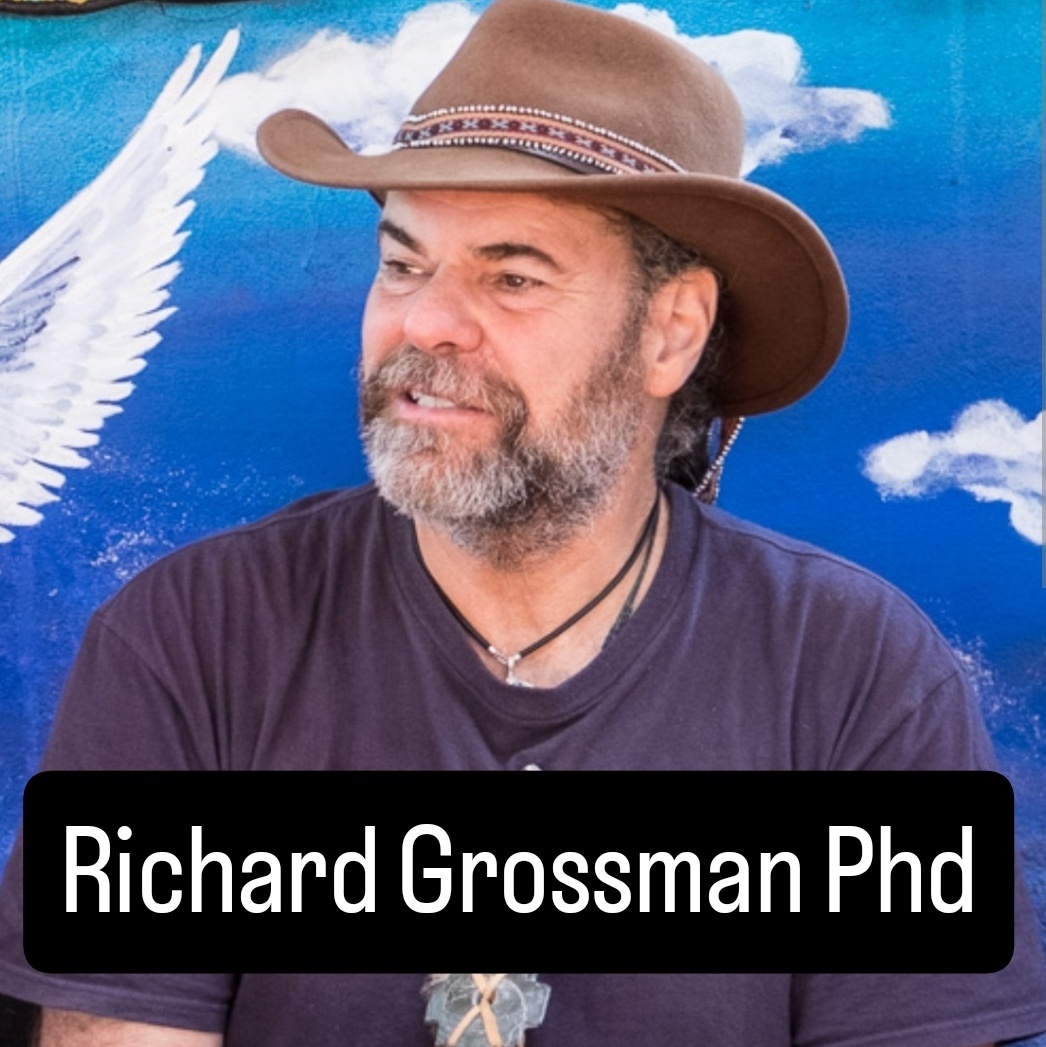
In this episode of Ayahuasca Podcast host Sam Believ (founder of http://www.lawayra.com) has a conversation with Dr. Richard Grossman, PhD. Richard is a healer, author, and visionary blending Eastern medicine, Amazonian shamanism, and sound healing. With over 30 years of experience, he has guided thousands through transformational plant medicine journeys, focusing on forgiveness, integration, and heart-centered living. He is the author of Trust and Forgive: The Medicine of Your Life and founder of Heart Feather, a space for healing and awakening.
We touch upon topics of:
- Richard’s first connection to plants and childhood calling (01:08)
- Early experiences with Ayahuasca and trauma healing (02:59)
- Healing as miracle and mystery (06:28)
- Visions, trust, and forgiveness in ceremony (09:00)
- Ayahuasca “claiming” him in the jungle (12:19)
- Importance (and limits) of visions in Ayahuasca (19:40)
- Poetry in ceremonies and its healing role (26:16)
- The lifelong process of healing and “how good can it get?” (33:53)
- Responsible path to serving medicine and training protocols (43:44)
- Minimum number of ceremonies before serving (51:24)
- Acupuncture in ceremony and bridging healing traditions (54:16)
- Five elements in Chinese medicine and plant medicine synergy (58:22)
- Richard’s book Trust and Forgive and upcoming novel (65:03)
If you would like to attend one of our Ayahuasca retreats go to http://www.lawayra.com
Find more about Dr. Richard Grossman at heartfeather.com or his book Trust and Forgive: The Medicine of Your Life available on Amazon.
Transcript
Sam Believ: Hi guys, and welcome to Ayahuasca podcast. As always, we do the host, Sam, and today I’m having a conversation with Richard Grossman. Dr. Richard Grossman PhD is a healer, author, and a visionary who blends eastern medicine, Amazonian shamanism, and sound healing. In his work for over 30 years, he has guided people through transformational plant medicine journeys, focusing on integration forgiveness, and heart-centered living.
He’s the author of Trust and Forgive, the Medicine of Your Life, and Founder of Heart Feather a Space for Healing and a and Awakening. Richard, welcome to the show.
Dr. Richard Grossman: Thank you. Thank you for
Sam Believ: having me, Richard. I know you started your journey with plant medicines and healing modalities pretty early, but tell us your tell us your story, how, what brought you into this line of work?
Dr. Richard Grossman: By my book. What got me into this line of work was miraculous. I would say something that I still don’t quite understand in that when I was a child, relatively small child, we were given an assignment by our teacher to decide we want be when we grow up. And everybody in the class was saying like, I wanna be a pilot.
I wanna be the president, I wanna be a lawyer, I want be a fireman. I wanna be a police officer. The usual things kids will say. And I said I wanted to study the effects of plants on the mind, and which was extraordinary because at that point I don’t think anybody really knew that very many plants had an effect on the mind.
I certainly didn’t, I don’t know where it came from. That started a lifelong fascination with consciousness altering through meditation, through focus, through music, through many things, and ultimately through plants, through fungi. And as I was traumatized as a child, physically traumatized, which led to a great deal of emotional traumatization and other layers of that, I was seeking my own healing first through the plants and whatever I did, I couldn’t really get there.
I could get close, I could see the light, I could see what it might feel like to be not traumatized, and yet I couldn’t get there. So one day I started working with a friend of mine. He was using various psychedelic medicines and entheogenic medicines, MDMA, two ccb mushrooms plus MAO inhibitors.
And then one day he calls me up and says I just got back from the Amazon. I have some ayahuasca with me. I’d like you to experience this. I think it’s the answer. And I thought about it for probably less than a 10th of a second before I said, okay. And a few days later, I had a cup in my hand and I was drinking it and had the most extraordinary experience of my life to that point.
And I can’t say that it healed me, but it certainly showed me that it was a path towards healing for me. And it wouldn’t take one session, it wouldn’t take 10, it wouldn’t take 20. It would take as money as it took. Until all the layers of that trauma were released from my body. What I realized also during that first session was, and you have to understand this was 30 something years ago, more than 30 years ago.
So there wasn’t an ayahuasca community. There weren’t hardly anybody even had heard of Ayahuasca, and there certainly weren’t shamans coming up from South America to give ceremonies. There were no bulletin boards for discussion. There was no Facebook, there was nothing. There was a couple books that mentioned it.
And so what I was realizing during these initial sessions wasn’t the result of my hearing many other people talking about these things. It was a real, in the moment understanding that the trauma didn’t begin with me in this lifetime. It went back quite far. Into the past and as I unpacked that the places that I recognized inside of me that were carrying trauma also went back in time.
And I, I’m not gonna say they were past lifetimes. I’m not gonna say they were anything other than, there were places in me that were carrying these scars, these impressions that had the setting of the past many settings of the past, that when I released them in the visionary state I was in, and when I could trust what was happening and forgive what was happening, it changed my life in the present.
Sam Believ: Thank you for sharing that. There’s so many things that you touched upon that we can. Go to. But let’s talk more about, obviously you work with the medicine now for 30 years and you’ve had your own healing process and you’ve experienced many other people heal. That’s a question I like to ask everyone’s in, in your understanding, how does that healing happens?
You talked about peeling off the layers of your trauma, but like, how does one heal from ayahuasca without, with ayahuasca, through ayahuasca? What is the mechanism in your opinion?
Dr. Richard Grossman: There’s probably many answers to that. First off, I have no idea. To me it’s a miracle. When they talk about Mila Garosa, medicina Miraculous Medicine, I believe that we’re with ayahuasca, we’re teetering on the frontier, on the border between.
This world and something mystical and magical. And so the healing, we can go through the physical healing of ayahuasca and the fact that mal inhibitors are antidepressant and all of the research that’s happening now about DMT, which I’m honestly not really up on. But all that’s happening.
But there’s also the part of the, call it the intention of what could be perceived or thought of as the spirit of ayahuasca. That there is a agenda in that combination of plants or what the combination of plants opens a person up to two that has the intention and the goal of healing. So that’s, that’s a semi mystical interpretation along with a semi physical interpretation.
For me, what happens is that we’re incredibly complex beings. These things we call humans, we’re multidimensional, multilayered, multi lifetime to pro, possibly, and we’re the sum total of everything that’s ever happened to us, plus how we interpreted it, and the interpretation part’s very important.
So I can, if you have two people who have the exact same experience, the interpretations will determine what the outcome is on each one of their lives. So when I am. When I was in, in an Ayahuasca vision in that first ceremony, and I found myself in a Nazi concentration death camp as somebody who was being led to their death.
3D ultimately realistic experience. I had to go through a whole process in my mind that led me to a place where I could trust something. I won’t give it a name. And what I say is trust. Trust, trust. The process of trusting. And I had to forgive everything about that experience that I was in and forgiveness, meaning letting go of all of the connections and threads and tendrils that impression or memory or whatever it was had inside of me that was.
Hoovering constantly in the realm of the unconscious mind. I might not be aware of it. That’s the definition of unconscious, but the impressions of it, the energy of it, hoovered underneath my consciousness. So when the medicine brought it to consciousness, I was given a choice. It wasn’t like, okay, Richard, you have a choice now.
It wasn’t like that. The choice was in me. The choice was my choice. It was my decision. My everything was to create a story about what I was experiencing, to create reason, to create judgment, to create anger, to create hatred, to create all of the stuff that human beings are so bloody good at doing.
Or I could release every aspect that I could find within me of my connection and that connection to me that impression had. And let the flow of time heal it and wash it away until it was no more. Obviously the memory of it’s still there, but the impact of it on me as a human being, as a soul was to a great extent, healed in that experience.
That’s why I say it’s magic. It’s magic, it’s yeah. It’s like psychology doesn’t deal with that, that I know of. Anyway. Hard to explain magic. Hard to explain magic unless people,
Sam Believ: as someone who’ve experienced magic through medicine myself I understand what you’re talking about, but it’s really hard to explain to someone.
It’s like, how do you explain to a blind person the color green if they’ve never seen any color? Red? It’s it’s similar to that. I like in, in your story, you describe a moment where ayahuasca claimed you and said, you, you’re mine now. Yeah. And it’s very interesting. I’d like for you to share it because I had a similar experience.
So tell us that story.
Dr. Richard Grossman: This was on my first trip to the jungle 2 0 3, 2003, I think, or two. I’m not, don’t remember exactly, but I was getting my ayahuasca interest revived somewhere around the year 2000 after putting it aside to start an acupuncture practice and become a doctor and all of the intensity that entails, but I wanted to go to the jungle and when I was 18, I wanted to go to the jungle. I had gotten back from a trip to India and I had two choices. One was to go to the jungle and I had no idea about ayahuasca at that point. I just knew that there was something down there for me, or to stay here.
And I chose to stay here. Glad I did. ’cause I probably wouldn’t have survived the jungle at 18. I certainly didn’t have enough money to fund myself down there. So anyway, long story, long I was invited to meet up in Ecuador with a shamanic family and take a probably about a week long boat trip down to Atos from Archie.
And I didn’t, again, I didn’t take more than a few seconds to decide yes on that one because it just seemed like the most amazing experience and I. So we had several ceremonies with this family. And then somebody told the father of the family, the medicine person of the family that you know gringo, we like the medicine strong.
And he, that upset him and it also was a challenge for him. And the next couple days later, we were sitting out on the porch of his little house and he was passing around up to this medicine, which each person drank, and almost immediately ended up heaving over the side. And I was the second to the last person to drink.
And then next to me was his son. And I drink his son drinks and his son sits down and goes, okay, fu which in English is, oh, how strong. So I understood maybe three or four words in Spanish at that point. And I’m. Oh, I wasn’t, I didn’t, by no means was I super experienced with Ayahuasca at that point.
And all the other gringos are over the side heaving. I’m sitting there and for some reason his son and I hooked up mentally and each one of us had the same thought is, I’m not gonna purge unless he does. And we confirmed this the next day. It was hilarious. So we’re both sitting there holding in this uber powerful medicine.
I think the vines it was made of, were over a hundred years old. Super powerful. Holding it in. And I am getting a tour of the spirit beings of the jungle, of that area of the jungle, each one of which is coming up to me in three dimensional full color reality. And looking at my, looking at me, looking in my soul and saying, oh, you’re welcome here.
We like you, you’re welcome here for an infinite amount of time. I don’t know how long that was. And then I became aware of a energy that was external to me. It felt like one mile, two miles away, this crackling, glowing orb of energy coming closer and closer to where we were. And I’m sitting there, these jungle spirits are still greeting me.
It’s most beautiful experience I’ve ever had in my entire life, and still holding it in. And then this 12 foot, 10 foot tall. Half naked jungle woman was standing in front of me with two sets of eyes looking at me with these two sets of eyes and just beautiful, powerful, feminine energy. And she looks at me and she says, you’ve been playing on the surface, but now we’re lovers.
Now you’re mine. And I was like, okay, sounds good to me. And that was such a powerful experience. Unique. I never had anything like that again. But such a powerful, beautiful experience of being welcomed into that world in such a warm, loving, powerful, and ultimate way. That’s it. Your mind.
There’s no escape. And I was very happy at that point. To understand that this medicine at that point became my life, became what I wanted to do with my life. I already knew it was what I wanted to do for my life from the first time I took it, but this was a confirmation of that for me. And I obviously didn’t go out the next day and start serving medicine.
It took me a number of years to get there, but it was powerful.
Sam Believ: It’s very interesting. ’cause I have a, I’ve had a very similar story. It was my seventh ever ceremony, and it was my second ever ceremony in the jungle, but arguably the first ceremony in the jungle where I like connected and broke through, I had this period of time where I just couldn’t break through.
And I had a similar experience where I was given a tour of something but it was not like entities were coming to me. I was somewhere else and they were showing me how things work. And then I had this. Message download this is your path and this is how you do it. But it wasn’t like, it wasn’t like a spirit told me, okay, you’re mine.
But it was very clear notion that said if you have to work with Ayahuasca and if you don’t work with ayahuasca, you’ll never be happy. Which is a little more menacing, but still saying the same thing was like this is your path. And like basically there’s no other option.
This is where, this is what you should do. Very interesting. ’cause there’s lots of parallels after that. I came back and I synchronistically started organizing ceremonies without even planning it. I’m, I’ve never served medicine. I’ve been working with it for five years now. I’m not really necessarily planning, maybe eventually if it’s necessary because my vision was different.
It was more about one-on-one work and I’m. So far, I’m satisfying that necessity just by organizing the retreats. But it’s definitely that path and it held me and just plucked me out of there. But, you described those beautiful visions, right? And people that will listen to this podcast, they will come to drink the medicines for the first time and then will not see those visions and they’ll be disappointed.
And I know you talk a lot about that. What is the what is the importance of visions? Or maybe we should not focus on visions that much.
Dr. Richard Grossman: Yeah, it’s, like I said, that was for me, a one one timer. I never had another experience like that. Don’t think I can’t remember any. Visions are what everybody, all the northerners love.
Most northerners will chase visions and give great importance to visions. I tend to not. I think that visions are, excuse me, are the most important thing because how does a person know what’s a real vision, a visionary, mystical state vision versus brain farts stuff discharging out of the brain.
And it takes, to me, it takes a lot of experience and a lot of wisdom to understand that there might be a difference and then to understand what the difference is. It’s a classic thing, people go down to Peru and, or Columbia, I dunno if it happens in, but I know it happens in Peru.
People go down there and I was in a restaurant once in the Sacred Valley and this group of Northerners came in and sat down in the table next to me and they’re talking, and I was like, oh yeah, I had the most amazing download. I gotta get a new tattoo today. Oh yeah, I had an amazing download too.
I’ve gotta change my name and I can’t wear green anymore. And these what are these downloads? What are they coming from? And they’re just levels of mind because we don’t have, in our culture the grounding to know what is mind and what is not mind. What is what’s going on in the head and what’s going on in the heart.
And because of that, when the, when we interface with the medicine, all too often we take the things that are of the mind to be coming from the medicine. And it’s why, one of one of my horrifying phrases that I hear, which is oh no, if somebody that I drank I serve medicine to says this.
I’m like, I’ve got some work to do. Here is, gee, last night the medicine told me dot. And. That always is gonna need unpacking, almost always gonna need great unpacking because all too often it’s exactly what you wanted to tell yourself. Not you personally sound, you wanted to tell yourself.
That is, again, interfacing with the brain via the power of the medicine to not necessarily create a state of clarity, but will almost certainly create a state of confusion. The medicine told me to quit my job. Just told me to get divorced, told me to get married. I was in a ceremony once in these two people were sitting next to each other that didn’t know each other, never met each other, and during the ceremony the medicine told them to get married.
They did the next day, two weeks later they were divorced. It wasn’t a good thing and a lot of pain came out of that. So how do we know what’s true and what’s not true in these visionary states? And it’s known. This is almost biblical stuff that we can deal with here. What is the still small voice of God within?
Does it speak English? Does it speak Spanish? Does it speak kiis or shabo or Hebrew or whatever? What language does that small, beautiful voice of love that’s in the heart speak. It doesn’t speak a language. Human language, the mind speaks human language. So if something comes to me in words, I’m going to be suspicious of it.
With the exception there’s certain exceptions here. Okay? If it says to me, Richard, you’re a lazy dude. Get up and exercise every morning, or you’re gonna have a heart attack in 10 years, I’m gonna listen to that. I’m gonna put that into practice number one, ’cause it’ll be good for me, whether it’s coming from medicine or coming from spirit, or coming from my mind.
Number one, it’s gonna be good for me, and number two, I need it. So that’s categorically different than richard, we’ve recognized on the spirit realm that you’re incredibly special. We’re calling you in for the work you have to do for the rest of your existence, and it’ll make you into a great human being.
Everybody will respect and worship you because of this. That’s bullshit from the mind. That’s equal inflation. So in a culture where we’re not taught the difference. It behooves a person to walk that pathway very carefully with great intention and intelligence. And that’s where I think the integration piece comes in, is hopefully the person who is doing the integration work with somebody else has gained the wisdom to know inflation from message of the heart.
Sam Believ: Yeah. The, whenever something is ego-based and is very attractive for you to receive, then I would question it as well. Yeah, exactly. If it tells you, oh my God, you’re the incarnation of Jesus and it, and you really like the idea that people grasp to it, but it can, it doesn’t mean the information is wrong, it just might mean a lot of different things.
You just have to try and interpret it and not just take it directly. You talk about. You use poetry in your ceremonies, which is very interesting. Can you tell us why and specifically Yeah. Which kinds of poetry and at which point of
Dr. Richard Grossman: time? Yeah, I’m not exactly, I don’t exactly recall the first time it happened, but I know that I had been reading various books on Sufi poetry particular, and then one day I’m in ceremony and I’d pick up a piece of paper I’d written a poem on, and I read it to the group.
And the next day everybody was talking about how incredibly beautiful and powerful it was and how it brought understanding to them of what they were experiencing. So I think a lot of times, especially. People go into ceremonies and they hear somebody singing in a foreign language they don’t understand.
And it’s a whole ritual. They don’t understand, especially in the beginning, of course, not so much when you’ve done it for a while. You might have learned Spanish or you speak Spanish as a native or any one of the jungle languages that you might be working with. There’s this place of almost a fracture between the experience and the understanding.
And so if I read a poem that speaks directly into the same experience that people in the room are having, it creates a connecting point where their mind can understand their heart a little bit better, their mind can then instead of having the heart, having the medicine work going on here and then the stomach and everything else, and the brain’s going, what the heck is going on here?
It’s like a point of focus. So if I, were to recite a Rumi poem, for example, which is where my poetry work started with Rumi and Kabi and EZ primarily. Now, I just collect poems now that each one of them has a specific place in ceremony that works really well. But if I were to read, a poem that said something to the effect of All in comparable giver of life, cut reason loose at last, let it wander.
Gray eyed from vanity to vanity. Shatter open my skull. Pour in the wine of madness that may be mad. Mad as you. Mad with you, mad with us. Beyond the sanity of Fools Lies a burning desert where your sun is whirling in every atom. Beloved, take me there. Let me roast in your perfection. So that’s a roomish poem, that one, at that place where you’re afraid to let go, where you’re afraid to surrender to the power of the medicine, you think it’s gonna destroy you.
And here’s something from possibly, a thousand years ago saying, we’ve been here, we’ve done this, we know it’s okay. This is a gift you’re being given. This is something valuable that you’re being given. Don’t fight it. Let go. Let your head be shattered open. Let your skull be shattered open and let that whine or vine of madness be poured into you.
And then beyond the sanity of fools, one of my favorite lines in poetry. Because what is the sanity of fools? That’s life unlived. That’s life unexplored. That’s life. As an ot, automaton, the prisoner of your thoughts, the prisoner of your emotions, the prisoner of your past, which is what we call San sane sanity.
Beyond that is a burning desert where the sun is whirling in every atom. Oh, incredibly beautiful. To recognize that a person can go into that experience of being utterly and totally overwhelmed of being utterly and totally shattered, and that it’s okay, that it’s okay, that it’s not only is it okay, but another beautiful wine is this is the greatest gift a human being can never be given existence, has no greater gift.
For somebody who’s in the middle of, maybe their head’s in their bucket and they’re processing through their life and they’re on the verge of a breakdown to recognize that, whoa, this is such a beautiful, incredible gift that you’re being given here. The possibility to heal, the possibility to really let go of the past, the present and the future to the past and the future, and live in the eternal present.
So poetry, sometimes it’s, sometimes a poem is good for a laugh. It’s just really funny and it breaks the tension sometimes they just, honestly I read them ’cause I love to read them.
Sam Believ: Yeah, no, I’m I’m very far from poetry. I’ve never read poetry, I’ve never appreciated it, but I’ve been recently.
Interviewing people and they mentioned that, and I’ve started watching those YouTube video where the poetry is read and it does make you feel a certain way. So I think there is something there. Kinda gave me an idea. Somebody needs to write some medicine songs with those lyrics and just get people to feel it through music as well.
How old are you, Richard? I never tell I’ll ask Chad GT later, but you’re obviously older and you have a big gray beard and you’ve been, I,
Dr. Richard Grossman: I die at Gray every night, so yeah. Good disguise.
Sam Believ: Okay. Yeah. But obviously you’ve done a lot of healing and you been doing this for 35 years now.
I’ve been in it for five years, so 30 years later I could probably. Expect similar level of results as you, I’ve been, the, occasionally I feel really confused because, I’ve learned so much and I’ve done so much and I’ve healed so much. But it’s like there’s seems to be always more and it’s increasingly more.
And is there ever a point where you’re like, yeah, you know what I’m healed now. I just feel good. Is you? Is there a light in the end of a tunnel or is it just a never ending battle to tell me about this? Because I know that you seem like someone who would know that.
Dr. Richard Grossman: As far as I can tell, it’s a never ending process.
But on the good side of this, there’s different stages to that never ending process. And the first stage is dealing with. You’re shit, dealing with your stuff that can take years or minutes, all the places in life that where there’s regrets, where there’s pain, where there’s trauma, where there’s grief, where there’s loss.
All of these things put impressions inside of us that can be untied. The knots can be untied. It’s a good analogy and there’s a lot of it, there’s a lot. Then there’s a familial karmic healing, which kind of can go back through family stuff. I’ve had experiences where I healed my ancestors. There’s karmic stuff, there’s all of these.
Let’s heal this. ’cause it’s causing me pain level. There’s a lot of it. And the good news is that even healing one aspect of that makes life better. So it’s, it’s putting the puzzle together or maybe taking the puzzle apart, but then there’s another level of healing that comes after that, which I call the how good can it get level of healing.
And in that level, that’s an infinite journey because we’re infinitely journeying into the infinite. And so matter how far I journey into love, there’s more, no matter how much light I experience, there’s more, no matter how much joy I experience, there’s the potential for more. And so that takes it out of the heavy, like I got a heel thing, which is certainly part of the process.
And takes us into the realm of the mystics and the saints is how good can it get, and I was talking to somebody last night about this and I said, imagine the miracle of just taking a breath with nothing else going on. Not easy, to take a full in and out slow breath while you’re letting your body breathe.
You. And the mind isn’t giving you a tour of it or finding all the reasons why one breath is enough, don’t take two, whatever. Whatever the noise coming out of the head is that’s gonna be there. Then we get into the realm of when I was first in the jungle, I had a realization that ayahuasca on some levels was the Raj yoga, the jungle’s interpretation or vision of Raj yoga, of the yoga of meditation, the yoga of consciousness, the yoga of understanding beyond intellect.
And I think that, that’s why you’ll get some of the old guys that have drunk a thousand times and hope to do it a thousand more. Because each one there’s new and there’s new learning, there’s new experience, there’s new joy, new bliss, it’s ever unfolding. And in the eastern cosmology, it’s the lotus that’s eternally blooming at the spinning heart of the universe, eternally blooming, and each moment of it is fascination. Each moment of it is something that. As Kabir said, my heart’s be drinks, its nectar, I’m in awe of this. And awe is, I think, the highest. Awe plus gratitude is the highest level of human experience. So I can, go through, oh, I gotta heal this. I gotta heal.
Is it gonna heal? And it’s horrible. I have to puke again, ugh. Then I think there’s a breakthrough point, and it could happen instantly. It could happen anytime. It’s not like it’s linear and it’s gonna take a certain amount of time for it to happen. It happen anytime of poof, the universe opens up, love opens up, understanding opens up, peace opens up, and then you’re in a place where the medicine goes from being, beating you over your head to get the shit out to.
Dancing with you in an eternal dance. ’cause it’s the eternal dance of your own soul. Medicine is the gatekeeper, not the gatekeeper, but the key in the lock. Some people need, some people don’t even need the key in the lock there door’s already open. I’m not saying everybody needs to drink ayahuasca, but that experience of releasing and letting go and allowing the light to take over, allowing the power of love to take over, that’s an experience that every human being should have.
Change the world overnight. ’cause we certainly live in a world that lacks love.
Sam Believ: Yeah, definitely. That’s that’s what makes me, and I’m sure many other people work with the medicine and try and bring more people to the medicine because of just how. Quickly, it can make you feel that even if it then fades away, still, it’s totally worth it.
I think nobody should die before having experienced that connection and that love through the medicine or through other ways. I like this conversation because what it does for me is you’re more mystical, more poetic view on the medicine. Makes me wanna drink again, have been I drink.
I run and I run a retreat center called LA Wire. And we do three retreats every month and quite receive quite a lot of people here with the Colombian tradition. I done serve the medicine, but I basically organize everything around it. And I know since when, but I’ve decided that I’ll be drinking medicine once a month.
I’ve been doing it consistently for years now, and, but still sometimes there’s this feeling of resistance. It’s do I really want to and this view of this view on the medicine, a more poetic, more mystical makes me want to I almost can’t wait for the retreat to start, it’s in a few days so I can drink again and I’m hoping to start drinking more medicine.
’cause I think I’m ready to go to this next phase where it’s like, how good can I get? Because I’ve never went there because, there’s this importance of integration and I, up to now I wasn’t able to integrate because my ceremony’s over and I have tons of work ’cause I’m responsible for other people.
And our team is now close to 50 people. So it’s there’s a lot of stress. So I don’t I haven’t been able to like, okay, this is time for me, but now I’m in the position where I’m hiring some people and I’ll be able to hopefully integrate and walk the talk. So I’m excited for this this stage and that this conversation is really helping.
Speaking of working with the medicine you obviously serve the medicine as well, and I know you don’t like calling yourself a shaman, but we do have this epidemic of people that come and drink the medicine and they want to serve it almost immediately. And there’s probably nothing wrong with it, as I like to say.
No, don’t confuse the letter. The invitation letter to study in the university with a diploma. So it’s like in, in your opinion, if someone gets that calling, what is the responsible way for them to get to the point they can serve the medicine, but without, let’s say, hurting anyone and doing it properly?
What is the protocol?
Dr. Richard Grossman: That’s a good question. I’m still working on that. Lemme just back up for one second. And just a suggestion. Try drinking small amounts of medicine and then really using the force of your own intention to meditate with a small amount of medicine. So it’s not dramatic, but you can use it gently.
So going to the protocol, what makes a person who serves medicine good at it is they have to have a deep understanding of who they are. They have to have undergone. Their own deep healing so they don’t bring their own stuff into ceremony when they’re trying to lead a ceremony.
What I noticed when I was in my Amazon years, is that of the people that I participated with, of the people that I drank with, some of them were incredible musicians with their, magicians with their eco rows and the plants and stuff, but they had very little logical sophistication, I would call it.
They didn’t understand the mind. They didn’t understand the difference between mind and heart, and they had not necessarily done their healing work because their work was all about learning how to be a shaman, cordero, whatever. So when the Northern mind comes down into that, I think there’s a good. A good opportunity or there was, I think it’s changing now because there’s a lot more sophistication now, but there’s, the necessity to, for people to do their own deep inner work that’s the most important thing I’m trying to get to is if you haven’t done your deep inner work, you’re not clear, you’re not gonna be clean while you’re singing your egar.
You put your own desires and intentions and ideas and thoughts and concepts into it. And we certainly have heard horror stories about what the results of that can be of people starting ayahuasca cults and horrible things happening in ceremonies. So I think that’s number one is do your own work. Number two, I think one of the things that I think is necessary, and I’m really thankful that I’ve had this, is learn about the human body.
Learn at least basic physiology and anatomy, or learn at least basic pathology. So I can know if somebody’s having an anxiety attack or a heart attack during ceremony, so I can know if somebody’s liver is going into a crisis or if they have a gas pocket in their, transverse colon that’s causing them a lot of pain.
So understanding, illness, understanding health, I think is really important. If I were to start a school for leading ceremonies, it would have a concurrent western medicine thread going on of anatomy, physiology, pathology, biology, things like that. I think having musical skill is incredibly important or an innate musical skill.
Singing An charro is much more than playing, singing on a guitar and singing some words you got off of YouTube, or Spotify or whatever, that it’s a quality of soul. Having a meditation, sitting meditation practice, I think is incredibly important. And being under the tutelage of somebody who could be considered a master is also very important or can be very important.
I know eventually if you go back far enough, the master didn’t have a master and they learned it on their own. And I think that’s possible for people now, but that’s a much trickier path. So finding a good teacher is really important, and in that the X factor would be loving the work would be loving it more than just about anything else there is other than maybe your family.
Wanting to see people heal and light up, and it’s it’s a tricky path there because there’s always the money thing, there’s always the power thing, and there’s always the people who hear voices in their head because they haven’t done their own work to know the difference, who are told strange things as the leader of the ceremony that they need to do.
And those strange things hurt people. How our imbalances happen. Having an incredibly airtight code of ethics that you practice by is incredibly important. Sacred Plant Alliance has a incredibly good code of ethics. I worked with, worked on, and no first aid, no CPR know when it’s out of your hands and you gotta get somebody to a hospital.
If you’re leading a good ceremony and doing good intake should never happen, but it does. People die in ceremonies or die because of ceremony still. And I think that’s basically incompetence on the part of the person who is leading the ceremony or really bad luck ’cause people die, but people who drink medicine and they’re healthy and then they die.
It’s ’cause of incompetence of the ceremony leader unless it’s like a CVA or a coronary or something. So it’s it’s making it your life. It’s understanding the amount of education that’s really needed. I think certainly as northerners we have a different psychological makeup than jungle people have.
I think it’s important to study and understand the western, northern mind. In other words, it’s a lot. If it was a school. If there was a school to teach people how to lead ceremonies, it would be at least a four to five year program. Full-time as though you’re going to chiropractic school or medical school or acupuncture school.
It’s no less intense. And certainly the level of competence is equal or greater than many of those things.
Sam Believ: And as a homework, there would be a lot of drinking, of a lot of medicine. How many ceremonies would you say? Minimums, how many has to do before they even consider serving a hundred?
I know you’ve done more than a thousand ceremonies. A
Dr. Richard Grossman: hundred hundred. Minimum first 10, you completely don’t know what you’re into and what you’re doing. It’s overwhelming. And then you gotta do your own work, which is gonna take a number of ceremonies. And I think a hundred’s a good level. ’cause if you get to a hundred, you know you’re dedicated.
You want to do it, it’s part of who you are and that, that takes the festival shaman away. The joke is just because you go to a festival and drop acid doesn’t make you a shaman, there’s certainly plenty of people that you’ve probably met, I certainly met, who it’s like, yeah, I’m a shaman.
Eyeball, spinning in opposite directions. Crystals,
Sam Believ: yeah. I’ve been there and I’ve seen them and unfortunately we have created some, has all, we’ve had people that came here and had medicine for the first time, and they’ve been inspired, but they just wanted to take a shortcut and I tried to always communicate that.
I think that analogy is really good. Don’t confuse the letter. Invitation letter to study with a diploma. That’s about it intense. And I think your expectation of four or five years and high good ceremonies, at least, I think that’s very reasonable. And in a way, you’re setting a very high standard, even to most indigenous shas because a lot of them don’t know the medicine and a lot of them are not good singers.
So I think it’s a reasonable thing to expect because I like to call shaman like a neurosurgeon for the soul. It’s like the work is invisible for most people, but it’s very complex, nevertheless. So would you trust your brain to someone with one year of experience? Of course not.
That’s why, neuro. Neuro neurosurgeons, they, they study for 10, 15 years and it’s even more complex. Your soul is even more complex as you implied, there’s layers and there’s, all this magic. So yeah, I think hopefully someday we’ll have a branch of medical school training with a bit of musical training and a bit of business training and everything that’s required to get someone to be like a proper medicine giver.
So yeah, there’s definitely lots, there’s definitely lots to grow there. You also do acupuncture in, in your ceremonies occasionally. It’s very interesting because someone reached out to me on your behalf trying to get you on a podcast and one of the reasons I was really interested is because I’ve been, talking recently, I’ve met a person that talk, talks a lot about acupuncture, and I’ve never really crossed my path before. And then I know you, about acupuncture, so it’s I wanna learn more about that. And what is the connection between acupuncture and the medicine work?
Dr. Richard Grossman: Yeah. I almost, I rarely do that, I have to say.
There was a period about five years ago, I did a lot, especially with wachuma. The needles have their own incredibly ancient and powerful magic to them and skill, and it’s not unusual for somebody who’s in a medicine ceremony to discover that there’s places inside of them, literal places, stomach, intestines, whatever, that are completely knotted up and stuck.
And some carefully placed needles at the right moment. Can almost immediately free up and balance the energy in a person’s body. Beautiful. It’s like
a matter of minutes and I don’t do it too often with ayahuasca. ’cause basically if I have 10 needles in somebody and need to purge, it’s gonna be not a good thing.
Sam Believ: Quick, quick it was out.
Dr. Richard Grossman: But with Chuma, there’s usually more of a warning and, there’s a purge point in them that doesn’t tend to happen again.
But, it’s the needles are phenomenally powerful and they do have a spiritual tradition to them as well as a healing tradition. Much of the spiritual tradition’s been lost or been hidden, I would say. But the, in, in lieu of the physical healing, which happened when, the ERC decided that anything spiritual was no longer part of who Chinese people were.
But there’s a, a great deal of wisdom in that tradition that I think matches perfectly with medicine work when it’s done skillfully. And please don’t go out and buy some needles and start sticking it into your second ceremony you’ve ever looked at. ‘Cause you know you’re a shaman ’cause you dropped acid at the festival and you know you’re an acupuncturist.
’cause it resonates. It takes a lot to, to learn acupuncture.
Sam Believ: Yeah. Okay. But yeah, tell us more about acupuncturist and what, it comes from the Eastern tradition, right? Yes. You, you said you do it in a ceremony. I’m considering to trying it for the first time soon.
Can psyched. Increase the efficiency of your acupuncture results and what are the results someone can explain for acupuncture for somebody that like, I literally know nothing about it. Yeah,
Dr. Richard Grossman: yeah. Mean acupuncture is it’s the same idea. It can work on physical illness it can work on pain.
Musculoskeletal pain is certainly what most people get acupuncture for these days. But it can also work on physical illnesses. The idea is that it’s really, it’s complex. I can’t explain it in five minutes, but it’s complex. In Chinese cosmology there’s five elements. Fire, earth metal water, wood, and fire.
I think I got that anyway. And each one of those elements relates to two specific organs in the body. For example, the earth element relates to the spleen, pancreas, and the stomach. And also they all relate to emotions. So if somebody has, for example, stick with earth somebody who thinks a lot, who ruminates choose their cu of their thoughts would be showing an imbalance in that particular element.
So there’s hundreds of points on the body. Some of them work on, there’s the points that are like shoulder points. Those normally just work on the shoulder, then there’s the points on the hands and the feet where the points on the hands and the feet become like circuit. What is it where you have a train going down the track and that can go to two different directions.
What’s that called? Junction? I don’t know. But anyway. Somebody pulls it and in the old days, and the train would go in, one or the other. So the points on the hands and the feet and the, to the great extent to the arms and the legs as well. Lower arms and lower eggs, legs serve as these switches that can shift energy from one part of the body or one element to another.
So as there’s these five elements there’s other ways of looking at acupuncture to, there’s many theories of it, but if one organ is excessive, another one is likely to be deficient. And excessive can be caused by external pathogenic factors, disease basically by internal pathogenic factors. What we think about our emotions, food, we eat, things like that.
And so if one is taking too much, one gets hyperactive, another one’s gonna be hypoactive. Generally this is growth simplification. So I can find by looking at the person’s face, looking at their skin, looking at the color of their face, looking at their tongue, looking at what’s on their tongue, what’s not on their tongue feeling their pulses.
There’s six pulses on each wrist, and each one relates again to a specific organ in the body. I can determine which point to use to open up the pathways where it might be stuck from one organ to another, and then bring things into balance. So Chinese medicine is the medicine of balance and harmony. The whole idea is to harmonize the physical, emotional, spiritual body.
Ease into ease with medicine. I think everything gets amplified on medicine. Somebody with a small degree of imbalance in their stomach might discover that they have stabbing intense pain in their stomach that won’t let up. And along with that, there may be hidden thoughts, repressed thoughts.
So if I then go in with a needle into the exact point, I can even do it with my hands into the exact point of pain and be there for a little while I’m doing points on the peripheral points to allow the balance and harmony to occur. Allow the switches that are stuck in one direction or the other to be freely flowing in whichever direction is needed.
Then very powerful treatment can happen. Very long lasting treatment can happen. That’s the beauty of that particular combination of work. Like when I was one of the, one of the jungle healers I worked with said, you’re really a bridge. You call me bridgeman. Because you know so many different cultures and ways and you’re bringing them all into this coherent, solid thing.
So I love learning. I love experiencing, I love, in, and my ceremonies. We don’t just have ikaros, we have music, a lot of beautiful music from different cultures, and they become medicine, music. So it’s this the medicine has escaped the jungle for good. I hope you know somebody, somebody wants.
Asked me about that. And I said, maybe Ayahuasca wanted to become a tourist for a while and learn about the rest of the world. Maybe she got a little bit tired of just e and wanted to experience more of what this world has to offer and see what the rest of these crazy monkeys are doing around the world.
Sam Believ: Wanted some Pink Floyd and Beatles on top of that, that yeah, medicine, my ceremonies. Yeah, medicines definitely have escaped and ones all over the place and there’s definitely merit to balancing all this knowledge because it’s kinda like in science, previously we had all kinds of different sciences and then it all came together and made a better, bigger science.
So there’s definitely a need to combine that knowledge and expend it i’m glad that you’re doing it and hopefully more people in the future. And thank you for your little workshop on the acupuncture. I’m gonna, I’m hopefully gonna try it soon. Before we wrap up, tell us about your your books and maybe some, explain to people where they can find more about you and learn more about your work.
Dr. Richard Grossman: Commercial break. This is called, I guess it’s backwards, isn’t it?
Sam Believ: Yeah, no, I can see. It says Press Forgive the medicine of your Life. Of your life.
Dr. Richard Grossman: Yes. The journey starts where you are and that’s it’s a major work for me. People for many years said, you should write a book. You should write a book.
And I’m like, I don’t wanna write a book. I don’t wanna write a book. It’s too much work. I’m not ready. I don’t have enough to say. And then I had done, like I’d written a bunch of essays and stuff that was just hanging out on my computer and then came COVID and then came. This became my world for a couple years, and fortunately the outside, I live in the mountains and there’s beautiful hiking trails here.
But I started writing and I wrote. I wrote about my life. I wrote about my stories. I wrote about other stories. I wrote about philosophy. I wrote about what’s wrong with the world and turns it into cohesive vision that is trust and forgive, which is what came out of that initial powerful experience in the concentration camp where what was being told me as a way to get out of it was to trust and forgive.
Which is a whole process that is a lot more than just those words. So has some stories in it. It has some fiction in it. It has a lot. I can’t even say everything that’s in it ’cause it’s too much. It’s a pretty hefty book. It’s I’d never written more than maybe 10 pages before.
And this one has 322 pages and it’s beautiful. Everybody I know who’s read it has gotten great value out of it. Some people have read it three or four or five times. ’cause it has that ability to unveil layers as you’re reading it. It even has a lot of footnotes. As footnotes
Sam Believ: For people like me that don’t know how to read, is there an audiobook version?
Dr. Richard Grossman: There should be an audio version. I’m guilty.
Sam Believ: You make one. It’s like I, I stopped reading books like 10 years ago. I’m just full audio. It’s just for some reason I enjoy it more. Even like the information absorbs better. I think you have a pretty good voice. You could voice it yourself. You have a nice microphone.
Maybe next time COVID comes back, you can do that. Hopefully not.
Dr. Richard Grossman: No, I should. I’m working on another book right now. I finished this one, which is nonfiction except for three stories, which are fiction. And I’m working on a fictional novel now that’s Ayahuasca based as well, that I’m probably three quarters of the way through.
So it should be published hopefully by spring. Sounds interesting.
Sam Believ: Well, Richard, thank you so much for sharing. Thank you for your story. All the knowledge. It’s on am
Dr. Richard Grossman: Amazon has it?
Sam Believ: Yeah, Amazon. Once again, trust and forgive. The Medicine of Your Life by Richard Grossman,
Dr. Richard Grossman: or it’s also on my website, which is heart feather.com, heart feather heart.com.
You can reach me through heart feather.com. If you need to reach me,
Sam Believ: I’ll leave some links in the show notes as well. So yeah, thank you so much Richard. And hopefully you can come to Columbia someday, visit us and maybe we can help you be even a, be better and bigger bridge if expand your knowledge.
So you’re definitely invited. And for those of you who are listening, thank you for listening and I will see you in the next episode.
Dr. Richard Grossman: Thank you, Sam.