
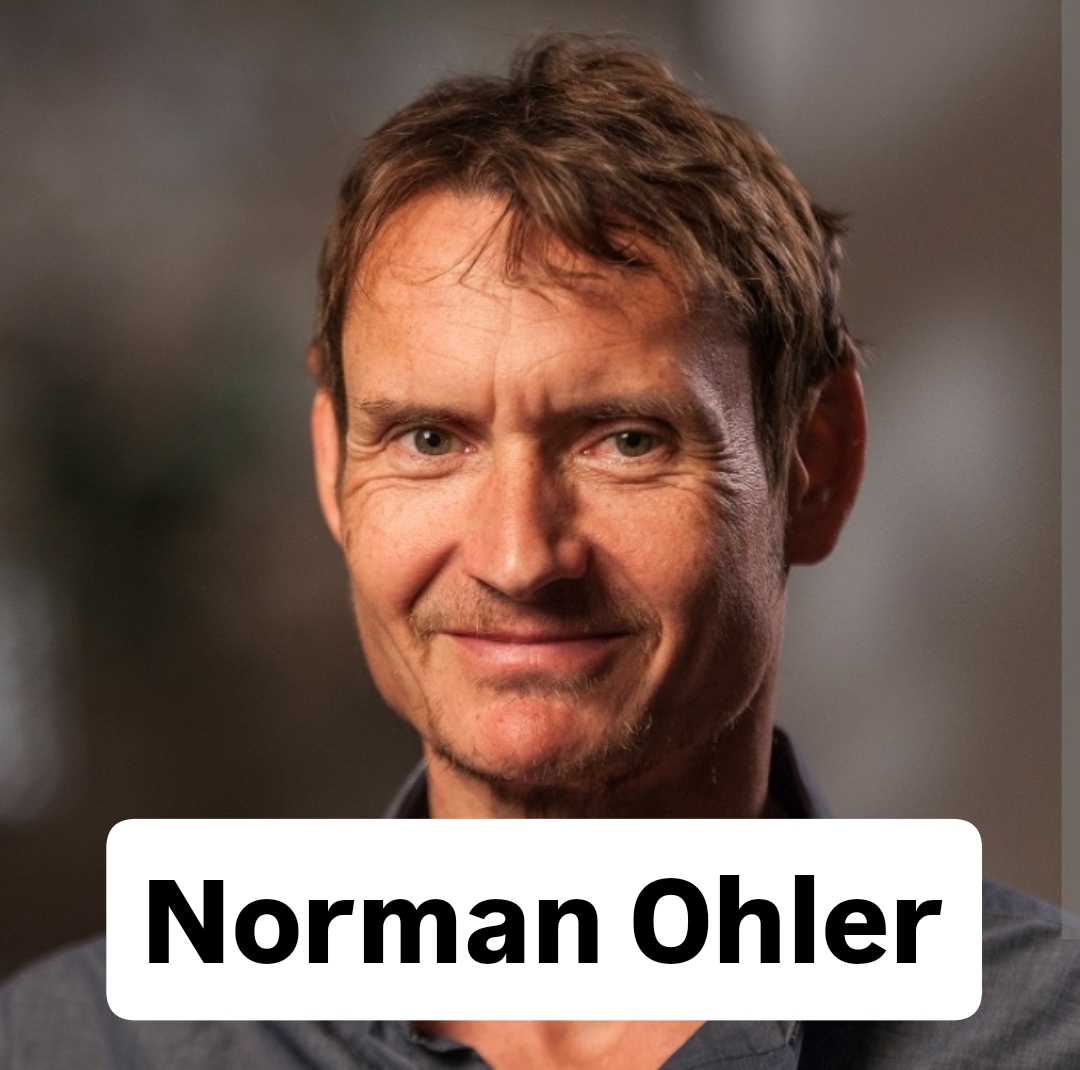
In this episode of Ayahuasca Podcast host Sam Believ (founder of http://www.lawayra.com) has a conversation with Norman Ohler, investigative author and storyteller known for his bestselling books Blitzed and Tripped. Norman’s work explores the hidden influence of drugs in history — from methamphetamine use in Nazi Germany to the political suppression of psychedelics — and challenges how we think about drugs and society.
We touch upon topics of:
- 00:36 – Norman’s personal journey into investigating drugs and hidden histories
- 01:28 – Nazi Germany’s use of methamphetamine and Hitler’s daily drug injections
- 07:30 – Could Hitler on ayahuasca have changed history?
- 09:36 – The untold origins of LSD and Nazi/CIA “truth drug” experiments
- 18:17 – Norman’s book Tripped, dementia research, and microdosing LSD with his parents
- 22:01 – Brain mapping studies with ayahuasca and early results from Sam’s retreat
- 25:08 – Capitalism, government control, and why psychedelics remain illegal
- 29:01 – Vision for an egalitarian, borderless, AI-supported global society
- 36:21 – Capitalism vs. spirituality and building new economic models with blockchain/AI
- 42:01 – How psychedelics foster empathy, healing, and potential planetary change
- 49:18 – Norman’s political vision and plan to run for German Chancellor
- 53:39 – Ancient ritual use of psychoactive plants and why prohibition is anti-human
If you would like to attend one of our Ayahuasca retreats go to http://www.lawayra.com.
Find more about Norman Ohler at substack
And check out his books Blitzed and Tripped.
Transcript
Sam Believ: Hi guys, and welcome to Ayahuasca podcast. As always, we to host and believe that they’re having a conversation with Norman ler. Norman is an investigative author and storyteller who’s bestselling books blitzed and tripped and uncovered the surprising influence of drugs from math in Nazi Germany to psychedelics and modern society.
His work challenges, how we view history and drugs. Norman, I’m really excited to have you on the show.
Norman Ohler: Thanks for having me. I’m excited too.
Sam Believ: Norman let’s start with with your story. What in your life took you to, to studying drugs and psychedelics and Nazis? What’s the story?
Norman Ohler: I don’t know. It’s a complicated question. Maybe maybe it was my upbringing in a boring German small town that made me suspicious that there must be enough, another world hidden somewhere. Like in David Limps movies when you go through the portal of an ear that you find lying on the floor and enter a totally different world and maybe that’s the real world.
So I guess I was always. Curious.
Sam Believ: So I believe you were if not the first guy, but one of the first people to actually discover that Nazi military they used. The math was, is that correct?
Norman Ohler: I made it, it’s popular and I discovered most of the facts, but my work is based on the work of, his, a historian at a southern German university who had found out that Pervitin, which was methamphetamine, was being used in the campaign against France.
And he published a scientific paper about it, which I read, but it was not very known. But it was quite interesting. So I met him and he said, where I found these documents, there’s actually a lot more, but I just don’t have the time or the interest to really go deeper into the subject. And he was so kind as to refer the actual signatures in the military archive of Germany to me.
So I knew where I had to look and that was the starting point of my extensive research. And then I was. I guess the first person to really write the story to really investigate the full story, also including the drug use of Hitler, which had not been properly examined, I would say, even though there were also already writings about this.
So I, my work is based on also the research that other people did. I would say.
Sam Believ: No, it’s it’s not a, it’s not a regular topic for the podcast, but I think it’s just really fascinating. You, you don’t really expect, to, to think about, historical people and their use of drugs or psychedelics or stimulants and things like that.
We never view history from that lens. But yeah, it kinda all makes sense when you. Add the meth, methamphetamine to the mix, the history starts to make sense, the Blitz Creek and everything. So what’s what’s the most interesting thing you found about Hitler and his drug use?
Norman Ohler: He even took an MAO inhibitor towards the end of his drug career.
I think it was Syrian. Syrian ru. An MAO inhibitor or is that a DMT containing plan?
Sam Believ: I think ACA is a DMT and Syrian RU is the MAI I’m gonna check while you’re telling the story I’m gonna check.
Norman Ohler: So Hilo is very advantageous in his drug use and he basically tried everything. He never really used ayahuasca.
I think at least I didn’t find any reference to that. ’cause I think it was completely unknown in Nazi Germany. This was like four William Burroughs discovered in the rainforest. Other than that I was quite fascinated by the extent of Hitler’s drug use, which was not only. Actually, it wasn’t really methamphetamine.
Methamphetamine was for the soldiers. And Hitler was not really a fan of methamphetamine because he was more into kind of finer highs, like opioid highs. I don’t know, finer is the right word, but he was more into opioids and cocaine than into meth. That in itself, that. That would use a lot of opioids was surprising to me, especially learning from his personal physicians private notes that he gave these drugs or medications intravenously.
So it actually received an injection almost every day, if not every day. Some days are not recorded. I thought when I re, when I saw that in the archive, that was quite extraordinary. ’cause DSS people that were guarding Hitler, they were like describing how this weird doctor always, walks in and then you know, the doors shut and then the doors open again and he walks out with a syringe and he washes it in the wash.
In the wash basin. And that’s quite weird, especially. If you know that one of the core points of Nazi ideology was their war against drugs, they invented the war against drugs. So you can see like how hypocritical they were on the one hand, putting people in concentration C for drug use on the other hand, like doing it themselves so they could improve there.
Performance or increase their mood or, work against their depression and anxiety. So that whole story is just fascinating. I just loved researching it and writing it.
Sam Believ: It is really fascinating because, MAOI, yeah. And I checked Syrian rule is the MAOI, it is basically almost halfway there.
Just one more ingredient and then you gotta, I ask, imagine if. If Hitler would have ayahuasca could have changed the history quite a bit.
Norman Ohler: I’m not really an expert on Ayahuasca yet, but I know some things and I also learned, and, but correct me if I’m wrong, that tribes have also used it to get ready for war, like to create.
Community that would be, that could defend or itself against an outsider or attack an outsider. So I think Ayahuasca not, if that is true, then it, that would mean that Ayahuasca doesn’t necessarily turn you into a peaceful or better person. It certainly could, but it also could like, create a sense of.
We against the other. So not sure how Hitler would’ve reacted on Ayahuasca. I don’t know if he would’ve seen the cosmic truth that we’re all one, or whether it would have reinforced his belief that him and the Germans were superior race. It’s hard to say. Actually.
Sam Believ: That’s a good question because we’ve given ayahuasca to more than 2000 people and in most cases it leads to.
Ego dissolution and this feeling of connectedness and love, but it’s also the container, right? But in some rare cases, for some people who already have a big ego, it actually makes their ego stronger and they get all kinds of like thoughts about how they are extra special. So yeah, I would, I don’t know.
You never know, but I’ve seen it going both ways. I think in decades the container matters more. So if you would’ve, accidentally synthesize ayahuasca farm ayahuasca, basically like the Syrian rule version. I. It would definitely do something, but we don’t know what, so it would change the history, but to which direction?
It would be, you could probably write another book about this, but you, your first book was Blitz and it was about Nazis and methamphetamine, Hitler and his drug use. And your second book took you more as strip and it took you more towards psychedelic. So there, there was connection between.
Germans Swiss LSD and this, it’s a fascinating story. So just give us give us the, your take on it for whichever angle you wanna start.
Norman Ohler: I think you should read, should all read the book. It’s hard for me to summarize it ’cause it’s I dunno. It’s a hard thing to do and the philosopher Nietzsche said, you actually shouldn’t do it.
You should let this book speak for itself. But let’s frame it that way, that I became interested in LSDA long time ago, actually, when I first took it in my twenties. But I never thought it would be become a topic for a book. I just used it for my own personal. Growth and recreation also. But I guess it’s always, for me, it’s a learning experience.
I don’t do just LSD just for fun, but it became even more serious in a way, or important when I read a study that LSD and micro doses could help against dementia, which by now I do think can work. I somehow believe that from all the evidence, I know that psychedelics are quite healthy for the brain, especially for the aging brain.
I might be wrong, but that seems to be the case to me. So that study was interesting to me because my mother suffers from Alzheimer’s and I wanted to help her. So I discussed this with my father who takes care of my mother and also with her to some degree. Especially my father who had been a judge in Germany was skeptical because he said, if LST so beneficial, why can I abide it in the pharmacy?
Which is a very obvious question, but also very naive question obviously, especially coming from a judge who’s like part of the war on drugs or at least sentenced people to prisons, to prison for using drugs. Like he did. Mostly not psychedelics, but more like heroin and cocaine, especially in my hometown in, in, in the southwest of Germany, especially heroin was quite big there.
So I told, I, I said to him I’ll, I’m going to research, why it actually did become illegal, because also I was interested in it. I about Hoffman, the discover of LSD wrote a book on his own. Discovery, which he calls LSD, my Problem Child. And in it he explains the process of LSD becoming illegal as a result to the hippie movement, overdoing the drug in the sixties.
And I, I don’t believe that story and I think that Hoffman. I don’t know why he did that. It’s an interesting question that should be researched. At one point, he omitted what happened in the late forties and in the fifties. He just doesn’t write about it, even though he must have known what happened to LSD because he was Mr.
LSD. So I tried to figure out what actually happened, focusing on the discovery point of LSD and then the later forties and the early fifties. And by going to the archives of Sandoz for which Hoffman worked and where he discovered LSD in base in Switzerland, archives that are now owned by Novartis, which is the company that bought Sandoz in the nineties, I was able to find correspondence between the CEO of Sandoz.
And the leading Nazi biochemist Koon discussing the ergo research that Sandals has done and also discussing NSD in 1943, when Sandals discovered it, the Nazis basically knew about it because this Kon guy, the German, and the guy, the Swiss CEO, they had been best friends since the twenties, which was a coincidence, or.
Maybe not a coincidence, but it was a fact. So they were friends and they stayed friends also during the dictatorship of national socialism. And Stone also was not reluctant to share his research with Kun. They always had shared their research, especially on ergot. They had exchanged, their knowledge.
So Kun the Nazi was, he knew a lot about ergo research and, received also LSD from sto. And at that time he was responsible for developing a truth drug for Hitler. ‘Cause the Nazis being paranoid, right? Wingers wanted to know, who belongs to us and who is our enemy. So the idea was to develop a drug that can extract all the secrets from someone during an interrogation, for example.
Because they had run into problems getting information out of Polish resistance fighters. So they wanted to break that resistance, that will of the other person. And then they did, in order to find out whether psychedelics could be the truth drug that they were searching for, they conducted.
As s experiments in the concentration camp of Taal in 19 43, 44, and early 45, until the camp was liberated by American military in April 45. And when it was liberated, the Americans found these documents documenting the psychedelic experiments in order to find a truth drug. So the American military.
Became interested in psychedelics, which they had never been interested in before, obviously, because psychedelics were totally new. So they were like, what is this? What is this masculine that they’re using here? What is this odorless taste of substance, which was most likely LSD that they were using here?
And that interest was then adopted by the CIA, which was formed in 47, which was. The central intelligence agency that was supposed to bring America into shape as being the superpower in competition with the Soviet Union in the emerging Cold War. The CIA kind of took over the truth drug research from the military, which had taken over from it, taken it over from the Nazis.
So that’s the line of truth drug experiments that I was able to. Yeah, describe and tripped, which had never been, to my knowledge, that link has never been found or described. So that what, that’s what makes the book tripped unique and obviously also the story that I then bring back to my father in the end of the book.
That’s just a, I really summed it up very briefly. The whole is quite is quite fascinating actually. So I tell my father the story, then he kinda realizes, yeah, LSD was not made illegal because it’s dangerous for your health, but it was made illegal for political and ideological reasons.
And those reasons did not apply to him at this point. And then he decided to use LSD with my mother together in Myosis. And that actually. Didn’t lead to her recovery, but it did lead to a slowing down of the disease and of improving her cognitive abilities. So that’s the happy ending of Trip.
Sam Believ: Yeah. Thank you for summarizing it. Yeah, I haven’t had a chance to read the books, but I’ve listened to quite a few podcasts, so I know that the books are really good. People say that they were. They’re really well written and they’re fun to read. ’cause I believe also in, in beginning of your career, you were you’re a no affection writer but yeah,
Norman Ohler: podcast just scratching the surface,
Sam Believ: yeah.
Norman Ohler: The books go. No,
Sam Believ: I definitely recommend Irv one to read the book, and I will definitely find that myself. The story is is just it’s pretty interesting how, one person in this case, you, yourself because you just looked at things differently. You discovered like this new angle and and like we all kinda accept the conventional story, like in Michael Pollan’s books, there was LSD and hippies overused it, but it’s like basically their, the reason LSD spread to us was because.
CIA took interest in it was because of Nazis had interest in it. And it’s like then this MK alter experiment, right? That kinda went astray. So it’s like we, maybe we wouldn’t have that second wave of psychedelics, if not for CIA. Like it’s interesting
Norman Ohler: how there’s going deeper. Yeah. That’s what that’s what John Lenon.
Said we have to thank the CIA ’cause they brought us LSD. I probably wouldn’t go so far as to thank the CIA, but because there was also at the same time, which maybe John Len didn’t know a lot of legitimate LSD research, Sandoz also gave LSD, they gave a lot to the CIA, they did. And the CIA tried to get a monopoly on LSD, but it didn’t have it for quite a while, and Sundus also gave it to researchers actually for free.
You just had to write to DU in the fifties saying that you wanna do a research with LSD and you’ve got free samples. They never sold it. This, I think they changed to selling at a certain point in time, but that was quite shortly before it became illegal for a long time. You could just get it from them because they were also interested in the reports.
You know what, because they also had, they didn’t really know what it’s good for. It was a problem for them as it is for pharmaceutical, psychedelic pharmaceutical startups today to really turn a psychedelic into a product because the regulations of, for example, the FDA in America or of other regulating bodies in other countries.
They’re not really designed to evaluate and appreciate psychedelic medicines because they’re just different animals. So it’s hard for pharmaceutical companies to put them onto the market. And Sando completely failed. They were not able to turn LSD into a product. And certainly the pressure from the CIA, it didn’t help at all, but even without that pressure, it would’ve been difficult for them to do it.
Sam Believ: Yeah. So you mentioned the, the effects on the brain and the story with your mother and that her symptoms improved. So I can’t really talk about all psychedelics, but so I was speaking to you for a while before maps, and then we met at Maps in person.
Also at Maps I met. This guy, Luke Jensen, I also interviewed him for the podcast, and now he’s he’s here at the retreat. And we’re doing a study where we brain map people before the IAS retreat and after IAS retreat. And so far it’s, it’s, the results are really good. It’s very clear.
We just need a big, bigger sample size, so it definitely works. What changes
Norman Ohler: in the brain?
What changes in the brain?
Sam Believ: So that’s the weirdest part is that, if you take, for example, a medication of some sorts, you know that it’s going to improve something and increase something and decrease something else.
Like I, I’m still very new to it, but what he describes it somehow Ayahuasca can increase and decrease same areas of the brain depending on what is needed. So that’s a little bit woo. The conclusion is somehow psychedelics or this plant medicines, traditional plant medicines they affect the brain for the better.
So if, let’s say you have low activity in a certain area of the brain, it will increase it. If you have high activity, it will decrease it, which is, which kind of makes no sense from phar pharmacological point of view, but that’s the observation. So basically the brain improves. And that there is like scores to measure it.
We’re still very early to it. We maybe have scan scanned maybe 30 brains or so. But it seems very interesting and hopefully, but when you come visit we can scan your brain as well. Yeah. If you, of course
Norman Ohler: we find it highly absurd that like governments are not trying to develop this for the good of their own citizens.
If I was. Leading a nation, I would probably want everyone to be as smart as possible. So I would encourage people to research something like brain mapping. And but our governments, they do the opposite. They make it actually legal to use these substances. And then you have to, it’s really strange.
It doesn’t make sense to me from a leadership point of view. Unless you want like a society full of dumb people, which is probably what capitalist societies are aiming for. So people just become consumers instead of liberated beings. That’s why we have to get rid of capitalism, by the way.
Sam Believ: It’s a, it is definitely a little political and it’s hard to know exactly what’s going on one, one way.
One way would be to assume that there is some kind of thought behind it and some kind of conspiracy and they just, for example, big Pharma doesn’t want Ayahuasca to get popular. But also from the government point of view, I think government want, if I was government, I would want like a lot of very well-trained people that know one specific thing, but they don’t really question.
How the things are done. And if you look you as a, journalist and now historian through your books, you probably found many moments where governments are not really doing the right thing. There’s like ulterior motives and I definitely question the way our society’s structured and you need unhappy people.
In order to consume, if you’re really happy, if you’re really grounded, you’re probably gonna live somewhere close to nature, just eat good food and you’re probably not gonna buy the absolute newest iPhone because there won’t be any necessity. So there’s definitely some problems with that, and I think psychedelics for, fortunately for us, and unfortunately for governments.
Kinda reveal it to people, the other people that came here, for example, to LA Wire and they just said I don’t wanna do this job anymore. I don’t wanna, have this relationship or whatever. It just gets, becomes obviously clear to them almost immediately. What do you think what’s the perfect society and then how do you think that tech dogs can improve us as, humans, maybe help us evolve.
Norman Ohler: I think the perfect society must be an egalitarian planetary society where every human being has the same political rights. And we’re also, the social situations are, coming towards each other. It’s intolerable that some of us live in. Overabundance while others are actually starving.
‘Cause people are not starving ’cause they’re like lazy or useless human beings. It’s just because they’re unlucky being born in a certain area. And I think that a happy human society can only be one where we acknowledge, that we’re all different, obviously, but at the same time that we, are empathetic, loving creatures that take care of each other.
So we have to find a way to organize this. So I have a few ideas, like a global minimum, basic income to which every human being is entitled. I think there should be no borders. Everyone should have the right to live in Columbia or in Thailand or in Germany. And I think we need to curb the power of the nation states.
We have to abolish national armies. We have to have a taboo on violence against other human beings, and we have to organize ourselves. Somewhat egalitarian and just way on a planetary scale, which probably will work with the help of a an AI system or a web of AI systems that help us and support us and that help us with the distribution of.
Food and wealth and raw materials. And so it’s a completely different society that I envision will come after this society that we have right now, which is a society based on separation violence. Prohibition will seed to exist, stop to exist. So I’m, I think there will be a completely different way of life.
I just hope that I will still see it, and that you will still see it. I don’t know how long it will take. The current system could collapse quite quickly, but it could also, drag on for another a hundred years, which of course would be a drag because so many people will suffer and die and the planet will be ruined.
So I think we are living in a pre-revolutionary situation, and we just have to, we just have to organize in a way, like we have to get, we have to, probably develop a blockchain based artificial intelligence including. Ways to communicate, which are not the social media channels we’re using right now but that which are channels which enable us to keep our data and not, give our data to some asshole in the United States who then sells it to, to make advertisement, to manipulate our brainwaves and all this shit.
A actually, we’re really in deep shit right now. We all feel it that the capitalist system that we have, lets evolve. Actually since the nineties, I would say, since Bill Clinton, enabled like this high speed capitalism to really take over. I think we can all sense that this is coming to an end.
I think the war in Gaza right now is like a, we can see what’s happening if we continue to live this way. It’s just it’s just. Horrible. How we treat other people by now. We just, we starve them to death and destroy them from the from the air with like planes, like dropping bombs on tents and, what the fuck is going on?
Is this really, this is really a disgrace from, for humankind how we are living right now with these leaders in the United States. Criminals in the government, in Israel, criminals in the government, and Germany is the same. It’s no real, like all China, Russia, they’re all North Korea, Iran they’re all ruled by ruthless criminals.
Turkey it’s really hardcore. And this is not for the good of us. Human beings. And this is actually what my next book is about. I’m writing a new world history, which is called Stone Sapiens, which kind of makes it clear what our history so far has been and who we actually are as human beings and what we need to do to create a different narrative and, get rid of these chains that are.
Holding us all back and creating so much suffering on the planet right now.
Sam Believ: Yeah, there’s there, it’s a definitely a noteworthy topic to write about. And I It seems obvious, yeah. That something is really wrong right now. I like to say that we’re sort in arms race like everyone with people that want to raise the consciousness.
Through plant medicines, meditation, and books and many things like this to kinda tell people like, okay, pay attention. This is what we are. And then on the other side, it’s people that are just crazy and all they want is more power and they don’t wanna let go of that power.
It’s depending on who wins, we either gonna disappear as a species or maybe evolve to the next step. And I kinda like your stone sapiens name, but. Definitely don’t like it. I like it. Yeah. Huh. Okay. I think that if we get to the point where psychedelics are mainstream, it will just get more difficult for people to ignore the deeper layers as in like spiritual reality of existence.
And there were not just these me bags living and dying, but it’s really interesting. Somebody said that I remember lots of quotes, but I never remember from whom, so I’m really ashamed always that, I dunno, but somebody said that capitalism is the worst system, but it’s the only system that worked so far.
And obviously I was. I was born in Soviet Union and that was my birth certificate actually has hammer and sickle, and then I know that story. Obviously that didn’t work out, but I also have keen interest in blockchain and obviously psychedelics and what you said. I’ve also heard about it a long time ago that the reason socialism doesn’t work is because this planned economy where you have to spread things.
It doesn’t work because it’s so hard to redistribute. But if you get internet of things and blockchain and ai maybe there’s a way to make it work. So AI could either help fix us or destroy us. There’s just a, it is a, it’s a really interesting time to be alive and it’s there’s this Chinese proverb that says, I wish you live an interesting time, which is supposed to be like a.
Like a negative thing to say because interesting times are the times where, which are also the most painful. So yeah I rarely talk about politics on this podcast. It’s really interesting and I hope I’m not gonna offend anyone, but Yeah. It’s interesting ’cause we are in this space, right?
Healing space and people come and we heal them, but it’s also, we’re in a capitalistic society, so we need to like charge prices and pay wages and it’s. It’s difficult because for me, as someone who tries to find that balance between spirituality and business, it’s a really difficult balance because like those energies seem to be so opposed to each other, but obviously there’s that, there doesn’t seem to be any other way unless you have huge amounts of money or something like that.
Yeah, I just just throw out, throw lots of words out there. I don’t know if you have any. F future thoughts or maybe tell us more about your book? What do you think is
Norman Ohler: the next step? No, also my gut feeling is that capitalism is corresponding to our way of also doing trade.
And I think it makes sense that that we put a value on our, services or on our goods. I think that unre, I think we can see by now that unregulated capitalism on a global scale doesn’t work ’cause it creates excessive behavior which results in destruction of the planet and in, in mass wars.
So I think we must find a way to regulate capitalism. And I don’t think this is a contradiction. I don’t think capitalism. Needs to be unregulated to be capitalism. I think capitalism actually needs to be regulated and this can be done through, laws which, for example, regulate the size of a corporation or regulate other things.
So I think actually, because I also don’t believe in the planned economy, it really didn’t work in the eastern block. Because who does the planning? Maybe if the, if there is the blockchain ai that can do the planning and we all agree that this is the way to go forward, maybe that’s a different ball game.
So I think actually we do need a new type of AI because so far the AI that we have, if I understand it correctly, are owned by certain corporations. Which then of course have a capitalist, monetary interest is behind the ai. I think we need, just like we have Bitcoin, I think we need like a free AI that we can all participate and that is not regulated by one person or one one company.
So I think actually coding and programming. Incredibly important, and we need like libertarian or freethinking people on that front who, don’t do it for meta or for some other bullshit corporation, but actually do it for, creating a free a free network. I think we, we really need that.
And, then I don’t think we need to get rid of capitalism because we like us to compete. We like to be different. We just don’t want billionaires. And then 1 billion people starving to death. That’s what we don’t want. And that is what is going to happen if we don’t regulate capitalism.
So we have to regulate capitalism, especially our American friends have to get used to that thought. ’cause it’s a very un-American thought. It’s the only thought that will, move us forward. So we have to find a way to regulate the excesses of capitalism. So yeah, I’m curious, how in how inventive in flexible we are going to be in the future.
And obviously psychedelics help us to become. Better people, even though I said before that not necessarily you become a better person, but I would certainly say that the tendency to understand more about yourself and about the limits of your ego and about empathy and understanding that we’re all one.
I think a lot of these like things that I would consider as good things. Come or are in fact supported by psychedelics without wanting to sound too naive I think it’s absolutely important that the ban on psychedelics is being lifted. A free planetary society obviously will be a society without, prohibition.
And we all must, maybe that’s the next step that we almost work on a global scale against our governments who still try to prevent us taking these substances. I think that’s quite important, and I see it as an important step in the liberation of our species. And of course, that’s the reason why, it’s, why it’s forbidden, because governments don’t want us to be free.
As you said before, they want us to be, dumb consumers, but that’s not gonna stand, and it’s, it doesn’t it’s not what we really want as human beings. It’s just amazing how many people are actually buying into it. And we all, in a way buying into it on a daily basis.
If we live like in a city or something like that, we. We buy like a coffee that’s way too expensive. And but we just have to, we just have to be aware and we have to be smart and we have to be sensitive. And that’s a challenge for every person. Like every person has to change. And the way to change is actually to do therapy.
And psychedelics are a therapy that is the quickest that can work for neuro. A, a big amount of, for everybody actually, I would say, or for most people it can be very beneficial. Or just love, we have to love, we have to, but some people just don’t know how it is to love, like I didn’t know for a long time.
So it’s not so easy. We grow up in in an, in a strange world, full of machines and cold behavior, especially. Like Germany or in the northern, north, northwestern hemisphere of the planet. It’s because we’re so focused on external things, on money on our egos we really have to form as human beings.
We have to get back to who we really are because I think we’re capable to do so much more. And whenever you meet. A nice human being, that can happen like every day. Just going to the market and buying a bunch of apples from a woman that, has, smiles at you from the heart, it’s all there.
We just have to be conscious of it and be aware of it and implement it in all of our actions in our daily lives as well as in our spiritual practice.
Sam Believ: Yeah, everything you talk about from, loving more and being more creative and just that evolution of consciousness. I think that definitely psychedelics is that secret ingredient that we’re missing as a society.
It’s just a matter of how long it will take, and as you said, whether we’ll still be alive for it. And the world is so crazy right now that like people, when they come here and they drink ayahuasca with us, we tell them. When they go back home to, to not watch the news and to try to, focus on themselves.
Because at the end of the day, the only thing we can do is start with ourselves and just get saner and happier and more loving, and then hopefully it will spill over to the society. But. It’s interesting that you mentioned Germany and my, my retreat is called Lara, which is like two words put together.
And I, for a period of time, I had so many German employees that we had this joke and we called it Dasra because we had more than half of our team were German speakers. And rolling jokingly, we call it das. Okay. But lots of Germans are attracted
Norman Ohler: to economic of Ayahuasca probably.
Sam Believ: Yeah.
And it helps a lot to loosen up and reconnect. I’m from Latvia originally, which is not too dissimilar from Germany in the way people act and live their lives. So what have you noticed so far with, how’s it, how’s in Germany? Do you see more people interested?
Are people reading your books to learn more about, history and then they get, get excited about psychedelics or what do you think what do you think about German future with plant medicines or psychedelics?
Norman Ohler: I live in Berlin, which is probably the most liberated place in Germany.
Most educated place. So there’s like tons of people who do psychedelics and work on themselves and have reached some kind of higher consciousness. But the psychedelic scene is still not as big as, for example, in the United States where it’s like already like totally mainstream to be like psychedelic, which I think is great.
And I would not be surprised if the United States would be the first, will be the first. Western country that legalizes psychedelics, which would be great because it would probably have an effect on other countries. So in Germany we’re like, we’re not like leading the PAC in terms of the psychedelic revolution.
But I don’t think we’re like lagging behind. I think we’re like in the middle field. My books are being read, I’m known or my work’s known in Germany. So I think it’s okay, but still, we have very conservative governments that supports wars and behaves and completely ir irresponsible, despicable way.
That’s actually why I want to run also in politics in Germany. I want to become German chancellor in eight years, so my campaign is slowly starting. The next elections are in four years. I will already want to be, take part with my new party in elections, and then in eight years I want to take over the country and then dismantle the system from within.
And work for the planetary society that will actually overcome nation states. If that works, of course Germany would, obviously also legalize all psychedelics immediately. So I would ask for every, anyone that listens to this podcast to support my campaign.
Sam Believ: Yeah. If if you’re, especially if they’re German, right?
I’m assuming.
Norman Ohler: Yeah. But also, non Germans can support, yeah. It’s basically, it’s an international movement, the stone sapiens movement. It’s not just, it’s not just, it’s not about Germany, it’s about humans.
Sam Believ: How can they support you? Is there some kinda link you have or something they need to sign or,
Norman Ohler: It’s still I’m still like starting the political movement right now, but you could already subscribe to my substack with, and then you will be, then you will keep in touch with the developments. That’s the stone sapiens Substack. So I invite everyone to join at least for free.
Or even for with paid with a paid subscription. Then of course you will support the evolving community. Would be good.
Sam Believ: Sounds good. You do sound very passionate about those things, so you do. Even though you’re a journalist and historian, you do feel more, you do feel more like a politician.
I can see that that side of you,
Norman Ohler: Or it needs changing. I think I could help bring about some of that change. I think it’s fun and I don’t wanna leave politics to all these assholes that are doing it right now. Because they actually have a lot of power and they do a lot of bad things.
So it would be nice to change that a little bit.
Sam Believ: I hope you succeed. It would be great to have met you then. Yeah, I
Norman Ohler: would come as German chancellor to Columbia and pay a visit. Sounds
Sam Believ: good. Maybe we can spread it to here as well. Like for example, in Colombia there’s this big problem with coca and cocaine and stuff like that.
I think if they would just legalize it, it would take away the money from the criminals and there’s.
Norman Ohler: Yeah, of course. Fighting, fighting drugs is like, all drugs have to be legalized. Also the bad drugs have to be legalized, ’cause they’re not really bad. They’re just handled in a very bad way.
Coca was a sacred plan for a very long time, and there’s no reason why it should be illegal now. Obviously it’s a way to keep countries like Colo and Mexico down, let them, sink in, drug war, let them, let not, let them not prosper because obviously drug cartels would be corporations, that would be companies that would be regulated and that would pay taxes, and that would employ people.
That would then, process their products, which might be, heavily regulated. But, the current situations in Columbia certainly cannot go on like this. And also in Mexico, it’s just drowning in violence. And that’s because of the war on drugs?
Sam Believ: Yeah. The Coco has has a good history before it was synthesized and taken away from its tradition. Speaking of which, I know you, you mentioned in some interview that psychedelics were always used as ritual. There was always some kind of tradition historically as you research this topic. So what have you found in that direction? Why is that
Norman Ohler: that’s like a very long answer because it concerns so many substances in so many places.
Of the world. And I certainly examine them all in, in the new book Stones, sapiens. But I don’t know how to summarize it. Basically psychoactive plants have always been with us because they do stimulate our brain and we are the creatures of the brain. That’s our that is our unique.
Will feature that sets us apart from the animals. And that comes with or that is supported at least by drugs or psychoactive compounds. So it’s normal for humans to take stuff, and change their brain. The idea to. Make drugs illegal is like a completely nonsensical idea. It’s like an anti-human approach basically.
So it’s, I think there will be obviously a time in history where we will, shake our heads. You know that in the 20th century, in the 21st century, drugs were like illegal and you they would put you in prison if you would take like magic mushrooms. It was a little, that just doesn’t make.
Any sense from an evolutionary standpoint?
Sam Believ: Yeah. Especially given how. The, those plants, they grow everywhere. Like here recently we had a guest and she came and we had this decorative plant that’s just a pretty plant. And she’s do you know, this is, it’s a psychedelic, and a lot of the plants we don’t even know are psychedelic.
And most plants contain DMT in some shape or form. Yeah, it’s it’s very hard to avoid people from consuming drugs or medicines. For example, here in the common neuro. You can find the mushrooms, like how can you control that? So yeah I I agree. It’s it’s probably the right way to go but yeah, it’s time for us to wrap up.
I think it’s late there in Germany. Any, any last messages to the audience and where can they find your books and your links and stuff like that you wanna share?
Norman Ohler: I would, emphasize again on the Substack, don’t say aps. And of course, check out the books.
They’re available also in Spanish in English or in other languages. I think it’s fun to read a book once in a while, so why not start with Trip?
Sam Believ: Sounds good. I haven’t read, but of what I’ve found. That’s a really great book, so I recommend it guys. Yeah. Norman, it was a pleasure having you on, and I hope you, you finally make your way to the wire soon.
And Noah, you were supposed to be here even sooner, but eventually make it happen.
Norman Ohler: I will come for sure. ’cause I haven’t had my really good ayahuasca experience yet, so I’m curious whether it will ever happen and maybe a geo retreat. It will.
Sam Believ: If you count for a week, I can almost guarantee you that you’ll have a good ioas experience.
If I come, I’ll stay for a week for sure. Yeah. If you count for four days and I’ll give you like 80% chance, but one week is, I’ll come for 99%. Okay, cool. Cool. Norman thank you so much. Guys, as always, you’ll be listening to Ayahuasca podcast you host, and I’ll see you in the next episode.